Wooster’s Fossils of the Week: Intricate networks of tiny holes (clionaid sponge borings)

The most effective agents of marine bioerosion today are among the simplest of animals: clionaid sponges. The traces they make in carbonate substrates are spherical chambers connected by short tunnels, as shown above in a modern example excavated in an oyster shell. The ichnogenus thus created is known as Entobia Bronn, 1838. I’ve become quite familiar with Entobia throughout its range from the Jurassic through the Recent (with an interesting early appearance in the Devonian; see Tapanila, 2006).
The holes in this Cretaceous oyster are the sponge boring Entobia; the cyclostome bryozoan is Voigtopora. This specimen is from the Coon Creek Beds of the Ripley Formation (Upper Cretaceous) near Blue Springs, Mississippi. (This specimen was collected during a 2010 Wooster/Natural History Museum expedition to the Cretaceous and Paleogene of the Deep South.)
This is a modern clam shell showing Entobia and several other hard substrate dwelling organisms (sclerobionts).
Entobia was named and first described by Heinrich Georg Bronn (1800-1862), a German geologist and paleontologist. He had a doctoral degree from the University of Heidelberg, where he then taught as a professor of natural history until his death. He was a visionary scientist who had some interesting pre-Darwinian ideas about life’s history.

References:

Bromley, R.G. 1970. Borings as trace fossils and Entobia cretacea Portlock, as an example. Geological Journal, Special Issue 3: 49–90.

Bronn, H.G. 1834-1838. Lethaea Geognostica (2 vols., Stuttgart).

Tapanila, L. 2006. Devonian Entobia borings from Nevada, with a revision of Topsentopsis. Journal of Paleontology 80: 760–767.

Taylor, P.D. and Wilson, M.A. 2003. Palaeoecology and evolution of marine hard substrate communities. Earth-Science Reviews 62: 1-103.

Wilson, M.A. 2007. Macroborings and the evolution of bioerosion, p. 356-367. In: Miller, W. III (ed.), Trace Fossils: Concepts, Problems, Prospects. Elsevier, Amsterdam, 611 pages.
Posted in Uncategorized | Tagged , , , , | 1 Comment

Theory to Practice: An Early GSA Abstract

This semester, I’ve had the pleasure of teaching a special topics lab course in geochemistry. Given our new lab facilities, I decided to approach the class as an analytical geochemistry course. We explored sampling strategies, data quality, and the theory and techniques behind X-ray methods (XRF), electron-beam methods (SEM-EDS), and mass spectroscopy methods (ICP-MS).  Unlike a typical survey course, our course was entirely research-based. We actually became analytical geochemists by conducting an authentic research project on a suite of Icelandic basalts. Our goal was to investigate the development of a structural basin in northern Iceland by interpreting the petrogenesis of lavas that were erupted during different phases of basin construction. This week, we’ve accomplished our goal and have written an abstract to submit to the Fall 2012 meeting of GSA.

Here is the text of the abstract:

A GEOCHEMICAL ANALYSIS OF THE VATNSDALFJALL STRUCTURAL BASIN, SKAGI PENINSULA, NORTHWEST ICELAND

Matthew Peppers, Sarah Appleton, Lindsey Bowman, Andrew Collins, Whitney Sims, Melissa Torma, Meagen Pollock

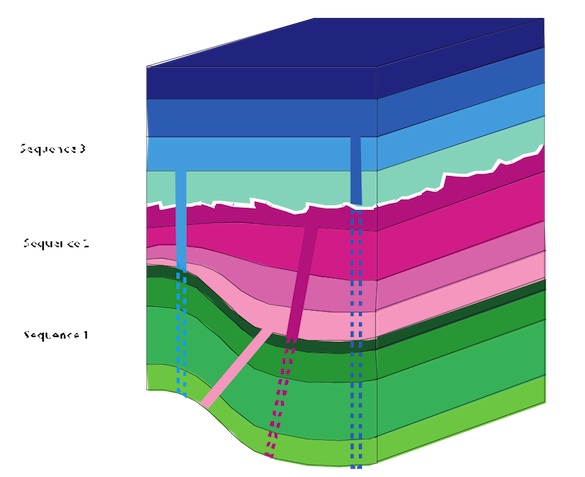
Vatnsdalfjall, in northwest Iceland, exposes the upper ~700 m of crust formed ~7 Ma ago at the extinct Hunafloi-Skagi rift zone. In general, the lava flows dip gently westward toward the abandoned rift axis, but are interrupted by a local area of steeply dipping lava flows known as the Vatnsdalur Structural Basin (VSB). The VSB is composed of three sequences of lava flows emplaced before, during, and after subsidence. Using the geochemistry (XRF, ICP-MS) of samples gathered in the field in 2006 and 2007 and previous data from Ackerly (2004) and McClanahan (2004), we were able to establish a basic eruptive history for the sequences. Major element analysis shows diverse rock types, including basalt, basaltic andesite, dacite, and rhyolite. Sequence 1 shows the greatest diversity and was primarily affected by mineral accumulation, while Sequences 2, 3, and the dikes follow the trend of a shallow level fractional crystallization model based on a modified parent magma from Sequence 1. Trace element ratios suggest the presence of 1 (or 2) parent magmas, although the intermediate to silicic lavas appear to be generated by a separate process. Sequence 1 contains various lava flows, each with a uniform thickness, emplaced on relatively flat terrain. Sequence 2 was emplaced on top of Sequence 1 as subsidence of the basin was occurring, creating lava flows that thicken toward the basin interior. Intermediate to silicic rocks are absent during this interval and dikes cut Sequence 1 to feed lavas in Sequence 2. After a period of erosion, Sequence 3 was erupted above Sequence 2. Dikes that feed Sequence 3 cut through Sequence 2. The development of the VSB may have been associated with a waning period in the magmatic system, where magmas cooled and evolved (following an evolutionary trend controlled by fractional crystallization) and there was little partial melting of the crust (given the lack of intermediate to silicic lavas).

And some key figures:

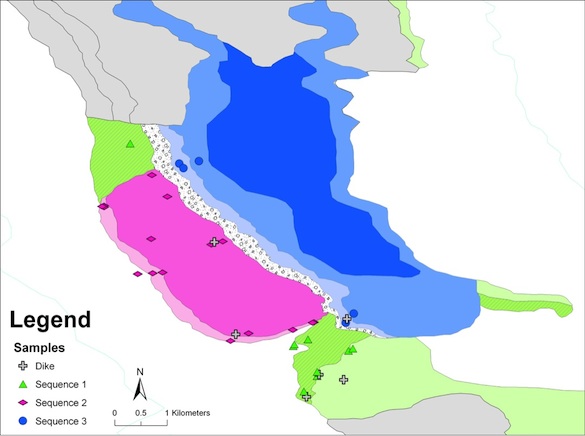
Geologic map that shows the location of our samples on Sequence 1 (green), Sequence 2 (pink), and Sequence 3 (blue).

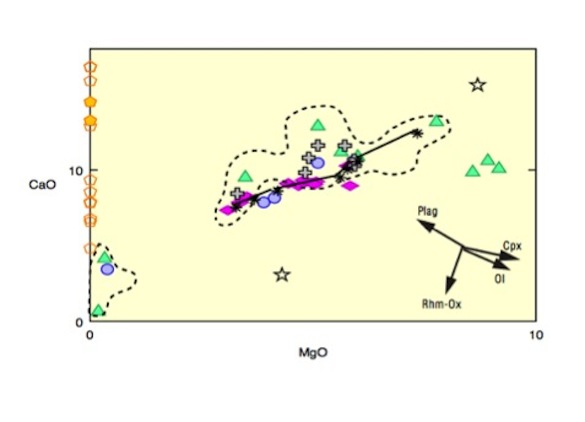
CaO vs. MgO (wt%). Symbols for dikes and Sequences 1, 2, and 3 are as shown on the geologic map. Previous data outlined by the dashed line. Fractional crystallization model shown by the black like. Arrows indicate effects of mineral accumulation. Plagioclase (pentagons) and clinopyroxene (stars) are also shown.

Schematic model (not to scale) for the development of the basin.

I applaud all of the students for their excellent work. They really took ownership of this project and deserve all of the credit. Look for us at GSA in the fall!

Posted in Uncategorized | Tagged , , , , , | 2 Comments

Behind the Scenes at the Smithsonian

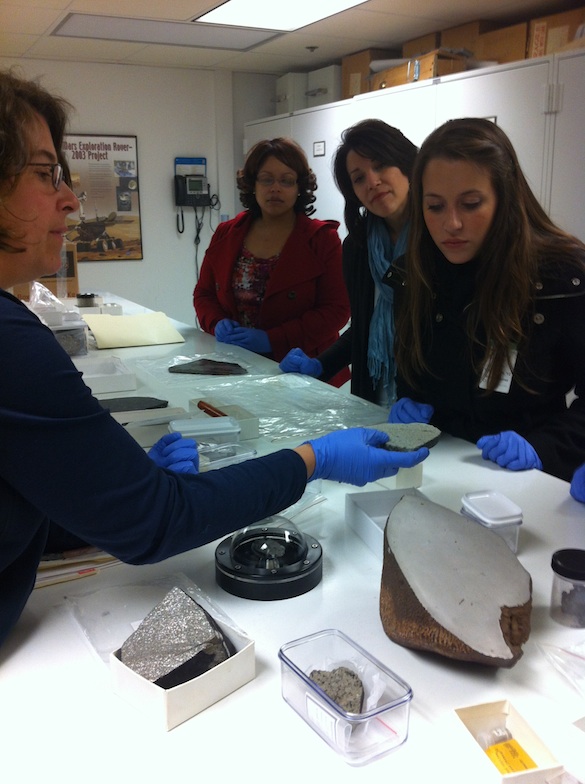
WASHINGTON, D.C. – Guest blogger: Lindsey Bowman (’12). As part of CUR’s Posters on the Hill event, we took a behind-the-scenes tour of the U.S. National Meteorite Collection at the Smithsonian. Our host was Dr. Cari Corrigan.

Dr. Corrigan showed us meteorites from the asteroid belt.

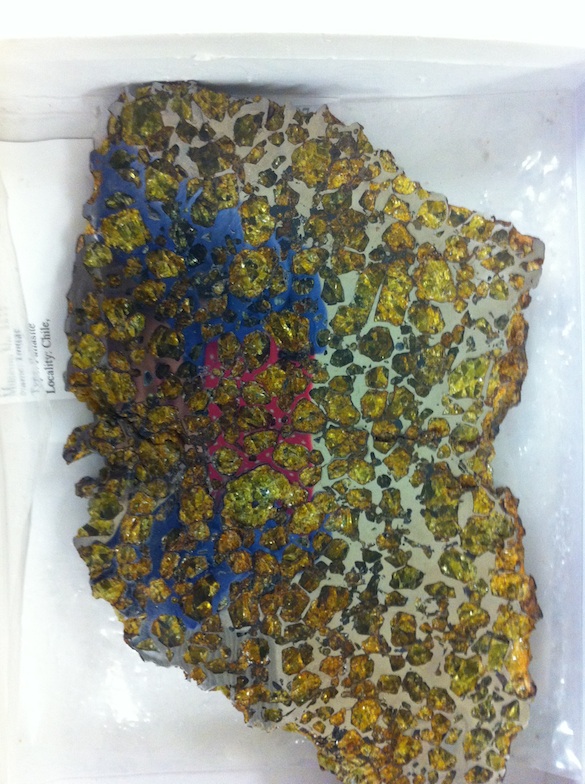
This is an Fe-Ni meteorite. The pink and blue colors are a reflection, but the green areas are olivine crystals.

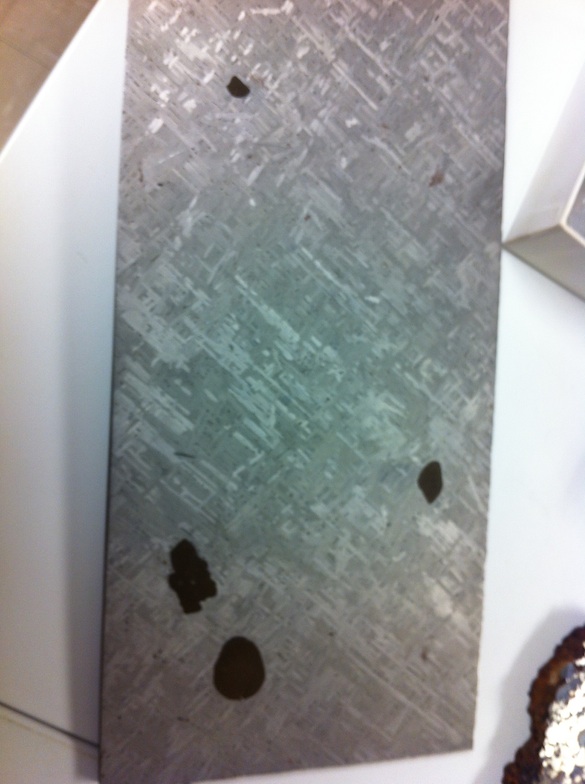
This core of an iron meteorite has been etched with nitric acid to reveal the widmanstatten pattern. The dark spots are iron sulfide inclusions.

This is the famous Allende carbonaceous chondrite.

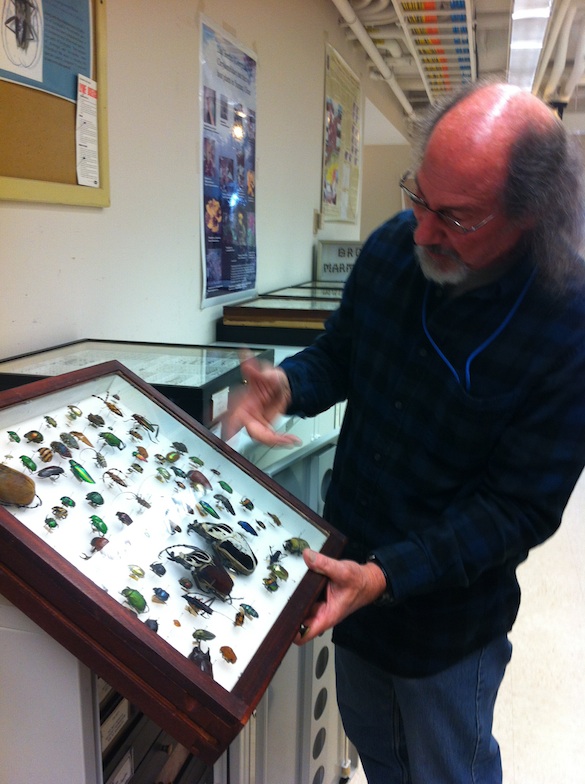
Next, we toured the Entomology Collections with USDA Entomologist Dr. John Brown, whose specialty is Lepidoptera (moths and butterflies).

We started on the 7th floor of the building at a cabinet labeled "Oh My!" where he showed us jaw-dropping, giant, colorful bugs.

Dr. Brown then took us to the "ugly little brown moths" that are the focus of his research. They feed on kiwi and avocado crops.

Finally, Dr. Brown showed us bright blue butterflies. The color of these butterflies won't fade over time because it's a structural optical feature of their wings.

Posted in Uncategorized | Tagged , , , , | 1 Comment

Presentations on Capitol Hill

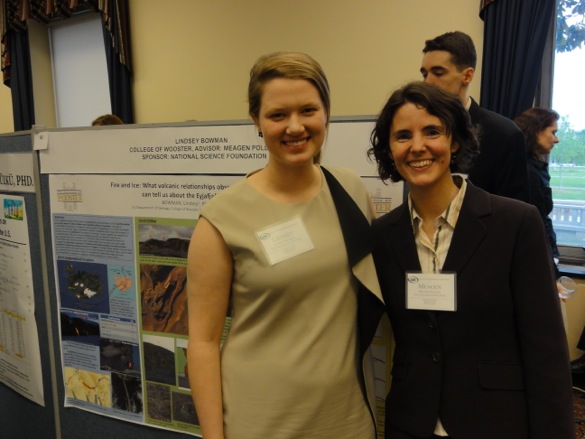
WASHINGTON, D.C. – Students and faculty aren’t the only audiences for Wooster I.S. presentations. This year, two Wooster students were selected (out of 850 applicants) to represent the best in undergraduate research at CUR’s Posters on the Hill event. Congratulations to Lindsey Bowman (’12) and Nikolai Radzinski (’13) on their accomplishment! Be sure to check out the press release to hear about their experiences in their own words.


Lindsey's research took center stage as she was interviewed by the camera crew.


Lindsey presented her I.S. research on subglacial eruptions.


Nikolai, a junior biochemistry major, presented his summer research on measuring motor function loss for brain injury victims.

Posted in Uncategorized | Tagged , , | 2 Comments

A rite of passage: Geology Junior Independent Study presentations

WOOSTER, OHIO–The College of Wooster requires an Independent Study (I.S.) thesis (or performance) from all of its graduates. These are not just extended literature reviews, but unique research projects crafted for and by each of our students. We devote three semesters to the process. Readers of this blog are well acquainted with Senior I.S. work because we highlight each study with multiple entries. The first I.S. semester, which is usually (but not always) taken in the spring of the junior year, gets far less outside attention. This is because most of the work is preparation for the research to come in the following summer and school year. Students and faculty sort out projects for each junior, narrow and focus their objectives, and then do a thorough library study to form hypotheses to test in the field or lab. Occasionally we have specimens to work on as a preview, or have even done some of the fieldwork during Spring Break. No matter what, though, each student eventually presents his or her research ideas to the faculty and fellow classmates. Last week most of our juniors gave their talks and posters. (Two of our juniors are out of sequence; one presented last semester, the other will this summer.)

This presentation is the first of three that these students will give to the department about their projects. It is always the most difficult because the research is just beginning and the students are new to giving talks. By their senior years these same students will feel like veteran speakers and masters of their topics. As juniors, though, the task is daunting. The faculty make the proceedings a little less formal than the senior presentations (note in the photo above Anna Mudd is giving her talk on paleosols from a cart as a podium!), but our juniors are still facing a group of their peers … and scary faculty charged with evaluating their performances. The students came through this year and did very well.

New to the system this year were posters from the Utah group (explained below). Each of these four students still gave an oral presentation, but rather than all repeating the same basic framework information (location, geological setting, etc.), they began their set of talks with these poster discussions. Above we see Kevin Silver starting to explain the Utah integrated projects, with Whitney Sims ready to do her part at the end.

Four students (and Clare Booth Luce award winner Tricia Hall) are going with Dr. Shelley Judge and Dr. Meagen Pollock to the Black Rock Desert in south-central Utah to explore petrological and structural questions:

Will Cary will be looking at the ballistics of volcanic bombs thrown from the eruptions.
Whitney Sims will examine the petrology and geochemistry of particular lava flows.
Kevin Silver is studying xenoliths in these lava flows.
Matt Peppers will be doing a fracture analysis of the Ice Springs lava flow.

Two of our students will be doing Keck Geology Consortium projects this summer:

Anna Mudd is examining paleosols (ancient soils) developed in the northeastern Oregon.
Joe Wilch is assessing metamorphic core complexes in the northern Snake Range of Nevada.

Two students are traveling with Dr. Mark Wilson to the western islands of Estonia:

Richa Ekka will concentrate on petrology and paleoenvironments of Silurian carbonates.
Jonah Novek will study Silurian paleocommunities and recovery faunas.

Two students will be in Glacier Bay, Alaska, with Dr. Greg Wiles:

Jenn Horton and Lauren Vargo will study the reaction of trees (and their rings) to climate change and isostatic rebound.

Finally:

Melissa Torma is studying Jurassic faunas in Israel with Dr. Wilson.
Kit Price will be examining Ordovician sclerobionts in the Cincinnati region, also with Dr. Wilson.

This summer you will see blog posts from all of the above as they start their senior adventures!

Posted in Uncategorized | Tagged , | 2 Comments

Wooster’s Fossil of the Week: A giant oyster (Eocene of Texas)

It’s no ordinary oyster, of course, because it comes from Texas. It certainly is the largest oyster I’ve ever seen. Wooster received it as part of a large donation in 2010. (You can see students studying it in this previous blog entry.)

All we know is that it came from Texas (a notoriously big place) and the Eocene Series. It appears to be the extinct oyster Crassostrea gigantissima (Finch, 1824). Curiously, this is the first fossil species described from the Paleogene of North America (see Howe, 1937). It is worth quoting the entire description:

Fossils. This extensive formation is chiefly composed of a large species of ostrea, which I believe has not yet been described. A specimen of it may be seen in the Philadelphia museum; it is twelve inches long and two and three-quarters wide, and each valve from half to two and a quarter inches thick — Major Ware says they occur larger; on account of their great size I propose to call them Ostrea Gigantissima. The shells appear but slightly changed by their residence in the earth, and are in many parts used for burning into lime. (Finch, 1824, p. 40)

This is what it took to name a new species in 1824! Since then, of course, we have a detailed set of rules for naming animal taxa detailed in the International Code of Zoological Nomenclature. The Lawrence (1991) reference below is an example of what we often have to do in order to bring old names like “Ostrea Gigantissima” up to, well, Code.

The interior of the attaching valve of Crassostrea gigantissima.

The top surface of our giant oyster is riddled with these small holes. They are produced by the boring sponge Entobia, which is the next Fossil of the Week.

References:

Finch, J. 1824. Geological essay on the Tertiary Formations in America. The American Journal of Science and Arts 7: 31-42.

Howe, H.V. 1937. Large oysters from the Gulf Coast Tertiary. Journal of Paleontology 11: 355-366.

Lawrence, D.R. 1991. The neotype of Crassostrea gigantissima (Finch, 1824). Journal of Paleontology 65: 342-343.

Posted in Uncategorized | Tagged , , , | 6 Comments

Now this is field trip weather

WOOSTER, OHIO–It is now difficult to believe that we were measuring stratigraphic sections in a sleety thunderstorm on Saturday. Today the Tuesday lab of my Sedimentology & Stratigraphy course visited a local outcrop of the Logan Formation (Lower Carboniferous) to get more practice with stratigraphic techniques. What an enjoyable afternoon!

Students hard at work on the Logan Formation outcrop in Wooster. I’m hoping there’s no poison ivy in there.

Alex Hiatt and Cam Matesich looking very closely at the sandstone like good sedimentary geologists.

A set of male pine cones that have already distributed their pollen.

Andy Nash found this Eastern American Toad (Bufo americanus americanus) and our amphibian expert Ned Weakland captured it. Ned’s advisor Rick Lehtinen picked up a similar toad last semester on a short geology field trip. It made us feel all the more that we were in Spring at last.

Posted in Uncategorized | Tagged , , , | Leave a comment

Wooster’s Fossil of the Week: the classic bioclaustration (Upper Ordovician of Ohio)

We’re looking at two fossils above. One is the bryozoan Peronopora, the major skeletal structure. The second is the odd series of scalloped holes in its surface. These are a trace fossil called Catellocaula vallata Palmer and Wilson 1988. They at first appear to be borings cut into the bryozoan colony. Instead they are holes formed by the intergrowth of a soft-bodied parasite with the living bryozoan colony. This type of trace fossil is called a bioclaustration. We gave it the Latin name for “little chain of walled pits”.

My good friend Tim Palmer and I found this specimen and many others in 1987 as we explored the Upper Ordovician Kope Formation in the Cincinnati region. We were collecting bioeroded substrates like hardgrounds and shells, and these features were clearly different from the usual borings. They do not actually cut the bryozoan skeleton, for one thing. For another it is apparent that the bryozoan growth was deflected around whatever sat in those spaces. Tim and I called this kind of interaction “bioclaustration”, meaning “biologically walled -up”.
Catellocaula vallata on the Upper Ordovician bryozoan Amplexopora. Note that the scalloped holes have more lobes than those seen in the lead image. This may mean it was a different species of infesting soft-bodied organism.

The infesting parasite on the bryozoan colony was itself colonial, consisting of small clusters connected by extended stolons. The bryozoan grew around the parasite, roofing over the stolons and making walls on the margins of the clusters. We think the parasite was a soft-bodied ascidian tunicate like the modern Botryllus. If true, it is the earliest fossil tunicate known.

This closer view of C. vallata shows the scalloped margins of the pits and the horizontal connections between them.

Another specimen of C. vallata. This view shows the flat floors of the bioclaustration features.

Acetate peels cut longitudinally through the bryozoan and bioclaustrations. On the left you can see that the bryozoan zooecia (long tubes) were deflected sideways as they grew. On the right is a tunnel connecting two pits, with bryozoan zooids forming the roof. (From Palmer and Wilson, 1988.)

References:

Bromley, R.G., Beuck, L. and Taddei Ruggiero, E. 2008. Endolithic sponge versus terebratulid brachiopod, Pleistocene, Italy: accidental symbiosis, bioclaustration and deformity. Current Developments in Bioerosion, Erlangen Earth Conference Series, 2008, III, 361-368.

Palmer, T.J. and Wilson, M.A. 1988. Parasitism of Ordovician bryozoans and the origin of pseudoborings. Palaeontology 31: 939-949.

Tapanila, L. 2006. Macroborings and bioclaustrations in a Late Devonian reef above the Alamo Impact Breccia, Nevada, USA. Ichnos 13: 129-134.

Taylor, P.D. and Voigt, E. 2006. Symbiont bioclaustrations in Cretaceous cyclostome bryozoans. Courier Forschungsinstitut Senckenberg 257: 131-136.

Posted in Uncategorized | Tagged , , , , | 5 Comments

A very damp field trip

FAIRBORN, OHIO–I actually used to brag about the great weather on my class field trips. The hubris! Today Shelley Judge and I took our combined Sedimentology & Stratigraphy and Structural Geology classes to Oakes Park Quarry near Dayton for a field trip. (Location = N39.81401°, W083.98374°.) We planned to describe and measure the exposure there of the Brassfield Formation, and then assess the joint fabric and the direction of glacial grooves on its top surface. I took three students there last week to test the concept. Since this is the last weekend of the semester, there was no do-over, so we went rain or shine.

It was 38°F and breezy when we arrived. That’s when I took my first and last picture, shown above. (It is of Tricia Hall and Scott Kugel in the middle of their stratigraphic task.) The rain came slowly at first. Not too bad. Then we heard the thunder and were quickly overwhelmed by a serious downpour. Near-freezing temperatures and a thunderstorm? That’s spring in Ohio. I haven’t been so cold and wet since I was in this place. This is why I very much prefer my field areas to be very warm and very dry.

The students were great sports, though, and we collected just enough data so that we could retreat to the bus with some geological honor intact.

The summer can’t come fast enough back here for the Wooster geologists!

Posted in Uncategorized | Tagged , , | 1 Comment

Wooster Geologists at the 2012 Senior Research Symposium

WOOSTER, OHIO–Six Wooster geology seniors presented their research to the campus and public this morning in Kauke Hall on the College of Wooster campus. They were among the first posters in the annual Senior Research Symposium in which Independent Study projects are highlighted and celebrated. They did very well — their geology faculty advisors are proud indeed. Here they are with their presentations:

Sarah Appleton ’12: Dating of the Mid-Holocene History and Glacial Stratigraphy of the Wachusett Inlet, Glacier Bay National Park and Preserve, Southeast Alaska. (Links to Sarah’s work on the Wooster Geologist’s blog.)

Lindsey Bowman ’12: Geochemical and Field Relationships of Pillow and Dike Units in a Subglacial Pillow Unit, Undirhlíðar Quarry, Southwest Iceland. (Links to Lindsey’s work on the Wooster Geologists blog.)

Andrew Collins ’12: A Comparison and Analog-Based Analysis of Sinuous Channels on Rift Aprons of Ascraeus Mons and Pavonis Mons Volcanoes, Mars. (Links to Andrew’s work on the Wooster Geologists blog.)

Nick Fedorchuk ’12: Stratigraphy and Paleoecology of the Wenlock/Ludlow Boundary on Saaremaa Island, Estonia. (Links to Nick’s work on the Wooster Geologists blog.)

Rachel Matt ’12: Paleoecology of the Hilliste Formation (Lower Silurian, Llandovery, Rhuddanian) on Hiiumaa Island, Estonia: An Example of a Shallow Marine Recovery Fauna. (Links to Rachel’s work on the Wooster Geologists blog.)

Katharine Schleich ’12: A Geochemical and Petrographic Analysis of the Hrafnfjordur Central Volcano, Westfjords, Iceland. (Links to Katharine’s work on the Wooster Geologist blog.)

Well done, Wooster Geologists!


Posted in Uncategorized | Tagged , | Leave a comment