


An important study was just published in Science Magazine by Dr. Nicolás Young (Lamont-Doherty Earth Observatory; Wooster Geology class of 2005). We knew this paper was coming as Dr. Young was our most recent Osgood speaker and during his visit he presented some of these results.
Conventional wisdom has always been that the last Ice Age was over, and that ongoing anthropogenic warming would delay indefinitely the inception of the next Ice Age. Young et al., show that the end of the Ice Age was instead over about 3.6 ka and that the world was in the midst of the next Ice Age for about 2000 years until very recently about 1960 CE. The evidence is a clever and careful study of trimlines, cosmogenic isotope dating, and vegetation and radiocarbon studies at the margin of the remanent of the Laurentide Icesheet (LIS) – the Barnes Icecap. The Barnes Icecap is an amazing place.
This paper changes quite a bit about the framework of the recent Ice Age and underscores the idea that we have ended an ongoing Ice Age. We could argue over whether this is a paradigm shift – it clearly is on some level. These inferences about the past could not have been done without the remarkable and clever use of multiple dating techniques that can resolve these changes. An excellent commentary in Science on this paper can be found here and an interview press release from Lamont here.
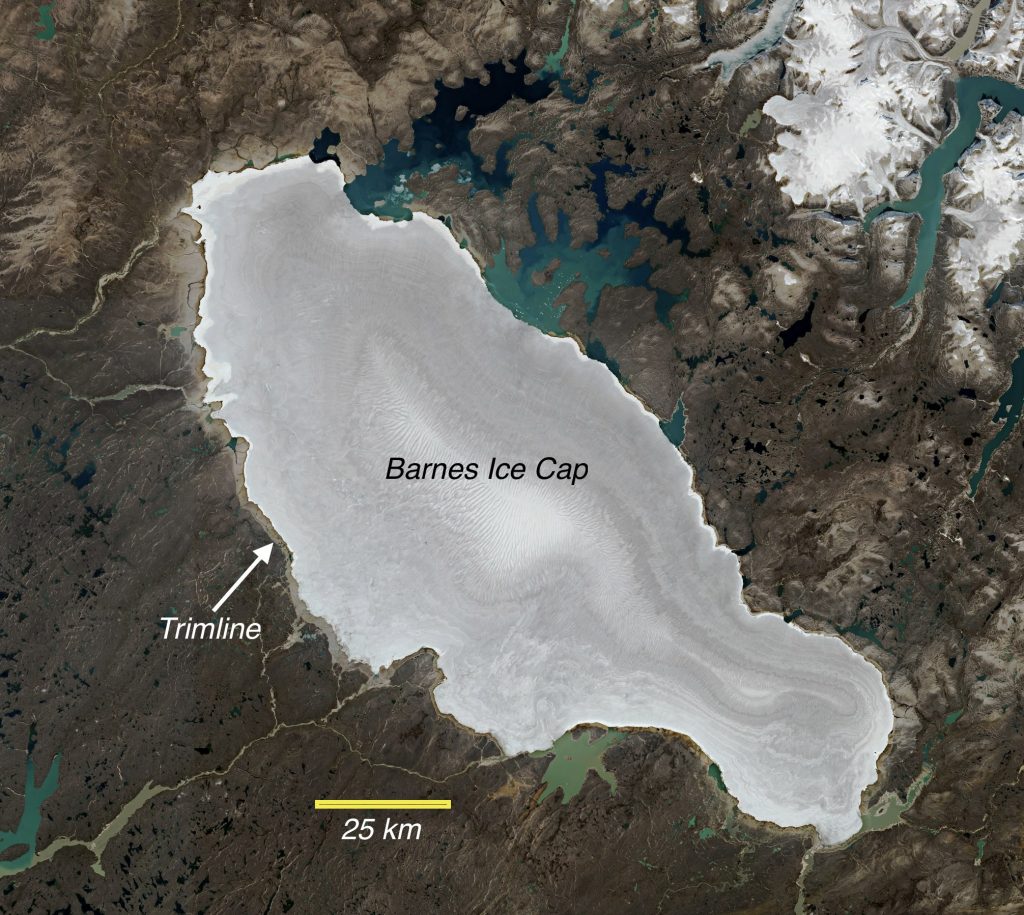
The Barnes Ice Cap and its recent trimline. Image from GoogleEarth. The figure below is from the Young et al. (2026) article showing the location of the Barnes Ice Cap and a portion of the geochronological dataset.

Reference:
Young, Nicolás E. et al. Late Holocene reexpansion of the Laurentide Ice Sheet. Science 394,455-459(2026).DOI:10.1126/science.aed3379.