


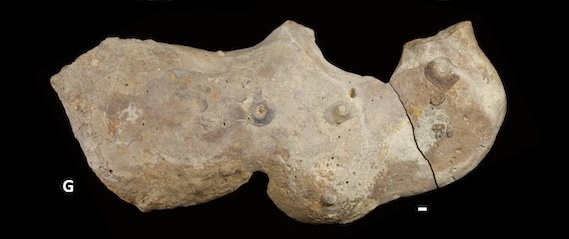
 In the spring of 1988, Wooster geology student Carolyn Reierson turned in her Independent Study thesis, defended it in an oral examination by the faculty, and then graduated. She had no idea that her IS work would be part of a published paper 38 years later! Carolyn, now Carolyn Princic, is an author on a new paper in the society journal Sessile Organisms (Buttler et al., 2026). It is another demonstration that good data retains its worth over time.
This scientific story began in 1984 when my wife Gloria and I were exploring fossiliferous outcrops in southern Ohio and northern Kentucky. We were looking for outcrops I could use for paleontology course field trips. At the end of a long day we made one last stop at a muddy roadcut near where the tiny Gunpowder Creek met the Ohio River. We stepped out of the care and at our feet was the elongated cobble seen in the photo above (scale bar = 5 mm). This cobble was encrusted with delightful fossils, including bryozoans, crinoids, and wormtubes. There were also borings of various types. There on this one rock was a community of ancient organisms still in their original places. (For a more detailed look at this cobble, see this blog post.) Glancing up the slope we saw there were hundreds of such encrusted and bored cobbles. I described and interpreted these fossils in one of my first papers (Wilson, 1985).
These Ordovician cobbles and that 1985 paper changed the direction of my research. I very much enjoyed working with encrusting and boring fossils on hard substrates (sclerobionts). Because of these interests I met my now great friends and epic colleagues Paul Taylor (Natural History Museum, London) and Tim Palmer (Aberystwyth University) on my 1985 research leave in the United Kingdom. In 1987, Tim visited the USA and showed me a layer of encrusted and bored cobbles in Newport, Kentucky, stratigraphically equivalent to the Gunpowder Creek cobbles I described two years before. That year Carolyn Reierson worked on the two cobble sets for her successful Independent Study project.
In 2025, two other fine British colleagues, Caroline Buttler and Lucy McCobb, and I decided to resurrect the Ordovician cobble project. Much had changed in the past four decades with the taxonomy of the sclerobionts and paleoecological concepts. We found that the data in Carolyn’s geology IS was still valid and meaningful, so we included her as an author. I personally found this all very satisfying because we could tie the most important paper of my early career to one of my last projects now completed two years after my retirement from The College of Wooster. Thank you to all my colleagues, especially Caroline Buttler who led our research team.
Our new paper is open access. The abstract and some images are reproduced below.
Abstract: Cobbles, eroded from a single bed of the Kope Formation (Pioneer Valley Submember, Southgate Member), Katian Stage of the Upper Ordovician in Newport, Kentucky, USA, show encrustation by a large range of sclerobionts including bryozoans, crinoids, Sphenothallus, Chaunograptus and Cornulites, as well as Trypanites and Petroxestes borings. They occur in the same hiatus horizon as previously described Gunpowder Creek cobbles, also from the Kope Formation of Kentucky, but are not as densely encrusted or bored. The Gunpowder Creek cobbles are exposed approximately 32 km southwest of the Newport cobble site. The Newport cobbles were formed first as concretions developed in soft sediment within Thalassinoides burrows that were sometimes penetrated by Planolites and Chondrites tunnels. They were cemented in the subsurface and then eroded out of the sediment during an episode of high energy, likely a storm. On the sea floor, the exposed cobbles were then bored and encrusted by sclerobionts. Later high energy events abraded the encrusting organisms and small shelly fossils were deposited in borings and exhumed Planolites burrows. The cobbles were then buried in fine sediment and later eroded out of bedrock exposures. The two cobble collections represent a depth and depositional energy gradient along a hiatus surface, with the Gunpowder Creek cobbles occurring in shallower waters just above the normal storm wave base and the Newport cobbles in deeper waters just below the normal storm wave base. The Gunpowder Creek cobbles are more densely encrusted and bored by sclerobionts than the Newport cobbles. The bryozoan faunas are similar in composition on both cobble sets, but thick encrusting trepostomes are more common on the shallower Gunpowder Creek cobbles and thin encrusting ceramoporids dominate the deeper Newport cobbles. On both sets of cobbles, the sclerobiont succession is roughly from bivalve and worm borings, crinoids and runner-type encrusting cyclostome bryozoans to sheet-like, massive and ramose palaeostomate bryozoans.
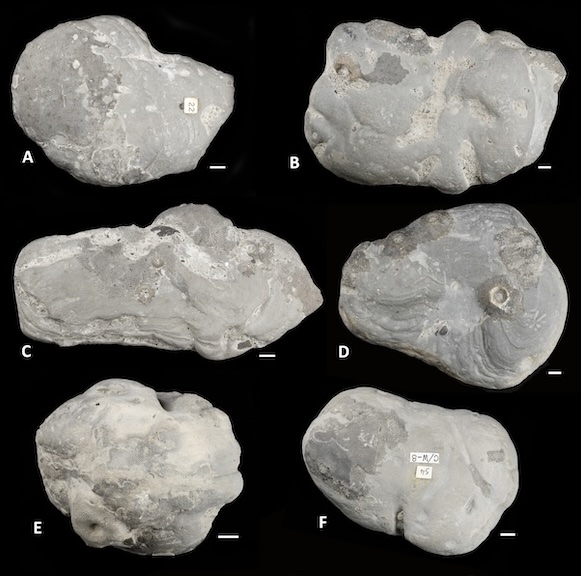 From Figure 1 of Buttler et al. (2026): A–F representative samples of cobbles from the Kope Formation, Katian Stage, Upper Ordovician, Newport, Kentucky, USA. Scale bars: 5 mm.
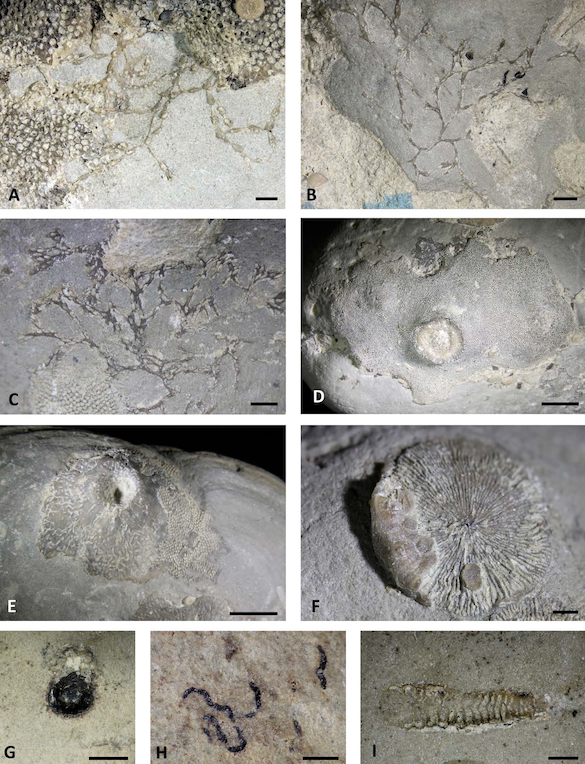 From Figure 3 of Buttler et al. (2026): Sclerobionts encrusting cobbles. A. Bryozoans, Corynotrypa delicatula, NMW 2025.3G.10 and encrusting palaeostomate; B. Bryozoan Corynotrypa inflata, NMW 2025.3G.2; C. Bryozoan Cuffeyella arachnoidea, NMW 2025.3G.11; D. Erect branch of encrusting trepostome, NMW 2025.3G.12; E. Anomalocrinus holdfast encrusted by palaeostomate bryozoan, NMW 2025.3G.4; F. Cincinnaticrinus, NMW 2025.3G.13; G. Sphenothallus, NMW 2025.3G.5; H. Chaunograptus, NMW 2025.3G.11; I. Cornulites, NMW 2025.3G.14. Scale bars: A–C, F–G = 1 mm; D, E = 5 mm.
References:
Buttler, C.J., Wilson, M.A., McCobb, L.M.E. and Princic, C.R. 2026. Ecological dynamics of a bryozoan-dominated sclerobiont fauna on hiatus cobbles from the Upper Ordovician (Katian) of northern Kentucky, USA. Sessile Organisms 43, Special Issue: sp27-sp35. (pdf).
Reierson, C. 1988. Diagenetic origin, depositional environmental and stratigraphy of encrusted limestone cobbles in the Cincinnatian series (Upper Ordovician), northern Kentucky. Independent Study thesis, The College of Wooster.
Wilson, M.A. 1985. Disturbance and ecologic succession in an Upper Ordovician cobble-dwelling hardground fauna. Science 228: 575-577. 43. (pdf)
