


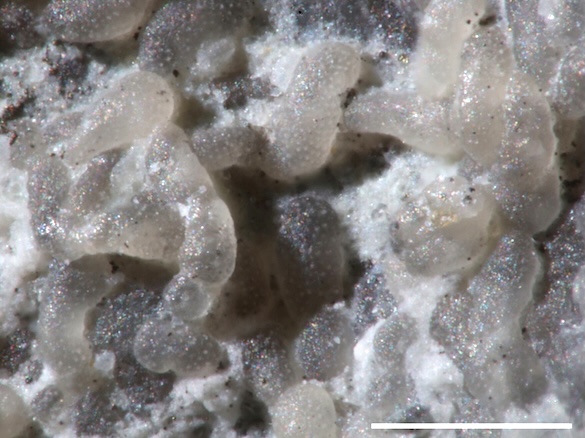
It was again my privilege to join my Estonian colleagues on a paper (published today in Palaeoworld) describing sclerobionts (hard-substrate dwelling organisms) from the Lower Paleozoic. This time we record the earliest species of the problematic genus Allonema, finding them in the Upper Ordovician, a range extension downward from the Lower Silurian. Of particular interest is the observation that these two species passed through the end-Ordovician mass extinction, appearing as common encrusters in the Lower Silurian. This survival is no mean feat considering this extinction eliminated up to 70% of marine species (Zhang et al., 2025). The image above is one of the species, Allonema moniliforme (Whiteaves, 1891), from the lower Katian of northern Estonia (GIT 770-1-6), Figure 8A of the paper. The scale bar is 0.5 mm. (These are very small!)
Abstract.–Two species of the encrusting calcitic sclerobiont Allonema have been identified for the first time in the Ordovician. Allonema moniliforme and A. botellus were originally known only from the Silurian but are here recorded from the Katian (Upper Ordovician) of Estonia. A. moniliforme reappears in the Rhuddanian–Aeronian of Estonia, and A. botellus emerges again in the Sheinwoodian of Gotland. Both species are unknown in the Hirnantian (latest Ordovician), and both survived the end-Ordovician extinction. Both species lived in similar, calm, muddy environments during their Ordovician and Silurian appearances. During the Silurian, Allonema was a much more common and widespread encruster than in the Ordovician, occurring on a broad range of biogenic hard substrates. This difference may reflect ecological and evolutionary shifts following the Late Ordovician mass extinction, which reorganized marine ecosystems and opened new niches. A. botellus maintained a stable morphology across the Ordovician–Silurian boundary, A. moniliforme underwent a narrowing of its morphological variability, possibly reflecting evolutionary canalization or shifts in ecological pressures over time.
Note that we do not explain exactly what Allonema was. It is a beautiful little series of connected calcitic chambers with numerous pores. They are always found encrusting hard substrates, usually shells. Paul Taylor and I (Wilson and Taylor, 2014) referred to them as “pseudobryozoans” because they were commonly confused with real bryozoans. We’re sure they were not foraminiferans, either. They for now are classified as incertae sedis (meaning “uncertain placement”).
This gives me an excuse to include one of Paul Taylor’s wonderful scanning electron microscope images below.
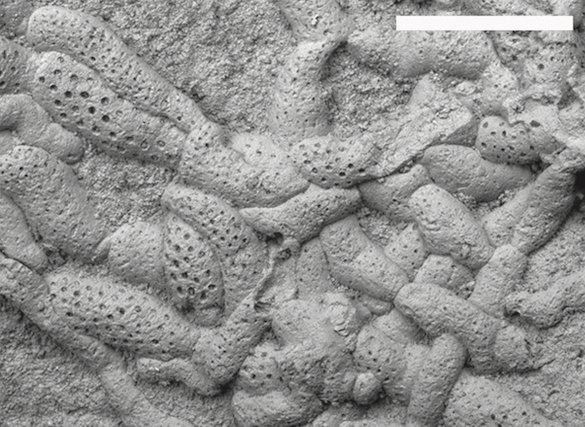 Allonema from the Silurian of Gotland, Sweden. From Figure 1D of Wilson and Taylor (2014); Scale bar is 500 µm.
A fun mystery, Allonema is, and now we know just a bit more about it.
References:
Vinn, O., Wilson, M.A., Toom, U., Tinn, O. and Lang, L., 2026. Two species of Allonema: Problematic sclerobionts that survived the end-Ordovician extinction in Baltica. Palaeoworld, p.201104.
Wilson, M.A. and Taylor, P.D., 2014. The morphology and affinities of Allonema and Ascodictyon, two abundant Palaeozoic encrusters commonly misattributed to the ctenostome bryozoans. Studi Trentini di Scienze Naturali, 94, p. 259-266.
Zhang, Z., Yang, C., Sahy, D., Zhan, R.B., Wu, R.C., Li, Y., Deng, Y., Huang, B., Condon, D.J., Rong, J. and Li, X.H., 2025. Tempo of the Late Ordovician mass extinction controlled by the rate of climate change. Science Advances, 11(22), p.eadv6788.
