


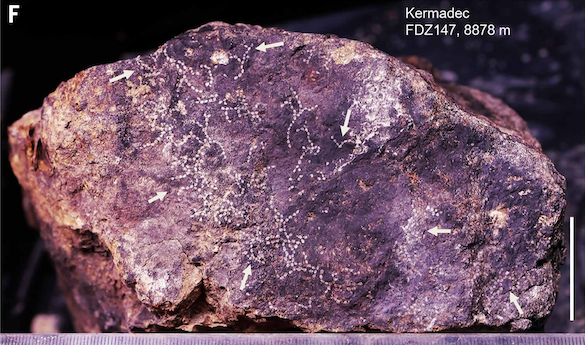
 Earlier this month a remarkable paper appeared in the journal Science entitled: “Protist-dominated hard substrate faunas thrive at the deepest ocean depths”. If you know any of my scientific enthusiasms, you know I very much love hard substrate faunas through space and time. The article by Song et al. (2026) describes a community of organisms found by the submersible Fendouzhe at extreme hadal depths (9,000 to 10,898 meters) in the Kermadec and Mariana trenches. Among the 32 species is a little soft-bodied bryozoan given the name Pierrella fendouzhei. Again, among my scientific passions is the study of bryozoans. This particular species now has the depth record for the Phylum Bryozoa: 9981 meters, about 6.2 miles down. For context, the wreck of the Titanic is 3800 meters deep, so Pierrella fendouzhei is living on rocky surfaces up to 2.5 times deeper than the legendary ship. The top image is from Figure 1F of Song et al. (2026). It shows Pierrella fendouzhei as series of connected white ovals. The scale bar is 3 cm.
 Now the Wooster connection. The genus Pierrella was first described and named by me and Paul Taylor in 2012 for a group of delicate fossils inside ammonite conchs collected from the Upper Cretaceous (Campanian-Maastrichtian) of the Pierre Shale in South Dakota and Wyoming (Wilson and Taylor, 2012; see figure above; scale bars are 10 and 5 mm respectively). The fossils show a spindly series of connected tear-drop shapes that were entombed by exquisite mineralization. The original bryozoans were entirely soft-bodied, so this is a rare form of preservation. We collected these fossils on an Independent Study field trip in 2008 with Wooster student John Sime.
 So the first described Pierrella bryozoan was a 70-million-year-old fossil from the Cretaceous Western Interior Seaway of North America. It probably lived in these shell interiors at the muddy bottom of these roughly 700 meters down. Above is an image of an ammonite internal mold with chains of Pierrella zooids.
 In 2018, a Russian-led scientific team collected metalliferous seafloor nodules in the Clarion-Clipperton Fracture Zone of the eastern Pacific at roughly 5000 meter depths (Grischenko et al., 2018). Astonishingly, they found living examples of our bryozoan Pierrella. This genus now had an unusual two-point distribution: a Cretaceous inland seaway and a modern deep-sea rocky substrate, with nothing in between. It is (for a bryozoologist) like finding a living Tyrannosaurus rex with no fossils between them! Above images are from figure 2 of the later analytical paper by Schwaha et al. (2021): (b) colonies attached to the surface of an arenaceous foraminiferan, showing dispersed zooids and thin proximal cystid appendage; (c) a single zooid; (d) the apertural folds — our Pierrella pleated collar! (Abbreviations: ap – aperture, pca/cd – proximal cystid appendage/cd, z – zooid.)
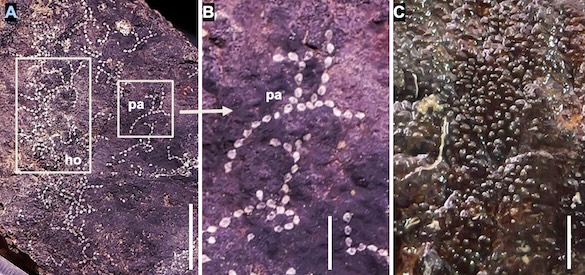
Then came this month’s Song et al. (2026) paper described above, which nearly doubled the depth record of Pierrella to 9981 meters. These authors also used Pierrella as the type genus of a new bryozoan family (Pierrellidae), and they commented on its archaic nature having implications for the evolution of ctenostome bryozoans, a topic also explored by Schwaha et al. (2021). The above images are from Song et al. (2026, fig. S10).
So what explains this extraordinary hiatus between the Cretaceous Pierrella and its living relatives? It is no doubt attributable to the small soft-bodied composition of Pierrella, along with cryptic habitats. The Cretaceous specimens were only found because of rapid fine-grained mineralization that enveloped their colonies shorty after burial. (And that some paleontologists were looking for cryptic fossils inside shells.) Ordinarily Pierrella had little chance of making it into the fossil record. Even the living Pierrella is difficult to see. Song et al. (2026) write that it “was almost invisible and easily overlooked, owing to its transparency and the rough black ferromanganese layers on the rock surfaces that it encrusts”. This is yet another example of how much the fossil record is controlled by the vagaries of preservation.
References:
Grischenko, A.V., Gordon, D.P., and Melnik, V.P. 2018. Bryozoa (Cyclostomata and Ctenostomata) from polymetallic nodules in the Russian exploration area, Clarion-Clipperton Fracture Zone, eastern Pacific Ocean-taxon novelty and implications of mining. Zootaxa, 4484(1), 1-91.
Schwaha, T., Grischenko, A.V., and Melnik, V.P. 2021. Morphology of ctenostome bryozoans: 4. Pierrella plicata. Journal of Morphology. doi: 10.1002/jmor.21344
Song, X., Gooday, A.J., Gordon, D.P., Leduc, D., Sun, Y., Wang, Z., He, Q., Gao, Z., Ruthensteiner, B., Waeschenbach, A. and Schwaha, T. 2026. Protist-dominated hard substrate faunas thrive at the deepest ocean depths. Science, 392(6799), p. 749-754.
Wilson, M.A. and Taylor, P.D. 2012. Palaeoecology, preservation and taxonomy of encrusting ctenostome bryozoans inhabiting ammonite body chambers in the Late Cretaceous Pierre Shale of Wyoming and South Dakota, USA. In: Ernst, A., Schäfer, P. and Scholz, J. (eds.) Bryozoan Studies 2010; Lecture Notes in Earth Sciences 143: 399-412.
