A Tunnel to a Frozen Past

SYAS RIVER, LENINGRAD REGION, RUSSIA–“Do you have a light? We are going into caves tomorrow.” I must admit to a bit of trepidation, hearing that question. I indeed have a small flashlight, but not one I’d like to have with me in a cave. Turns out the caves today were actually abandoned mine tunnels in a Cambrian quartzose sandstone on the right bank of the Sass River (N60.05429°, E32.59517°). The mines were designed to extract the quartz sand to make glass — some kind of Stalinist enterprise in the 1930s to turn the local peasants into proletarians. These mines were abandoned once the Germans invaded in 1941.

Yes, I followed. Nuts, but worth it.

Yes, I followed. Nuts, but worth it.

“We will have to crawl a bit.” As you can see from the photograph of the tunnel entrance, “crawling” is not quite the term. “Squirming on your belly” would be closer. I didn’t want to play the soft American, so I just made sure someone was behind me and in front of me, and in I went. The squirming through the mud with my back scrapping against the ceiling seemed interminable, especially since I couldn’t hold the light and pull myself through at the same time. This had better be a good blog entry in the end, I thought. The substrate dropped below me and I slid down into a comfortable cavity (relatively speaking) about five feet high and lit fleetingly by the flashlights of the others ahead. I hunched over and crab-walked to the source of the lights, finally emerging in a mine tunnel fortunately higher than my head. Half success! (Full success is getting out, of course.)
tunnel060609
Now it is more interesting than terrifying. The mine cuts horizontally along bedding, so you can follow a single unit of rock throughout the tunnels, watching it change character with distance. The main rock is very white, relatively soft, and marked by the pickaxes of the miners. At about eye-level are darker beds with contortions which contrast dramatically with the flat-bedded sandstone below. Cracks descend down into the sandstone and are filled with iron pisolites (spherical structures made of hematite and from bb- to marble-size). In places the darker beds drop downward into complex breccias (conglomerates in which the clasts are very angular).

Cryokarst features in the abandoned mine tunnels.

Cryokarst features in the abandoned mine tunnels.

The interpretation of these rocks by Andrey Dronov is that they represent a Cambrian permafrost buried by Ordovician sediments. The reason the Ordovician clays, pisolites and siliciclastic sediments are contorted is that they had collapsed to varying degrees as the ice below them was melted after burial. We are looking, then, at a wonderful example of “cryokarst”, or the deformation of sediments associated with ice formation and melting. I had known of only such features in theory, never in practice. It is even more remarkable that these structures are almost half a billion years old. Well worth a bit of slithering through dark Russian mud!
Posted in Uncategorized | Tagged , , , | 1 Comment

First Find

NEAR KHAMONTOVO, LENINGRAD REGION, RUSSIA–When you’re a paleontologist in the field with other geologists for the first time, you need to prove your general scientific worth by either saying witty things or finding an excellent specimen right away. I went for the latter and picked up on our first outcrop the rhombiferans you see below. I’m golden now, at least for a few days.

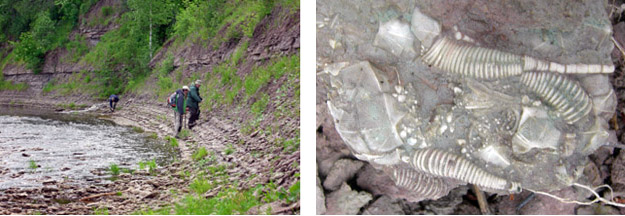
Ordovician outcrop near the field house, and the beautiful eocrinoids found there.

Ordovician outcrop near the field house, and the beautiful rhombiferans (probably Glyptocystites) found there.

Rhombiferans are Early Paleozoic echinoderms which resemble crinoids and blastoids but have few brachioles (extensions around the mouth to filter food from the water). I’ve only previously seen random plates and holdfasts, so I was plenty surprised by these beauties. I donated them graciously, of course, to the echinoderm expert. This is not hard to do since Russian law does not allow foreigners to take fossils out of the country.

Posted in Uncategorized | Tagged , , | 1 Comment

A Geological Field House

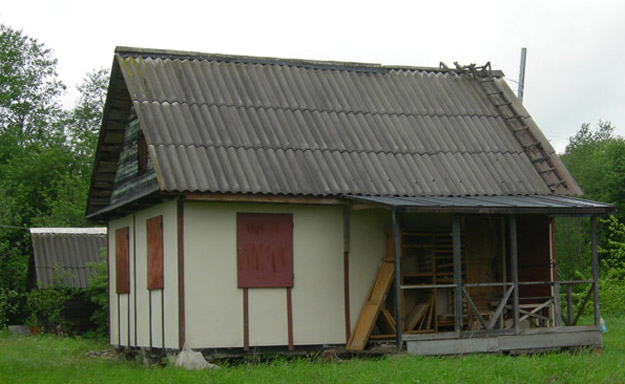
NEAR KHAMONTOVO, LENINGRAD REGION, RUSSIA–It is not your typical Russian dacha, this field house.  It was purchased partially-finished by Andrey because it is ideally located (N60.01114°, E32.56416°) very near important Paleozoic outcrops.  The setting is beautiful — on the top of a steep bank overlooking the Lynna River as it meets the larger Syas River.

Our field house on the first day of our work.

Our field house on the first day of our work.

There is no running water, but there is electricity (most of the time).  Heat was originally supplied by a large wood-burning stove, but alas (!) someone broke in and stole it before we arrived.  It is a very cold place right now, so I wear my down jacket all the time, even to bed.  The outhouse is … well … as basic as it can get in the hole-in-the-floor Russian fashion.  Our water comes either directly from the river or from a nearby well.  “Completely pure and safe to drink”, I’m told.  I’ve seen the outhouse, though, and I’m imagining a few hundred others like it upstream.

Nevertheless, this is an excellent base for just what we want to do.  One of the prime outcrops is just a few meters away from the front door, and the others we need on this expedition are mostly within 10 kilometers.  I can rough it here for two weeks, especially since there isn’t a mirror in the house.  Another benefit is that I’m a guest of the Russian Academy of Sciences — the lodging, food and transport here doesn’t cost a kopeck.

We are joined in this house and in the field by another member of the Russian Academy of Sciences, Nikolai Kuznetsov, and two geologist-technicians, Andrei Schatsilov and Sergei Orlov.  They are interested in tectonic and paleogeographic issues with the Lower Paleozoic of this area.

Posted in Uncategorized | Tagged | Leave a comment

Sleeper Train West

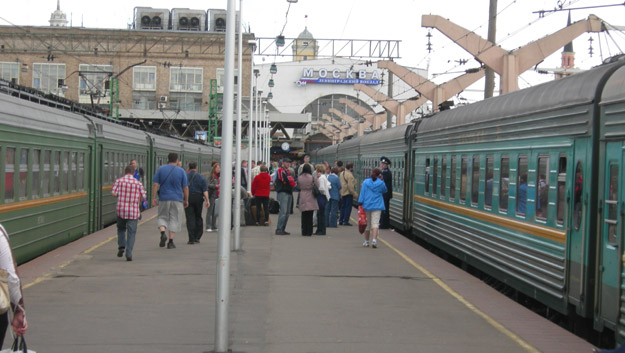
Andrey and I boarded a west-bound train in Moscow at 6:25 in the evening. It is a nine-hour ride to Volkhov, so the cars are equipped as sleepers. This meant that we shared an open compartment with two other people, and then at some point of mutual agreement we made our beds by placing sheets on thin mattresses and spreading them out on the seating benches and the two suspended bunks above. Andrey and I had upper bunks, which meant we climbed high and slid ourselves into narrow alcoves about two feet wide and something considerably less than 6’3″ long. My sock-clad feet hung out over the aisle, unfortunately, to be frequently bumped with a whispered “izveeneetyeh” (excuse me). Since our stop was at 3:15 a.m., I didn’t sleep well because I was worried they wouldn’t wake us.

Train loading at Moscow Station.

Train loading at Moscow Station.

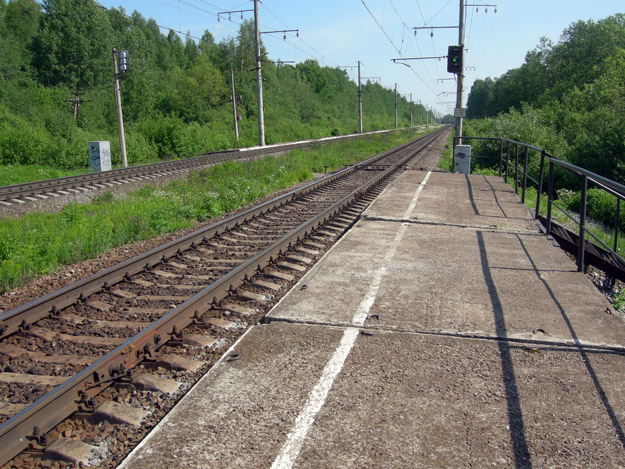
The uniformed car attendants did wake us in time to fumble on our shoes and gather our luggage as the train slowed. I lugged that 57-pound suitcase of equipment down the dark aisle, doing a set of my own izveeneetyehs. We were dropped off on a railroad siding opposite the station, so all the passengers as a matter of course climbed down onto the tracks, crossing them in the dusky lighting of one of the famous “white nights”. We waited in the station another six hours for a local train to take us fifteen minutes to the field house, which is fortunately only 200 meters from the tracks. The temperature was 40° F with a light rain — not nearly as warm as I expected!

Train stop near the field house, Leningrad Region.

Train stop near the field house, Leningrad Region.

Posted in Uncategorized | Tagged | Leave a comment

Touring Moscow

MOSCOW, RUSSIA–As I write this entry and the following few, I’m deep in the Russian woods in a small “field house” with no internet connections.  I will post this entry and the others when I get the chance and back-date them so they show the day they were written, not posted.

This is a brief cultural note before the field accounts to come.  Andrey and Veronica Dronov picked me up from my hotel and gave me a wonderful tour of the primary Moscow sites.  We started with the Kremlin walls and then walked around Red Square.  Stalin and Lenin appeared to be posing for photos, so I checked their last resting places and confirmed that they are indeed still dead.
combinedredsquare060409

Afterwards we had a minibus tour of the city, another walk through parks, and then a Tajik dinner (lamb kebabs for me).  My first impression is how very deep the history of this city is, from buildings erected by Ivan the Terrible through the drama of “Soviet times” to today’s attempts to soften Moscow’s public image with massive reconstruction of churches and other pre-revolutionary buildings.  This is also a city which is not easy for visitors to negotiate on their own.  I admire my daughter Amy even more for spending her junior year here.

Posted in Uncategorized | Tagged | Leave a comment

The Miracle of Wireless

Somehow I stumbled upon a wireless connection in my Moscow hotel room this morning. I shall post quickly before it vanishes. It disappears now and then, but I’ve thus far been able to retrieve it.

First, a couple of images from my recent neighborhood:

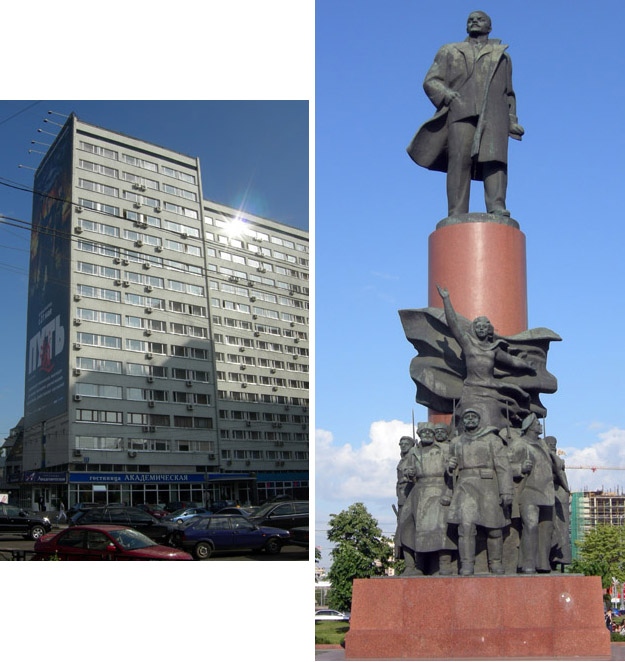
My hotel on the left.  On the right is some statuary they forgot to knock down.

My hotel on the left. On the right is some statuary they forgot to knock down.

Yesterday afternoon I arrived in the airport and met my new friend Andrei Dronov from the Russian Academy of Sciences. It was a bit of a trick because he sent me a photo of his face for me to recognize and I learned quickly that there are many Russian faces like his at the airport! But I found him and we set off for the city center. Riding the Metro was an adventure in itself. It was like being shut up in a rocket and blasted into the darkness, although maybe a bit faster and noisier. It all worked out, though, even while schlepping 57 pounds of equipment.

The tiny bit of Moscow I’ve seen in the last few hours is very much like any megacity, save for the Cyrillic signs. The traffic is extraordinary, and the noise from it lasts through the night. There is plenty of food available from stalls on the streetsides. The blocky Stalinist buildings (like my hotel) are relieved by the occasional pre-Revolution stonework and the bright golden-domed churches. There is a streetcar system just outside my room which looks ancient, but it is fast and apparently efficient.

This evening I go with Andrei by train to St. Petersburg and then the Volkhov region to the southeast of the city. He describes our lodgings there as a “field camp”. It is an unfinished house taken over by geologists because of its prime position on a famous Ordovician outcrop. I doubt very much I will be posting through wireless from there!

My goal on this trip is to explore the Lower Ordovician hardgrounds and fossils to test some hypotheses I’ve developed over the years in other regions.  These Russian rocks are among the best exposed earliest Ordovician in the world.  I also want to see how feasible it will be to bring Independent Study students to these sites.

Posted in Uncategorized | Tagged , | Leave a comment

Wooster Geologist in Russia

My first day in Russia.  I’m in Moscow hotel lobby with only this cranky connection to the Internet, but I’m here.  Tomorrow I leave with my colleague Andrei Dronov for work in the St. Petersburg region on the Lower Ordovician.

I wish I could post some of my great photos of Moscow, but they willl have to come later.  I’ve already had adventures in the Metro and buying food.  All is well.  The geology will come when I can connect my computer to the Internet — which may not be for two weeks!

Posted in Uncategorized | Tagged , | 7 Comments

Urban Dinosaurs

My last geological fieldwork (if we can call it that) in Israel on this trip was to examine the Upper Cretaceous limestones and dolomites exposed in Jerusalem. I far prefer my rocks be found in pristine wilderness areas with only bird songs in the background, but the right rocks, of course, can be anywhere. Sometimes, then, we have to work with traffic zooming by, sirens wailing, blasts of car exhaust, and schoolchildren offering to hammer the rocks for us.

The coolest location was in the moshav of Beit Zeit, just five minutes from downtown Jerusalem. (A moshav is a type of cooperative agricultural community, although in this case heavily urbanized.) A beautiful trackway of ornithomimosaur dinosaur footprints is exposed on a bedding plane of Lower Cenomanian limestone.

combinedbeitzeit052709

The site is of great importance because thus far these are the only dinosaur tracks known in the entire Middle East. The local community purchased the land and erected a protective roof over the trackways. They had a mural painted showing what the area may have looked like in the Cretaceous, installed a custom-made life-size dinosaur model on the bedding plane, and made the area into an educational park. You can see for yourself what happened later. The surrounding fence was too low, so it became a drug hangout, vandals spray-painted the mural and then broke the dinosaur into bits. (The crater where the dinosaur stood is just visible in the photo.)  This natural wonder was simply too accessible to the public.  There are plans to protect the site more thoroughly, and then reconstruct the displays.

I was able to collect a small piece of the limestone bedding plane for analysis back in Wooster. My hypothesis is that the limestone is a marine hardground which cemented very soon after the dinosaurs waded across it, thereby preserving the prints. A thin-section of the rock may show if it had these early cements.

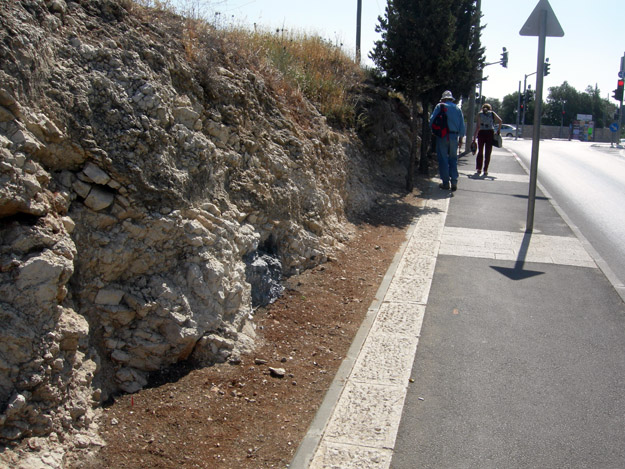
The rest of our urban geological work was on the streets of Jerusalem. Rocky outcrops are common because the city is built on several steep hills which have been quarried for thousands of years. We were able to correct the geological map in some places because of new exposures, and I gathered several ideas for future projects.

Mizzi hilu ("sweet rock"), a lithographic biomicrite member of the Judea Group (Turonian).

Mizzi hilu ("sweet rock"), a lithographic biomicrite member of the Judea Group (Turonian).

Posted in Uncategorized | Tagged , , , , , , | 2 Comments

The Drawbacks of Working in the Golan Heights

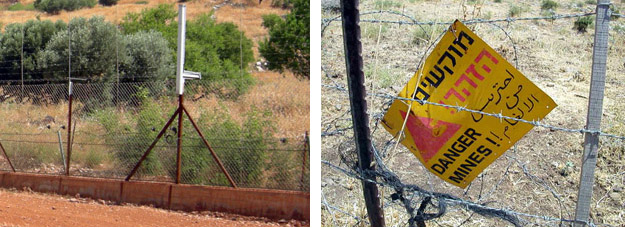
combined052609Today we could visit only one Jurassic site in the Golan. The others were in a militarily sensitive area to which we were not admitted, even after a long conversation with the commanding officer and classic geological special pleading. (“But our American guest, a famous geologist, has come thousands of miles just for these important rocks!”)

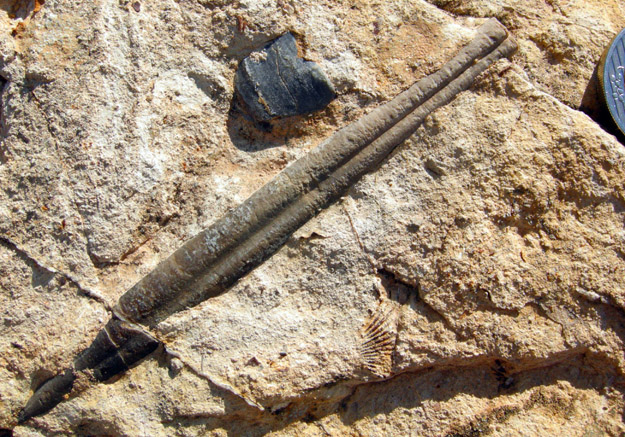
So, the fossil of the day will be a Jurassic belemnite from the top bed of the Zohar Formation. These are among the simplest of fossils (basically a calcite dart) but they are remnants of sophisticated cephalopods which are relatives of the modern squid. The fossil belemnite “guard” acted as a stiffening and weighting device inside the soft body.

Belemnite from the Jurassic Zohar Formation.  Note sliver of coin on the right for scale.

Belemnite from the Jurassic Zohar Formation near Neve Atif, The Golan. Note sliver of coin on the right for scale.

Posted in Uncategorized | Tagged , , , | 3 Comments

Fieldwork in the Golan Heights

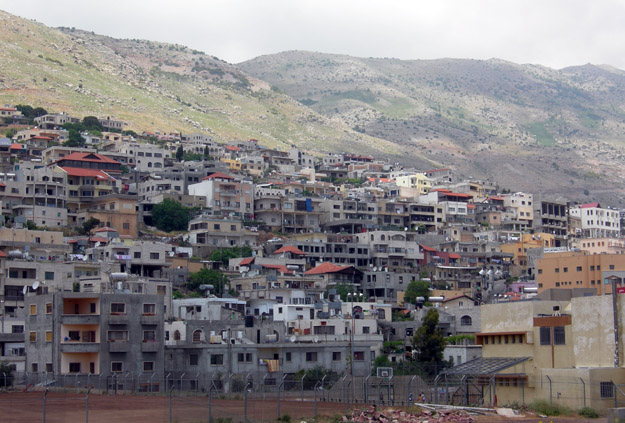
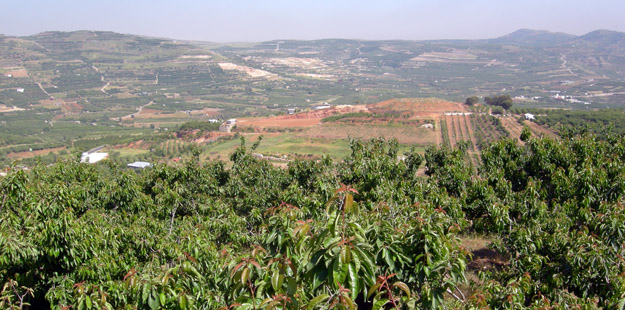
I finally got out into the field today. My Israeli colleagues and I left Jerusalem early in the morning and arrived about noon in the Druze village of Majdal Shams on the slopes of Mount Hermon. It is a lovely place with steep hillsides and extraordinary views over green valleys filled with cherry and apple orchards. (I’ll write another post sometime about the complicated politics here, including a long lunchtime lecture I tolerantly received from a Druze man about all the problems in the world coming from “America and the West”. It may have been a good thing that I didn’t quite understand what he was saying until it was explained to me later!)

Part of Majdal Shams seen from the town center and facing Mount Hermon.

Part of Majdal Shams seen from the town center and facing Mount Hermon.

One of the cultivated valleys near Majdal Shams.

One of the cultivated valleys near Majdal Shams.

Our goal today was to examine three marine Jurassic formations (from bottom to top in the geological fashion): the Zohar (mostly limestone), Kidod (mostly shale), and Beersheva (mostly limestone). I had two primary questions: What indications can we find in these rocks of the water depth when they were deposited? What was the intensity of bioerosion of the corals and sponges in these units? Both questions are part of larger studies placing these rocks in context with the rest of the known Jurassic world. This region was on the equator when these units were formed, so we have an unusual opportunity to study Jurassic equatorial ecological conditions.

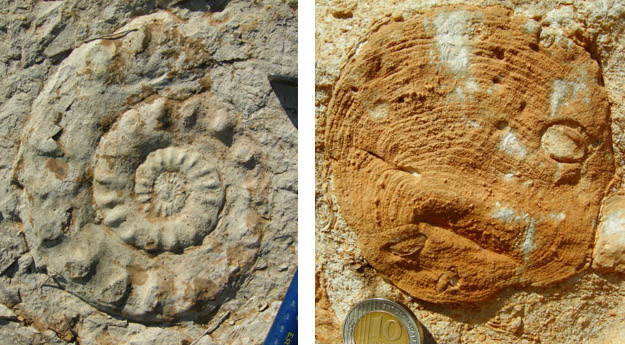
As is often the case in paleontology, we found some of the best fossils at the boundaries between formations. The top of the Zohar and bottom of the Kidod have wonderful ammonites, belemnites, bivalves, and brachiopods, some appearing to show patterns of microbioerosion. The top of the Beersheva has massive corals and sponges which are thoroughly bored by bivalves, some of which are still in the crypts they excavated for themselves.

On the left is a very large ammonite we found in the top of the Zohar Formation.  Note the hammer for scale.  On the right is a closer view of a partially silicified coral from the top of the Beersheva with holes drilled in it by bivalves, some of which are still in place.

On the left is a very large ammonite we found in the top of the Zohar Formation. Note the hammer for scale. On the right is a closer view of a partially silicified coral from the top of the Beersheva with holes drilled in it by bivalves, some of which are still in place.

All the indications we could find showed that the limestone units were clearly shallow water deposits. The thick shales of the Kidod were laid down in deeper waters well below wave base. Much more work is required, though, before we can come to any conclusions. This is a reconnaissance trip to sort out potential projects for Wooster Senior Independent Study students and my own research. I now see many opportunities here.

Posted in Uncategorized | Tagged , , , , , , | 2 Comments