A Bit of the Triassic in Svalbard

NEAR DIABASODDEN, SVALBARD–Yesterday’s field trip was a brief survey of three Triassic (Anisian to Carnian) siliciclastic units, with students concentrating on the third. From bottom to top they are the Botneheia Formation (a gray to black shale with numerous bits of ichthyosaur bone), the Tschermakfjellet Formation (shales notable for the many Monotis bivalves preserved within them), and the De Geerdalen Formation (mostly sandstones with excellent ripples and hummocky cross-stratification). We concentrated primarily on the De Geerdalen, with the students measuring various sedimentological parameters. I was amazed at what they could do in a constant high wind and while encumbered by all the cold-weather gear. My students who complain that they are too cold or the mountain is too steep will now hear about the sturdy students in Norway!
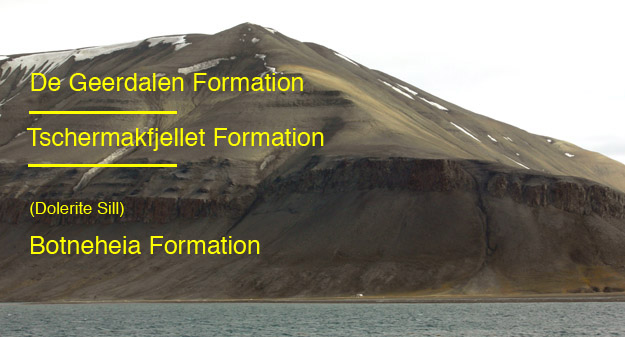
Triassic units in the field area near Diabasodden, Svalbard.

Triassic units in the field area near Diabasodden, Svalbard.

My small contribution was identifying fossils, especially trace fossils which would be useful for paleoenvironmental interpretations. We found Chondrites, Rhizocorallium, Lockeia, and Diplocraterion in the De Geerdalen Formation, along with occasional infaunal bivalve molds and a brachiopod-rich shell hash in a carbonate. It all indicated relatively shallow water to me, just below normal wavebase.

A bonus was the set of modern geological processes around us as we worked. The river coming out of the De Geerdalen has made a great little delta, complete with a sediment plume showing the prevailing current in this part of the fjord. There are also various cold-climate features including patterned soil and mounds of frost-heaved rocks.
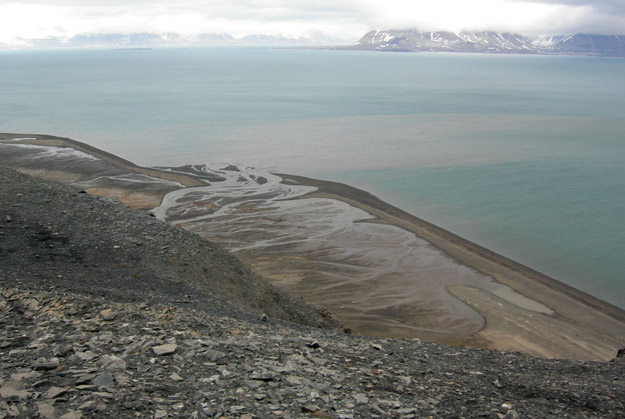
De Geerdalen Delta, Svalbard.

De Geerdalen Delta, Svalbard.

Besides the introduction to a particular set of geological issues, I learned on this trip how critical the logistics are for organizing work in this part of the world. Keeping track of all the equipment needed for any geological expedition, and then adding the requirements of a long trip in an open boat (those survival suits being just one factor), then the Arctic weather preparations, and finally the rifles and other polar bear precautions — a lot more than just ordering the vans and a few box lunches! I am very grateful to Maria Jensen, my Norwegian host, for inviting me on this trip with her students. She was busy enough without a clumsy American along.
Posted in Uncategorized | Tagged , , | Leave a comment

Any activity which involves survival suits and rifles …

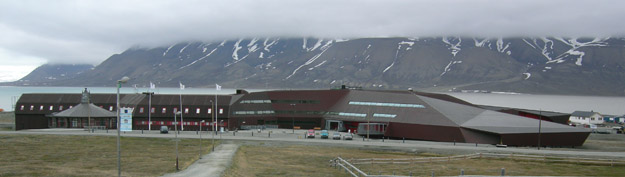
SVALBARD, NORWAY–A geological high adventure today when I joined a field trip of Norwegian faculty and international graduate students on a day trip to a Triassic section north of Longyearbyen. We met at the University of Norway research station (a fantastic facility) for orientation and equipment. My host is Maria Jensen, a Norwegian geologist who specializes in siliciclastic sedimentology and stratigraphy.

University of Norway research station (UNIS) in Longyearbyen.

University of Norway research station (UNIS) in Longyearbyen.

We then were issued survival suits (always a good sign), rifles (not for me, unfortunately), helmets, and other gear. We were a group of ten, so we loaded into a single Zodiac boat. I was the last onboard because I had difficulty on the dock in the cold wind putting on my survival suit, which is one piece with built-in boots and gloves. (Students jump in and out of them — not me! I felt like an astronaut … or a very big toddler). Luckily the only thing I dropped in the ocean was my helmet, which I grabbed back. Since I was last in the boat, I had the privilege of being bounced around in the bow on our long trip across heavy seas (well, to me). I held up my end, though.

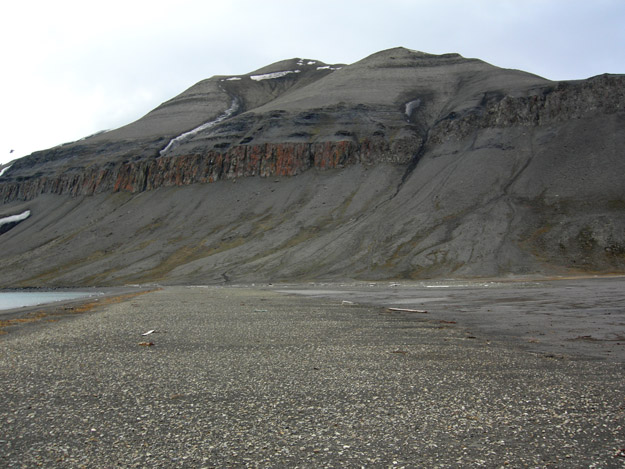
Outcrops of Triassic rocks near Diasbodden, Svalbard.

Outcrops of Triassic rocks near Diasbodden, Svalbard. N78.34480°, E16.36062°.

I would have had photos of the boat trip, but sealed as I was in the suit, and the fact that I was not going to release a hand (or even a foot) on the journey, all my photos are land-based. When we arrived at the outcrop I saw how it was worth any wet and bumpy ride. Fantastic exposures — and we climbed right up them in a howling wind. (A real test of equipment where the slightest action requires thought. You don’t want to lose your gloves or hat over the cliff into the ocean. My expensive purchases at REI this summer were well worth the price.)

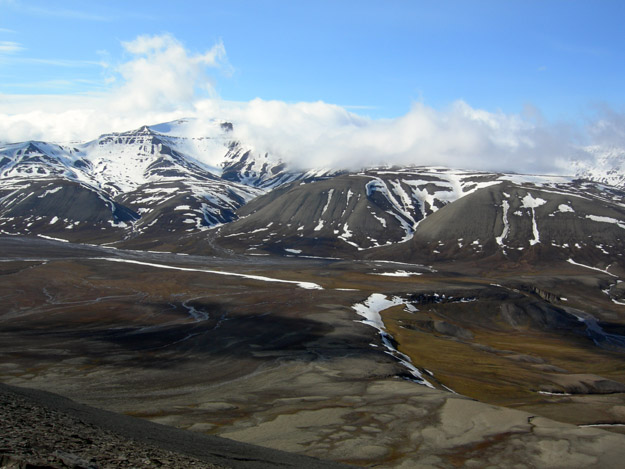
View from the Triassic outcrops into a nearby valley.  Note blue sky which appeared for a few hours.

View from the Triassic outcrops into a nearby valley. Note blue sky which appeared for a few hours. View from N78.33986°, E16.35474°.

I’ll post later about the geology when I get a better connection. It was incredible. I was even able to make a few contributions as the only paleontologist on the trip.

The steep terrain we worked on above the fjord.

The steep terrain we worked on above the fjord. Maria Jensen is on the right.

Another even bumpier and wetter ride back to Longyearbyen. (I grip to the few ropes for life itself while students slept beside me unconcerned.) No bears on this expedition, but a few reindeer and lots of shore birds. A fantastic experience for geology, wilderness, and adventure.

Posted in Uncategorized | Tagged , | 4 Comments

N78.20316°, E015.59476°

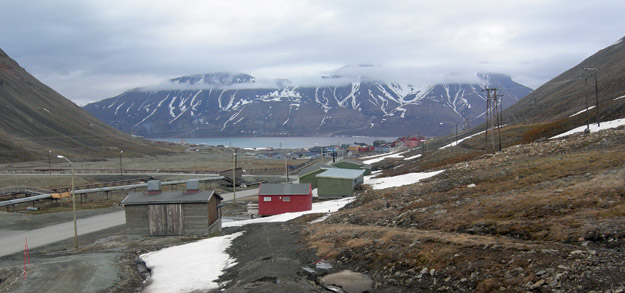
View from my room in a "guesthouse" a few long kilometers south of Longyearbyen.

View from my room in a "guesthouse" a few long kilometers south of Longyearbyen.

LONGYEARBYEN, SVALBARD, NORWAY–The sun makes a crazy circle in the sky. Polar bear warnings. Houses on stilts. Muck for soil. (“Don’t worry. You can only sink three feet.”) Russian coal miners. International scientists. Cruise ship tourists. Stunning vistas of rock, ice and snow. This is certainly one of the most dramatic places I’ve been lately! As you can see from the images, geology is one of the main attractions here, from glaciers (one is just up the road from my guesthouse) to the massive rock exposures from every time period and much of the Precambrian. Tomorrow I take a trip out into it with faculty and students from the University of Norway.

Abandoned coal mine outside of Longyearbyen, Svalbard, Norway.

Abandoned coal mine outside of Longyearbyen, Svalbard, Norway. This mine was destroyed by the Germans in World War II (I've heard those words a lot lately) and then rebuilt in the 1950s.

Posted in Uncategorized | Tagged , | Leave a comment

Why go to Iceland when you can stay in Boston?

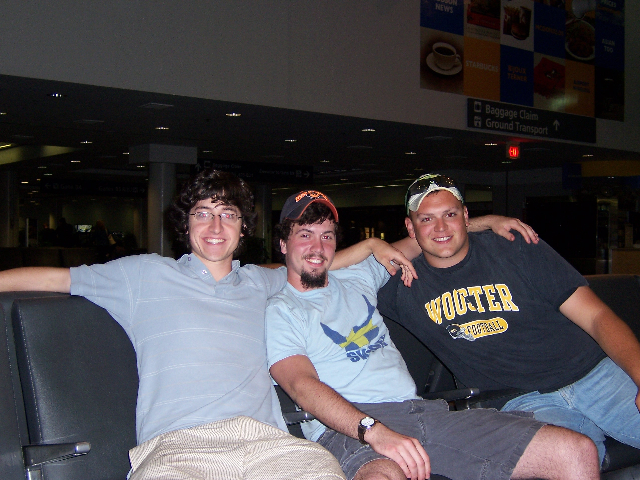
10 hours into our Iceland trip, we’ve made it all the way to…Boston! We know it’s hard to believe, but the weather wasn’t on our side and we had “airport trouble.” So, we’re spending the night at an awesome Holiday Inn Express and we’ll try the same flight again tomorrow. Wish us luck!

Adam, Rob, and Todd "chillaxin'" at Logan

Adam, Rob, and Todd "chillaxin'" at Logan

Posted in Uncategorized | Tagged , , , , | 2 Comments

A Great Geological Day in Norway

OSLO, NORWAY–This Wooster geologist had an excellent time here in the capital city of Norway today. I met up with Hans Arne Nakrem, a Norwegian paleontologist with the Natural History Museum, University of Oslo, and we looked at specimens he had collected from Jurassic strata on Spitsbergen, the Arctic island I am visiting tomorrow. He and his colleagues have some fascinating geological and paleontological hypotheses about some of the carbonate units and structures preserved with large marine reptile bones. There are opportunities here to help sort out the scenarios, especially with trace fossils.

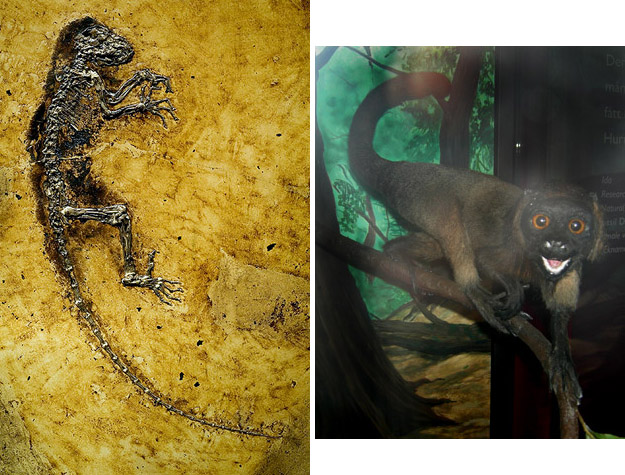
Hans Arne also showed me one of the most famous fossils found in modern times: Darwinius masillae, an Eocene (Lutetian) stem group primate also known as “Ida” (pronounced “ee-dah”). It may be a transitional form between the prosimian and simians.

The fossil on the left (it is about 10 cm long) and a reconstruction on the right.

The fossil on the left (it is about 58 cm long) and a reconstruction on the right.

This fossil, which was found in 1983 in Germany, was only recently acquired by the Natural History Museum and formally described. In fact, we had lunch today in a sunny courtyard in the Botanical Gardens with Jørn Hurum, the paleontologist who led the research team studying D. masillae (and who is also famous for finding “Predator X“, an enormous pliosaur from the Jurassic of Svalbard). Inspiring.

Later Hans Arne gave me a tour of Oslo on what must have been one of the most beautiful days of the year. Among the many sights were some outcrops, including the Middle Ordovician interbedded shales and limestones shown below at the shoreline of the Oslo Fjord.

Middle Ordovician shales and limestones on the western shoreline of the Oslo Fjord.

Middle Ordovician shales and limestones on the western shoreline of the Oslo Fjord.

Posted in Uncategorized | Tagged , , , , | 2 Comments

The Åland Islands

skerries062009
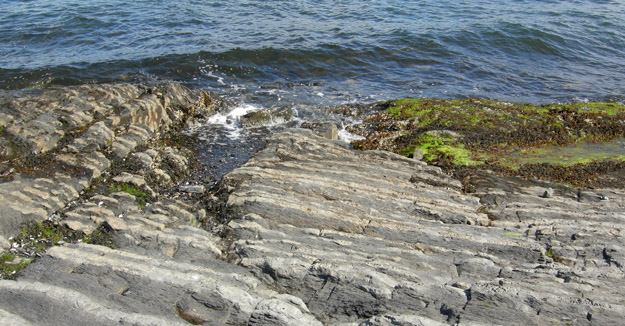
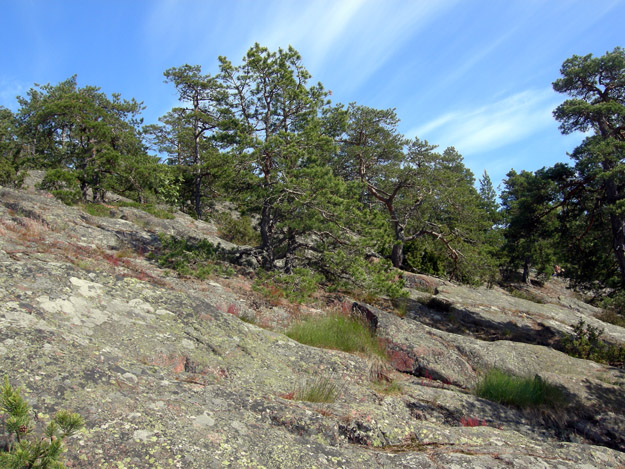
There is an exquisite archipelago of thousands of  islands between Finland and Sweden.  I took a six-hour ferry ride this morning from Turku in southwestern Finland to Mariehamn, capital of the Åland Islands, where I am spending a day and an evening.  Most of the islands are formed of a brilliant red Precambrian granite, polished smooth on the top by glaciation.  Scraggly pine trees grow in the cracks they can find in the bedrock, reminding me of the terrain in the High Sierra just below tree line.

N 60.08276°, E 19.93422°

N 60.08276°, E 19.93422°

A close look at the granite shows a wonderful mix of potassium feldspars, clear quartz, and flecks of biotite.  The weathered surfaces are thickly covered with colorful lichens, which are symbiotic associations of algae and fungi.

combinedgranite062009

These islands have an unusual political history.  They are populated almost entirely by Swedish-speakers, yet are a province of Finland.  Various international agreements in the 19th and 20th Century gave the islanders autonomous status within Finland and, most famously, completely demilitarized the islands, a status they managed to retain through two world wars and the Cold War.  They have their own government with a premier and parliament, they fly their own flag, and they print their own stamps.
combinedstamps062009

And there you see the attraction Åland has for a geologist.  Any place that features geology on its stamps deserves a visit!

Posted in Uncategorized | Tagged , , | Leave a comment

Wooster Geology Major = Featured Bagpiper

Check out the recent Daily Record Article on Palmer Shonk, a senior geology major and bagpiper who led Wooster delegates into the All-America City competition in Tampa, FL. Way to go, Palmer!

Posted in Uncategorized | Tagged , , , , | Leave a comment

Another Beautiful Montana Day

We have beautiful weather again here in Montana. The CUR meeting is moving along swiftly and we’re all working hard to accomplish as much as possible in the short time that we have. Some committees managed to take advantage of the warmth and sunshine this afternoon by holding their discussions on the lawn. Fortunately, mine was one of them! Soon, we’ll head back indoors to vote on issues like the merger of CUR with NCUR (National Conference on Undergraduate Research). I bet you thought they were one in the same, didn’t you? Well, they may be soon! Until then, I’ll be reading about the most influential leaders in undergraduate research (as the newest member of the CUR Fellows Committee) and enjoying the sweet, fresh Montana air.

Plaque detailing the journey of Lewis and Clark

A plaque detailing the expedition of Lewis and Clark.

View of Baldy Mountain from the steps of my dorm.

View of Baldy Mountain from my dorm (sigh).

The sticker on my nametag shows how infinitely cool geologists are

The sticker on my nametag shows how infinitely cool geologists are

Posted in Uncategorized | Tagged , , , | 3 Comments

Wooster Geologist in Bozeman, MT

Promoting undergraduate research doesn’t always mean that we’re trekking across some exotic landscape sampling rocks with our students. Sometimes, it means tackling difficult issues through in-depth conversations with faculty who mentor undergraduate researchers in a variety of settings. That’s why I’m here in Bozeman, MT. I’m on the campus of Montana State University at the Council on Undergraduate Research (CUR) business meeting. Even the gorgeous weather didn’t distract us from setting an ambitious agenda. We’re going to spend all day tomorrow talking about issues that impact undergraduate research, such as how to advocate for funding, how to convey the benefits of undergraduate research to a broader audience (e.g., policy makers, administrators, institutions), and how best to address the needs of the geoscience research community. CUR’s mission is to support and promote high-quality undergraduate student-faculty collaborative research and scholarship. Undergraduate research is rapidly becoming main-stream pedagogy, and it’s thrilling to be a member of the organization that is paving the way.
100_5627b

Posted in Uncategorized | Tagged , , | Leave a comment

A Wooster Geologist in Helsinki

I’m between geological field trips right now. I left Russia by train through Karelia to Helsinki, Finland. It was a remarkable trip through woods and villages, with the swampy environs of St. Petersburg giving way to higher and drier ground where ribs of granite occasionally showed. Next week I go to Spitsbergen in the Arctic to look at a Jurassic sequence for a few days, and then I meet two Wooster students, Palmer Shonk and Rob McConnell, and an Ohio State University paleontologist, Bill Ausich, in Estonia where we will work in the Silurian with our Estonian colleague Olev Vinn.

Helsinki is, of course, a highly cultured city with many attractions. I don’t want to minimize those, but since this is a geology blog, we must note the gorgeous granite mounds which dot the city.
helsinkigranite061809
They were polished smooth on their upper surfaces by Pleistocene (and Holocene) glaciers, which left classic striations showing the direction of ice movement. The Finnish Parliament building is in the background.
glacialstriations061809

Tomorrow I leave by train for the ancient city of Turku on the southwestern coast of Finland, and then the Aland Islands for a quick look. It’s a tough job, but someone has to do it.

Posted in Uncategorized | Tagged , , , | Leave a comment