Recent Comments
- Kira on Posts from Antarctica: Life at McMurdo Station
- Mark Wilson on Voices in the Trees: Update on the Alaska Youth Stewards and The College of Wooster Tree-Ring Lab Collaboration at Five Years
- Mark Wilson on Wooster’s Fossil of the Week: How to make brilliant acetate peels, with a Jurassic coral example
- Nuy on Wooster’s Fossil of the Week: How to make brilliant acetate peels, with a Jurassic coral example
- Mark Wilson on Wooster’s Fossil of the Week: A pentamerid brachiopod from the Lower Silurian of New York
Meta
-
Recent Posts
- A new paper: Two problematic sclerobiont species that survived the Ordovician-Silurian extinction event
- Voices in the Trees: Update on the Alaska Youth Stewards and The College of Wooster Tree-Ring Lab Collaboration at Five Years
- Dr. Nicolás Young – Our 44th Annual Osgood Speaker
- Dating a Cabin from Pittsburgh
- A new paper describing the feeding apparatus of Silurian cornulitids from China: More evidence supporting placement of this group in the lophophorates
April 2026 S M T W T F S 1 2 3 4 5 6 7 8 9 10 11 12 13 14 15 16 17 18 19 20 21 22 23 24 25 26 27 28 29 30 Blogroll
Other Links
Wooster Links
Tags
- Alaska
- basalt
- British Columbia
- Cambrian
- Carboniferous
- climate
- climate change
- Cretaceous
- Devonian
- England
- Estonia
- Fossil of the Week
- fossils
- France
- GSA Meeting
- history
- Iceland
- ichnology
- Independent Study
- Indiana
- Israel
- Italy
- Jurassic
- Kentucky
- lava
- limestone
- Miocene
- Mojave Desert
- Negev
- Ohio
- Ordovician
- paleoclimate
- pillow lava
- Pleistocene
- Pliocene
- Poland
- Russia
- Sicily
- Silurian
- tree ring
- UK2015
- undergraduate research
- Utah
- Wooster
- Wooster Geology
Archives
- March 2026
- February 2026
- January 2026
- December 2025
- November 2025
- October 2025
- September 2025
- August 2025
- July 2025
- June 2025
- May 2025
- April 2025
- March 2025
- February 2025
- January 2025
- December 2024
- September 2024
- July 2024
- June 2024
- May 2024
- April 2024
- March 2024
- January 2024
- December 2023
- November 2023
- October 2023
- September 2023
- August 2023
- July 2023
- June 2023
- May 2023
- April 2023
- March 2023
- February 2023
- December 2022
- September 2022
- August 2022
- July 2022
- June 2022
- May 2022
- April 2022
- March 2022
- February 2022
- January 2022
- December 2021
- November 2021
- October 2021
- August 2021
- June 2021
- May 2021
- April 2021
- March 2021
- February 2021
- January 2021
- December 2020
- November 2020
- October 2020
- September 2020
- August 2020
- July 2020
- May 2020
- April 2020
- March 2020
- February 2020
- January 2020
- December 2019
- November 2019
- October 2019
- September 2019
- August 2019
- July 2019
- June 2019
- May 2019
- April 2019
- March 2019
- February 2019
- January 2019
- December 2018
- November 2018
- October 2018
- September 2018
- August 2018
- July 2018
- June 2018
- May 2018
- April 2018
- March 2018
- February 2018
- January 2018
- December 2017
- November 2017
- October 2017
- September 2017
- August 2017
- July 2017
- June 2017
- May 2017
- April 2017
- March 2017
- February 2017
- January 2017
- December 2016
- November 2016
- October 2016
- September 2016
- August 2016
- July 2016
- June 2016
- May 2016
- April 2016
- March 2016
- February 2016
- January 2016
- December 2015
- November 2015
- October 2015
- September 2015
- August 2015
- July 2015
- June 2015
- May 2015
- April 2015
- March 2015
- February 2015
- January 2015
- December 2014
- November 2014
- October 2014
- September 2014
- August 2014
- July 2014
- June 2014
- May 2014
- April 2014
- March 2014
- February 2014
- January 2014
- December 2013
- November 2013
- October 2013
- September 2013
- August 2013
- July 2013
- June 2013
- May 2013
- April 2013
- March 2013
- February 2013
- January 2013
- December 2012
- November 2012
- October 2012
- September 2012
- August 2012
- July 2012
- June 2012
- May 2012
- April 2012
- March 2012
- February 2012
- January 2012
- December 2011
- November 2011
- October 2011
- September 2011
- August 2011
- July 2011
- June 2011
- May 2011
- April 2011
- March 2011
- February 2011
- January 2011
- December 2010
- November 2010
- October 2010
- September 2010
- August 2010
- July 2010
- June 2010
- May 2010
- April 2010
- March 2010
- February 2010
- January 2010
- December 2009
- November 2009
- October 2009
- September 2009
- August 2009
- July 2009
- June 2009
- May 2009
Wooster Geologists Invade Skagi Peninsula
We’re on the Skagi Peninsula now and internet access is a little more random. We started field work on Rob’s and Adam’s projects this week. Rob found some awesome zeolites – too many to name – and a lot of altered basalt (my poor babies!). Adam ran into some trouble early on because many of the rhyolites appear highly altered, but has managed to find some pretty decent samples that he can use for geochemical analyses.

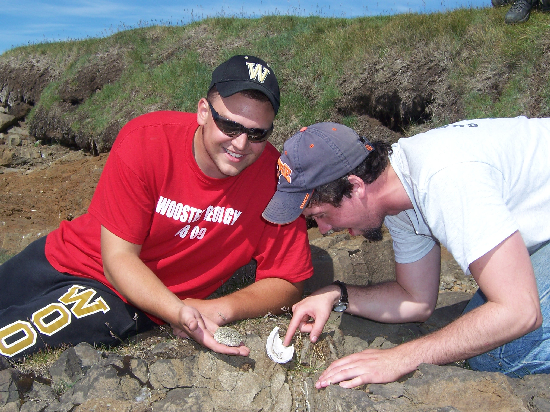
Rob poses while searching for zeolites in sunny Iceland (ha ha Estonia Group).

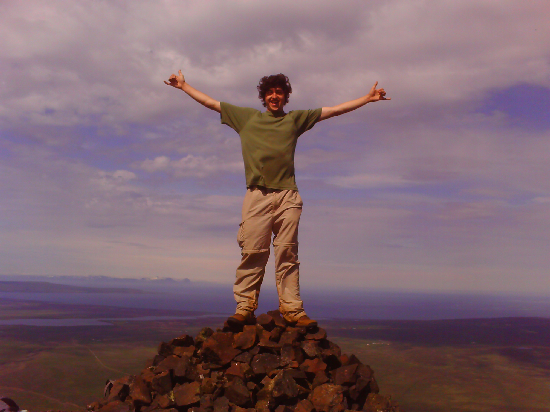
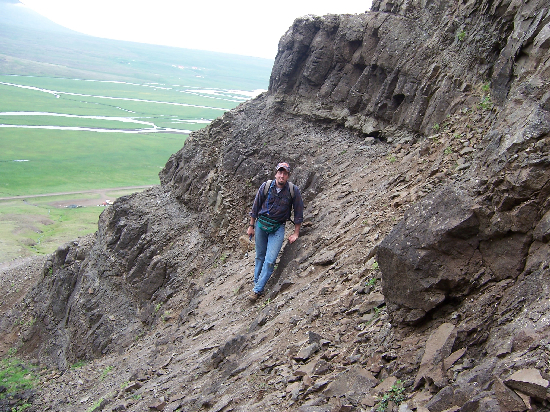
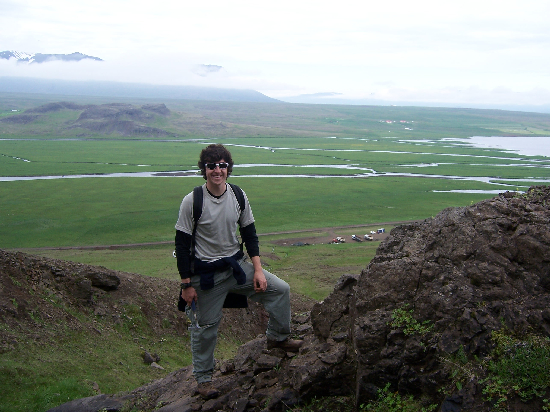
Adam conquers Vatnsdalsfjall on his way to the top to sample rhyolites.
We’re living in a house with 12 people – sounds like a reality show (The Geology World or Big Brother: Geo-Style). Meagen is in a room with 4 girls – it looks like their clothes exploded. Todd, Rob, and Adam are sharing a room – it smells…refreshing(?). They have swum in the arctic ocean EVERY DAY since we arrived. They are CRAZY!
We’re going to be here until July 14. Sadly, we’ll be missing the Hunavaka, a local celebration with colorful balloons and music. Still, every day is a celebration when you’re doing geology!
A Second Project Emerges on the Glorious Fourth of July
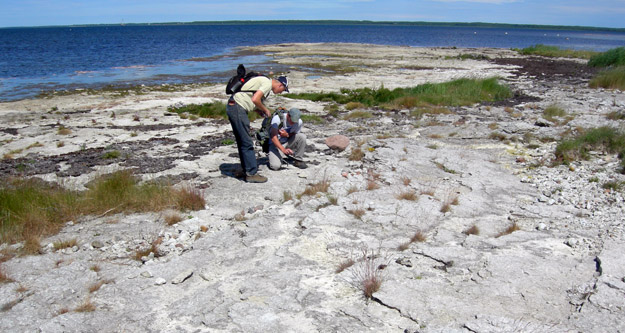
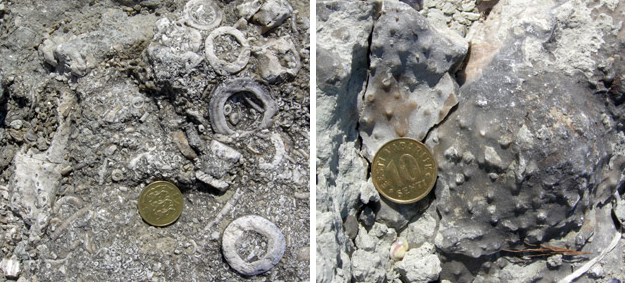
KAUGATUMA, SAAREMAA, ESTONIA–It is always an important moment for a Wooster geology research team when it identifies its final student independent study project. Today Palmer Shonk found his. There is a remarkable exposure of a high-energy deposit in the Aigu Beds (Kaugatuma Stage, Upper Silurian) on the Sõrve Peninsula of southwestern Saaremaa island. These rocks have spectacular crinoid materials, including elaborate holdfasts, along with stromatoporoids, bryozoans and brachiopods. The sediments still retain their original dune bedding forms showing the high energy conditions under which they were deposited.

Palmer and Rob at the Kaugatuma locality (N58.12409°, E22.19375°). I probably shouldn't point out again the spectacular weather. That would be like bragging.
Palmer’s job will be to understand the original organisms and the environments in which they lived and died (a paleocommunity study) as well as the means by which the remains were redistributed and preserved (a taphonomy study). It is exciting material which will make an excellent project.
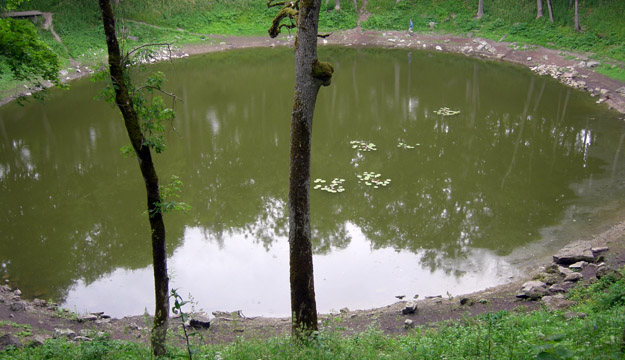
At the end of the day we said good-bye to our generous and thoughtful Estonian hosts Olev and Ingrid Vinn. We are on our own now in Estonia, but they’ve trained us well. They left us at the marvelous Kaali Meteorite Craters, estimated to be about 7500 years old.
Heavy Soviet Footprints Remain
TAGAMOISA PENINSULA, SAAREMAA, ESTONIA–The Soviet Union forcibly occupied Estonia in 1940-41, it was briefly replaced by German invaders from 1941 until 1944, and Soviet occupation resumed in 1944 until Estonian independence in 1991. Tens of thousands of Estonians were deported to Siberia and Kazakhstan. Tens of thousands more were forcibly conscripted into the Red Army in World War II (only 30% returned home), and thousands were executed. It is a wonder of history that this small country survived such Soviet oppression and then flourished so quickly when it liberated itself less than two decades ago.
The Soviets turned coastal Estonia into a vast fortified area, closing long coastlines and declaring all the islands as restricted “border zones”. Estonians could not even visit most of their own northern shores and islands. Abandoned Soviet concrete bunkers and other military facilities are still very common along the coasts and in the interior.

Soviet bunkers which once housed anti-aircraft missile batteries near Suuriku Cliff, northern Saaremaa, Estonia.
Today by Estonian law, all land within 300 meters of a coastline has guaranteed public access. Vast amounts of territory were liberated when the Soviets finally evacuated all their troops in 1994. As scientists we intersect this tragic and ultimately inspiring history when we visit these once forbidden coastlines. We look at rocks and fossils which were untouched by geologists for over half a century. It is a celebration to bring information from these wonderful regions out into free scientific dialogue again.
One Student Project Born

The Estonia team at Panga Cliff on the northern coast of Saaremaa (N58.55321°, E22.28577°). Note the gorgeous weather.
KURESSAARE, SAAREMAA ISLAND, ESTONIA–It was an exquisitely crystalline day of blue and gray here with clear skies, a sparkling sea, and beautiful limestones just waiting for the touch of our hammers. We continued to explore the Lower Silurian (Wenlock) of the Saaremaa coast, fascinated with the numbers and varieties of fossils we found. These rocks have been carefully cataloged by biostratigraphers, so we know exactly how they fit into the larger geological picture in time and space. This gives us the opportunity to concentrate on the paleontological and sedimentological questions before us.
There is a distinctive and widespread horizon in these rocks of stromatoporoids, a kind of calcareous sponge which built on the shallow seafloor stony mounds up to the size of large cabbages. These stromatoporoids were bored by at least two kinds of worm-like organisms, and then encrusted by corals and bryozoans. Some corals even grew inside the skeleton of the sponges in a kind of symbiosis. There are many riddles here about how these fossils are preserved, how the community was structured, and what sort of environment it flourished and was eventually buried in. This will be the basis of Rob McConnell’s Independent Study thesis. We will all return to this site in a few days to do the detailed work of measuring, counting and collecting.

Rob and Palmer closely examine stromatoporoid fossils found in place at the foot of the Liiva Cliff on the northern coast of Saaremaa (N58.57553°, E22.36821°).
Rob, by the way, was reunited with his luggage late this afternoon, so he’s a happy man.
The Great Basalt Race
Todd Finished his I.S. Research!!!! – Rob

Todd measuring the diameter of a pillow.

The Iceland crew taking meticulous notes.
Yes I did and it feels nice to say that I have my field work complete. Thanks to Meagen, Rob and Adam for all of their help! We had a good time in the quarries collecting samples and we even had some competetive racing.
Now its time to go to Blonduos to work on Rob’s and Adam’s projects. -Todd
The Baltic Boys

Rob McConnell and Palmer Shonk at the Uugu Cliff locality, Muhu Island, Estonia (N58.67136°, E23.23988°). The blue Baltic Sea is in the background.
KURESSAARE, SAAREMAA ISLAND, ESTONIA–Like the Iceland team, our first full field day in Estonia was spent in reconnaissance on the islands of Muhu and Saaremaa. We visited an abandoned quarry just north of Koguva to examine Lower Silurian (Wenlock) dolomitic mud mounds and limestones near Koguva, and then went to the Uugu Cliff which exposes a similar sequence but a little younger within the Silurian. Caves are found high in the cliff which were cut by waves of Ancylus Lake, a freshwater precursor of the Baltic Sea between 9500 and 8000 BCE. There are also trenches on the top of the bluffs dug by Tsarist Russian soldiers during World War I.
Later in the afternoon we collected Wenlockian fossils at the seaside Paramaja Cliff which had been weathered out of their rock matrices by the waves. We found a good collection of rhynchonellid brachiopods, strophomenid brachiopods, rugose corals, tabulate corals, encrinurid trilobites, crinoid stems, nautiloids, and cornulitids. (Like music, isn’t it?)

Palmer and Rob in the traditional fossil collecting position at Paramaja Cliff (N58.61531°, E22.89790°). Palmer was not particularly happy about the long walk through the stinging nettles.
Tomorrow we continue our survey of Silurian localities. The weather could not be better. (It sure beats sleet in Svalbard and mosquitoes in Russia, I must say!) Rob’s luggage is scheduled to arrive at our Kuressaare hotel in the afternoon, so we’ll finally have our full kit.
Estonia Geology Research Team in Place (More or Less)
KOGUVA, MUHU ISLAND, ESTONIA–We are spending our first night together in a small model village (N58.59638°, E23.08559°) designed to show what farming life was like in 19th century Estonia. Our rooms have rough-hewn wooden walls, rope mouldings, and iron bedsteads. We’re a bit concerned that we will have to milk cows before breakfast. The weather is simply perfect.
In the photo below you see Bill Ausich (on the left), a paleontologist from The Ohio State University, Mark Wilson, Palmer Shonk, and Rob McConnell. You may see Rob in these clothes for awhile. In his epic journey here from Montana, his luggage has yet to arrive!
Pillows, Pillows, Everywhere
Today, we spent nearly all day mapping and sampling one pillow quarry. We found that the pillows are highly varied in size, shape, and orientation. Todd is interested in understanding the relationship between pillow morphology and the physical properties of the magma. He hypothesizes that magma viscosity plays a large role in controlling pillow size. To test his hypothesis, he and his trusty field assistants (Adam and Rob) measured the dimensions and orientations of several pillows. They also sampled the interior and glassy rinds so that Todd can analyze the geochemistry when we return to the States. Tomorrow = another day = another quarry.

Adam, Rob, and Todd working in the pillow quarry.