One Student Project Born

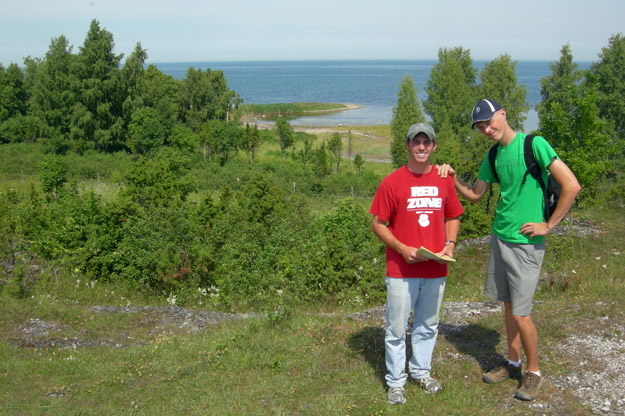
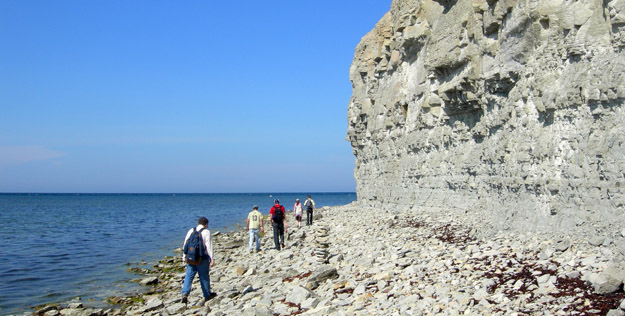
The Estonia team at Panga Cliff on the northern coast of Saaremaa (N58.55321°, E22.28577°).  What a spectacular day it was.

The Estonia team at Panga Cliff on the northern coast of Saaremaa (N58.55321°, E22.28577°). Note the gorgeous weather.

KURESSAARE, SAAREMAA ISLAND, ESTONIA–It was an exquisitely crystalline day of blue and gray here with clear skies, a sparkling sea, and beautiful limestones just waiting for the touch of our hammers. We continued to explore the Lower Silurian (Wenlock) of the Saaremaa coast, fascinated with the numbers and varieties of fossils we found. These rocks have been carefully cataloged by biostratigraphers, so we know exactly how they fit into the larger geological picture in time and space. This gives us the opportunity to concentrate on the paleontological and sedimentological questions before us.

There is a distinctive and widespread horizon in these rocks of stromatoporoids, a kind of calcareous sponge which built on the shallow seafloor stony mounds up to the size of large cabbages. These stromatoporoids were bored by at least two kinds of worm-like organisms, and then encrusted by corals and bryozoans. Some corals even grew inside the skeleton of the sponges in a kind of symbiosis. There are many riddles here about how these fossils are preserved, how the community was structured, and what sort of environment it flourished and was eventually buried in. This will be the basis of Rob McConnell’s Independent Study thesis. We will all return to this site in a few days to do the detailed work of measuring, counting and collecting.
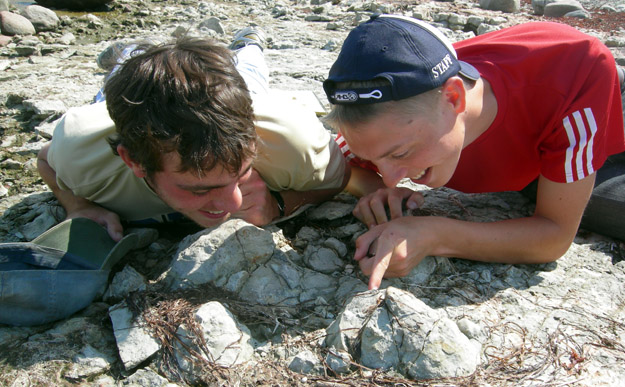
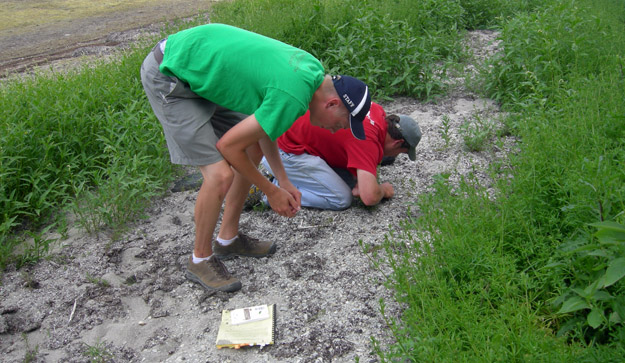
Rob and Palmer closely examine stromatoporoid fossils found in place at the foot of the Liiva Cliff on the northern coast of Saaremaa (N58.57553°, E22,36821°).

Rob and Palmer closely examine stromatoporoid fossils found in place at the foot of the Liiva Cliff on the northern coast of Saaremaa (N58.57553°, E22.36821°).

Rob, by the way, was reunited with his luggage late this afternoon, so he’s a happy man.
Posted in Uncategorized | Tagged , , | 1 Comment

The Great Basalt Race

Todd Finished his I.S. Research!!!! – Rob

Todd measuring the diameter of a pillow.

Todd measuring the diameter of a pillow.

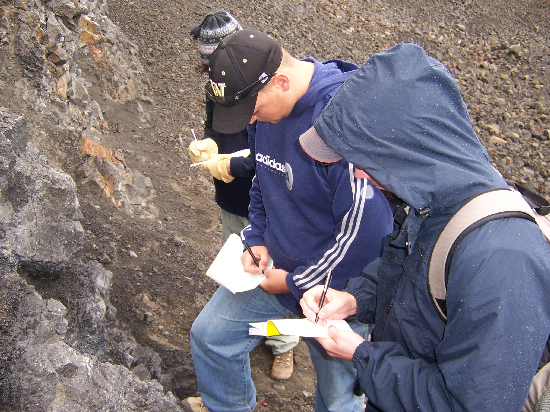
The Iceland crew taking meticulous notes.

The Iceland crew taking meticulous notes.

Yes I did and it feels nice to say that I have my field work complete. Thanks to Meagen, Rob and Adam for all of their help! We had a good time in the quarries collecting samples and we even had some competetive racing.

Now its time to go to Blonduos to work on Rob’s and Adam’s projects. -Todd

Posted in Uncategorized | Tagged , , , | 1 Comment

The Baltic Boys

Rob McConnell and Palmer Shonk at the Uugu Cliff locality, Muhu Island, Estonia.  The blue Baltic Sea is in the background.

Rob McConnell and Palmer Shonk at the Uugu Cliff locality, Muhu Island, Estonia (N58.67136°, E23.23988°). The blue Baltic Sea is in the background.

KURESSAARE, SAAREMAA ISLAND, ESTONIA–Like the Iceland team, our first full field day in Estonia was spent in reconnaissance on the islands of Muhu and Saaremaa. We visited an abandoned quarry just north of Koguva to examine Lower Silurian (Wenlock) dolomitic mud mounds and limestones near Koguva, and then went to the Uugu Cliff which exposes a similar sequence but a little younger within the Silurian. Caves are found high in the cliff which were cut by waves of Ancylus Lake, a freshwater precursor of the Baltic Sea between 9500 and 8000 BCE. There are also trenches on the top of the bluffs dug by Tsarist Russian soldiers during World War I.

Later in the afternoon we collected Wenlockian fossils at the seaside Paramaja Cliff which had been weathered out of their rock matrices by the waves. We found a good collection of rhynchonellid brachiopods, strophomenid brachiopods, rugose corals, tabulate corals, encrinurid trilobites, crinoid stems, nautiloids, and cornulitids. (Like music, isn’t it?)

Palmer and Rob in the traditional fossil collecting position.

Palmer and Rob in the traditional fossil collecting position at Paramaja Cliff (N58.61531°, E22.89790°). Palmer was not particularly happy about the long walk through the stinging nettles.

Tomorrow we continue our survey of Silurian localities. The weather could not be better. (It sure beats sleet in Svalbard and mosquitoes in Russia, I must say!) Rob’s luggage is scheduled to arrive at our Kuressaare hotel in the afternoon, so we’ll finally have our full kit.

Posted in Uncategorized | Tagged , , | Leave a comment

Estonia Geology Research Team in Place (More or Less)

KOGUVA, MUHU ISLAND, ESTONIA–We are spending our first night together in a small model village (N58.59638°, E23.08559°) designed to show what farming life was like in 19th century Estonia. Our rooms have rough-hewn wooden walls, rope mouldings, and iron bedsteads. We’re a bit concerned that we will have to milk cows before breakfast. The weather is simply perfect.

In the photo below you see Bill Ausich (on the left), a paleontologist from The Ohio State University, Mark Wilson, Palmer Shonk, and Rob McConnell. You may see Rob in these clothes for awhile. In his epic journey here from Montana, his luggage has yet to arrive!

estoniateam063009

Posted in Uncategorized | Tagged , | 3 Comments

Pillows, Pillows, Everywhere

Today, we spent nearly all day mapping and sampling one pillow quarry. We found that the pillows are highly varied in size, shape, and orientation. Todd is interested in understanding the relationship between pillow morphology and the physical properties of the magma. He hypothesizes that magma viscosity plays a large role in controlling pillow size. To test his hypothesis, he and his trusty field assistants (Adam and Rob) measured the dimensions and orientations of several pillows. They also sampled the interior and glassy rinds so that Todd can analyze the geochemistry when we return to the States. Tomorrow = another day = another quarry.

Adam, Rob, and Todd working in the pillow quarry.

Adam, Rob, and Todd working in the pillow quarry.

Posted in Uncategorized | Tagged , , | 1 Comment

Thoughts on Leaving Svalbard

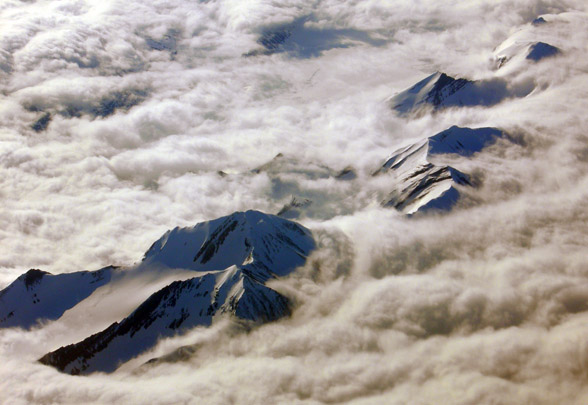
Peaks of Spitsbergen, Svalbard, poking up through the clouds as we took off for Oslo.

Peaks of Spitsbergen, Svalbard, poking up through the clouds as we took off for Oslo.

I’m now in Tallinn, Estonia, awaiting the arrival of Bill Ausich (OSU Professor), Rob McConnell, and Palmer Shonk (intrepid Wooster Senior Independent Study students). Our fieldwork will begin tomorrow once the team is assembled with our Estonian host, Olev Vinn (University of Tartu).

Yesterday I spent several more hours with paleontologist Hans Arne Nakrem of the Natural History Museum in Oslo. We had excellent discussions of possible joint projects with material from Svalbard, and even me joining a future expedition there. (I know what to expect now!) There are very interesting Jurassic carbonates which need analysis for bioerosion and other trace fossils. It is also clear that many of the numerous marine reptile skeletons, especially the common ichthyosaurs, have invertebrates associated with them and other odd features beyond the vertebrate paleontology. Hans Arne and I have discussed exchanging students during the summers, and the easy framework the University of Norway has for visiting scholars in the summer. We’ve opened new doors for future Wooster geology research. In combination with the Alaska and Iceland teams, we’re gaining quite the northern exposure!

Posted in Uncategorized | Tagged , , | 2 Comments

Solving the Jigsaw Puzzle

Wooster geologists Terry Workman and Greg Wiles are joined by Alena Giesche (Middlebury College), Jessa Moser and Tom Lowell (U. Cincinnati) on Alaska’ Kenai Peninsula undertaking paleoclimate research. We are coring lakes in collaboration with The Kenai National Wildlife Refuge to get a better understanding of climate change and precipitation changes since the Ice Age.

Jessa, Alena, Terry and Tom researching glacial retreat at Exit Glacier in Kenai Fjords National Park

Jessa, Alena, Terry and Tom researching glacial retreat at Exit Glacier in Kenai Fjords National Park


Tom, Alena and Terry paddling the "The SS-Morass" to the coring site on Jigsaw Lake
Jessa (team geophysicist) spins up gear to image the stratigraphy below the lake and a sonar image of the lake floor
Alena archives another meter of sediment as Terry looks on.

Alena archives another meter of sediment as Terry looks on.

Posted in Uncategorized | Tagged , , , | 2 Comments

Once upon a time, there were three pillow quarries

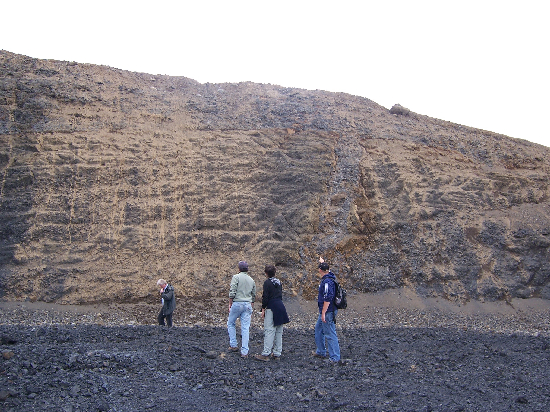
Ben Edwards arrived from the States today. After a short morning of getting acclimated, he and the Wooster crew headed out to the field with our Icelandic colleagues, Steina and Hauker. We visited 3 quarries that expose the internal architecture of 2 different pillow ridges. Pillow ridges form during subglacial eruptions, where the the ice melts and the lava is quenched. Thanks to the heavy machinery, we are able to see natural cross sections of the ridges, and we’re observing a lot of unexpected details. Most quarries show nicely preserved pillows, with radial cross sections and glassy rinds. Vesicles appear in a variety of patterns, sometimes concentrated in the center of the pillow or in concentric zones around the center. Surprisingly, there are a lot of intrusions as well. We observed one of the best examples of a feeder dike in contact with its lava flow. There were also some irregular and sheet-like intrusions that stood out against the wall of pillows. Clearly, there are a lot of questions to be answered here. Todd is going to address some of those questions in his I.S.

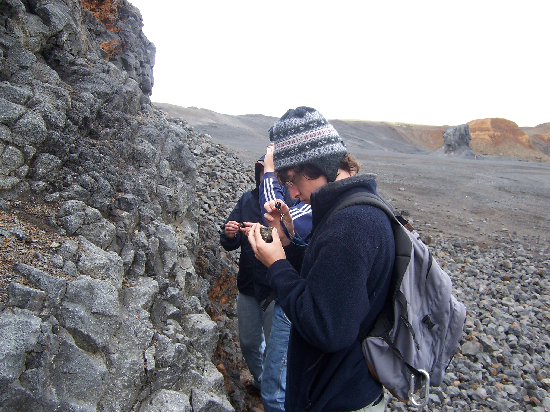
Adam using a hand lens to identify phenocrysts.

Adam using a hand lens to identify phenocrysts.

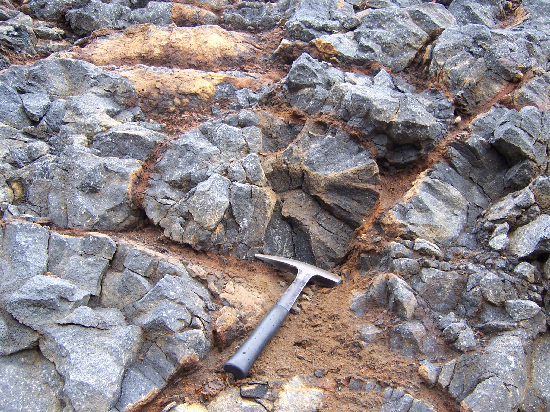
Pillow lavas with a hammer for scale. Notice the radial joints. The pillows are surrounded by brown, altered glass.

Pillow lavas with a hammer for scale. Notice the radial joints. The pillows are surrounded by brown, altered glass.

A light gray dike intrudes through black, glassy, brecciated material and feeds an upper unit of gray pillows.

Todd (on the right) is pointing to a light gray dike that intrudes through black, glassy, brecciated material and feeds an upper unit of gray pillows.

Posted in Uncategorized | Tagged , , , | 1 Comment

Iceland: The Beginning

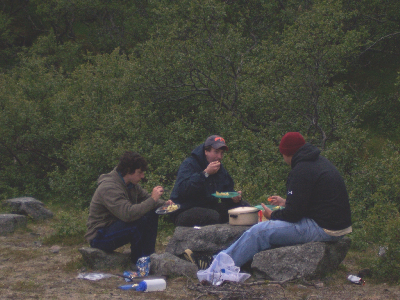
We made it to Iceland! We landed Friday morning and have been busy having fun (and seeing great geology). Our chefs have been cooking excellent meals.

Adam, Rob, and Todd eating their awesome salmon dinner on the first night.

Adam, Rob, and Todd eating their awesome salmon dinner on the first night.

All of the food has been fantastic, especially the cheese. Todd likes it so much, he bought a whole block of it for himself! Rob and Todd have eaten fish for every meal and plan to continue for the entire trip.

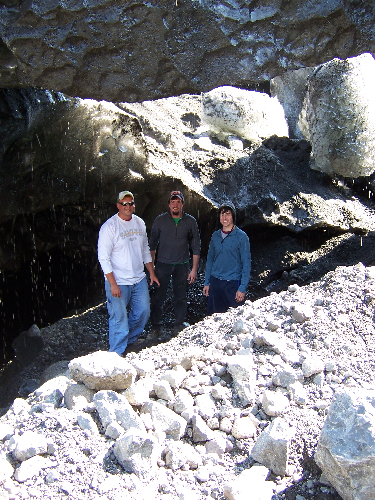
As soon as we landed, we traveled along the southern coast to meet a group of geologists on a field trip. We’ve seen glorious columnar joints, complicated intermingled granophyre and basalt, and highly altered hyaloclastite. We also ventured all over a glacier, where we drank some melt water and stood in a glacial cave.

Todd, Rob, and Adam standing in a glacial cave.

Todd, Rob, and Adam standing in a glacial cave.

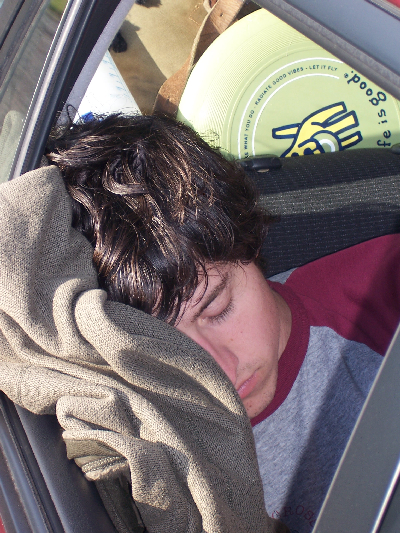
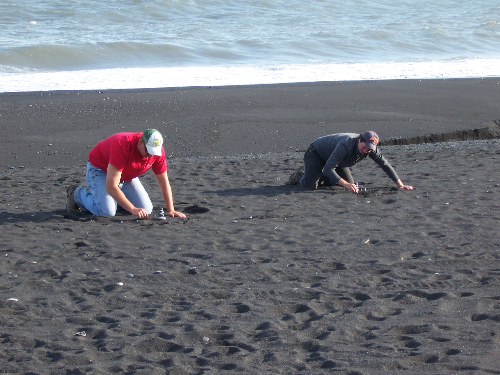
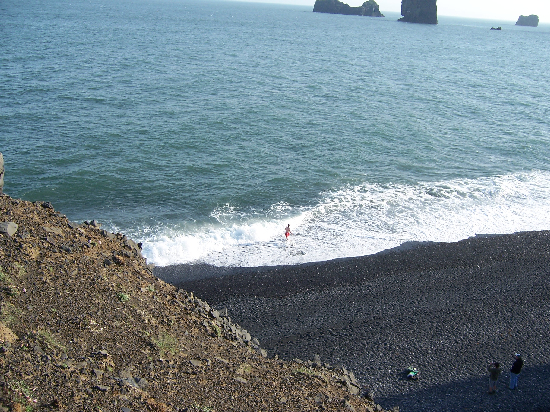
At one stop, we walked along a black sand beach. Well, most of us did.

Adam taking a snooze.

Adam taking a snooze.

Todd and Rob made rock sculptures and signed the sand.

Todd and Rob on the black sand beach.

Todd and Rob on the black sand beach.

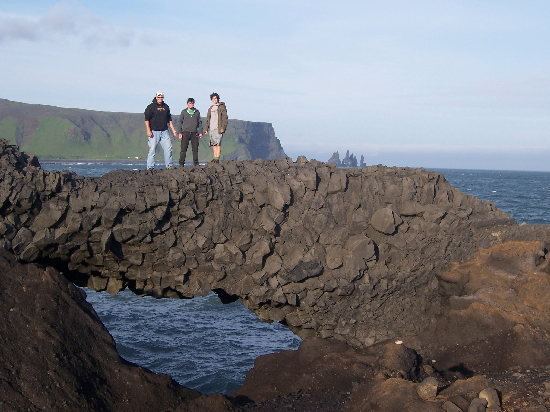
Just down the road, we visited the Dyrholaey bird sanctuary. The basaltic lavas and hyaloclastites have been carved into interesting shapes by the crashing waves.

Todd, Rob, and Adam on a VERY stable rock bridge.

Todd, Rob, and Adam on a VERY stable rock bridge.

Hyaloclastites are glassy fractured rocks formed when lava erupts explosively in water. One of us attempted to find the source of the lava…in the COLD Atlantic ocean.

Rob (in the red trunks) searches for the lava source while his comrades (lower right corner) observed his methods.

Rob (in the red trunks) searches for the lava source while his comrades (lower right corner) observed his methods and took notes. They concluded that they should not follow.

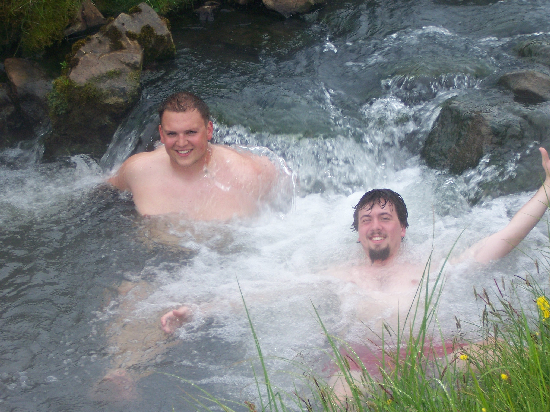
In Hveragerdi, we observed the effects of the hotspot in action. We hiked along a trail that had fumaroles, hot springs, and mud pots. The local stream is heated by drainage from the hot springs and serves as a natural hot tub.

Todd and Rob soaking in an Icelandic stream.

Todd and Rob soaking in an Icelandic stream.

We’re in Hafnarfjordur tonight, staying with Steina, one of our Icelandic colleagues. Tomorrow starts our field work – we’re headed to Todd’s site: Undirhlithar.

Posted in Uncategorized | Tagged , , , , , , | 1 Comment

Geology Along the Fjords of Svalbard

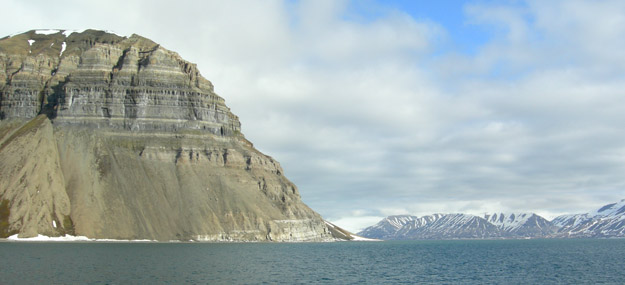
Today I took a day trip with about 25 other people on the small ship M.S. Polargirl in Isfjorden. The geology in view was fantastic, it didn’t rain, and the sun came out occasionally in the morning. I also got to answer numerous questions about geology from my fellow passengers, which I enjoyed. This little trip also gave me more information about the stratigraphy and interesting geological issues which future Wooster students may be able to address.

There are many abandoned mines along the shores of the fjords. Most are easy to spot because the mine developers wanted to be able to transfer their products directly to ships from the shore. Two types were visible on this trip: gypsum mines and coal mines.

Abandoned gypsum mine at Skansen.  The gypsum and anhydrite units are visible as white units at the base of the mountain on the right.  The mine is on the left almost completely covered by talus and snow.  The mine was abandoned soon after it was started in the 1920s because there was more anhydrite than gypsum in the units.

Abandoned gypsum mine at Skansen. The gypsum and anhydrite units are visible as white units at the base of the mountain on the right. The mine is on the left almost completely covered by talus and snow. The mine was abandoned soon after it was started in the 1920s because there was more anhydrite than gypsum in the units.

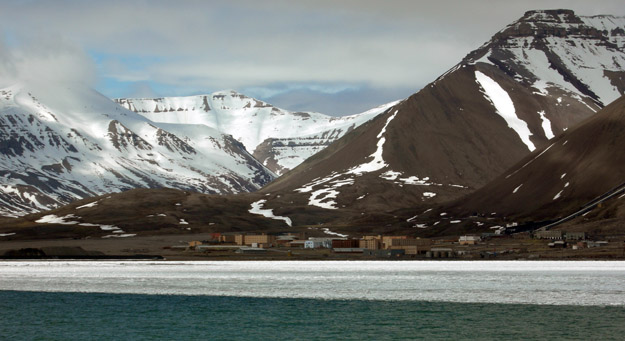
This is the abandoned Russian coal-mining town of Pyramiden.  We were unable to land there because of the thick pack ice between us and the harbor.  The town was evacuated quickly in 1998 as it became evident it could not survive economically without the subsidies it had received from the Soviet Union.  I wanted to see its "northernmost statue of Lenin".

This is the abandoned Russian coal-mining town of Pyramiden. We were unable to land there because of the thick pack ice between us and the harbor. The town was evacuated quickly in 1998 as it became evident it could not survive economically without the subsidies it had received from the Soviet Union. I wanted to see its "northernmost statue of Lenin".

The very steep mountainsides on the edge of the fjords have developed spectacular talus cones dropping down into the sea.

Talus cones along the margin of Tempelfjord.  Can you tell which two cones are not natural?

Talus cones along the margin of Tempelfjord. Two cones were modified by the glacier now confined to the adjacent fjord.

We also saw three glaciers nosing into their fjords. One is still calving off icebergs.

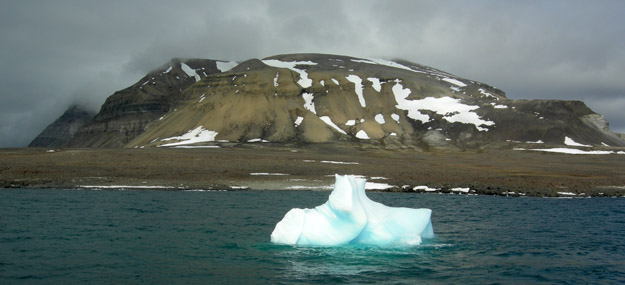
Iceberg from the Tunabreen Glacier at the proximal end of Tempelfjord.

Iceberg from the Tunabreen Glacier at the proximal end of Tempelfjord.

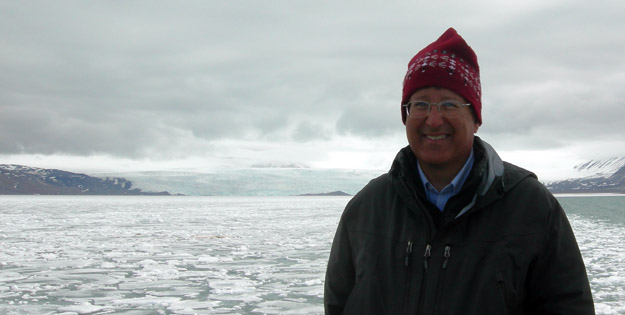
With the Nordenskiold Glacier in the background, along with pack ice, this is as far as I can tell the northernmost Wooster geologist on June 27, 2009 (at N78.64044°, E16.43892°).  He certainly is the coldest Wooster geologist on this date.

With the Nordenskiold Glacier in the background, along with pack ice, this is as far as I can tell the northernmost Wooster geologist on June 27, 2009 (at N78.64044°, E16.43892°). He certainly is the coldest Wooster geologist on this date.

Two short clips: the ship moving into pack ice outside Pyramiden, and waves lapping onto an iceberg in Isfjorden.

Posted in Uncategorized | Tagged , , | 6 Comments