The Mojave Desert Field Trip and Wikipedia (again)

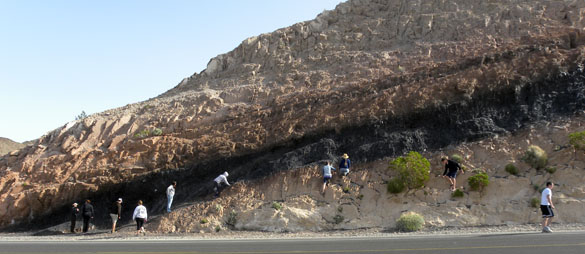
Fiamme in the Resting Spring Tuff near Shoshone, California.

WOOSTER, OHIO–As with last year’s Mojave Desert field trip, this spring we also generated public domain images for Wikipedia. It is such a privilege and pleasure to take trips like this that we at least want to share some images with this free online encyclopedia. Here are some linked Wikipedia articles which have been improved with images from this month’s expedition:

Telescope Peak
Devil’s Golf Course
Blister Beetle
Phoradendron
Desert iguana
Ventifact
Granite Mountains
Fiamme
Lenticular clouds

These and many more free public domain images can also be found on Mark Wilson’s Wikimedia page.

Posted in Uncategorized | Tagged | Leave a comment

Wooster’s Fossil of the Week: A mastodon tooth (Late Pleistocene of Holmes County, Ohio)


Time for a vertebrate fossil from the College of Wooster paleontology collections.  Above is a side view of an American Mastodon tooth (Mammut americanum) from the Pleistocene of the county just south of us. It has been passed around through hundreds of student hands in our geology classes to demonstrate basic features of these large animals and their dietary habits. The image below shows their characteristic cusped chewing surface.


Mastodons looked like elephants but are actually in a separate family (Mammutidae instead of Proboscidea). They browsed diverse vegetation rather than grazed like elephants and mammoths. The American Mastodon roamed most of North America. They lived in herds in the cool woodlands, probably meeting final extinction under the spears of Paleo-Indians about 10,000 years ago.

My favorite reproduction of the American Mastodon is shown below. It is by the famous scientific illustrator Charles R. Knight (1874-1953). There is something very spirited as this young male charges into the scene. It even looks a bit like northeastern Ohio.

Posted in Uncategorized | Tagged , , , | 4 Comments

A few of the Mojave wildflowers

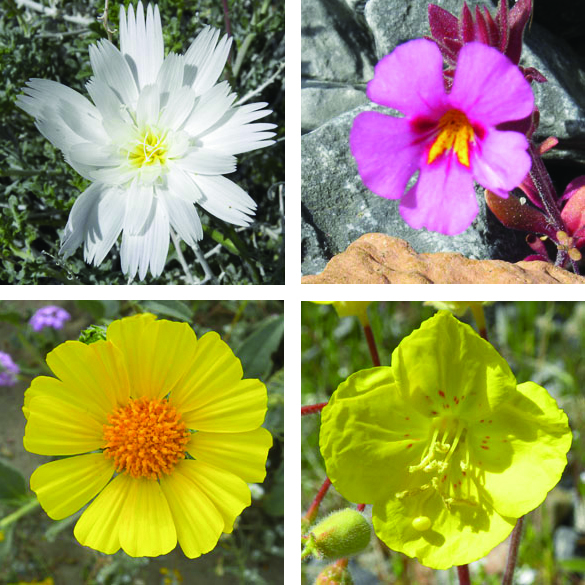
Several people have asked what kind of wildflowers we saw this spring on our departmental field trip in the Mojave Desert. They were gorgeous and diverse — more than last year in variety and abundance, but far below the carpets of flowers we wandered through during the very wet 2005.  Here are four of the most common blooms. Feel free to identify them in the comments!

Posted in Uncategorized | Tagged , | Leave a comment

An outpost of Wooster in the Mojave celebrates today’s basketball victory!

Congratulations from Zzyzx to the College of Wooster Men's Basketball team!

(Guest post from Lindsey Bowman.) After an afternoon of rewarding trilobite collecting, nothing was more welcome than the news this afternoon from Salem, Virginia. Our basketball team advanced to the NCAA Division III finals after defeating Williams College by two points. We listened live from Meagen Pollock’s cell phone to Woo91 updates, it was a dramatically close game. Best of luck in the final match tomorrow!

Posted in Uncategorized | Tagged , | 1 Comment

The last stop of the field trip: Date shakes!

ZZYZX, CALIFORNIA–Apparently visiting China Ranch and having the famous date shakes is a tradition on at least a few other geology field trips. We were introduced to it by Matt James at Sonoma State, and today we met students and faculty from Columbia and the University of San Diego also spending the week in the Mojave. The high point of our encounter was when the student bodies sang to each other intricate and harmonious geology songs they had created! The date shakes were also a treat (especially with chocolate added) and a suitable way to end the 2011 Wooster Geology Mojave Desert field trip.

Thank you to the Desert Studies Center staff at Zzyzx for their excellent hosting and advice (and superb food from Chef Eric). We were also very fortunate to have on our trip this year our administrative coordinator Patrice Reeder who solved many problems, gave us several new ideas, and had enthusiastic questions that kept our game up. Our students were, of course, delightful and the reason why we enjoy these trips so well. Tomorrow we pack up and leave for the Las Vegas airport and home to Ohio.

Posted in Uncategorized | Tagged | Leave a comment

Trilobites! Now it’s a field trip.

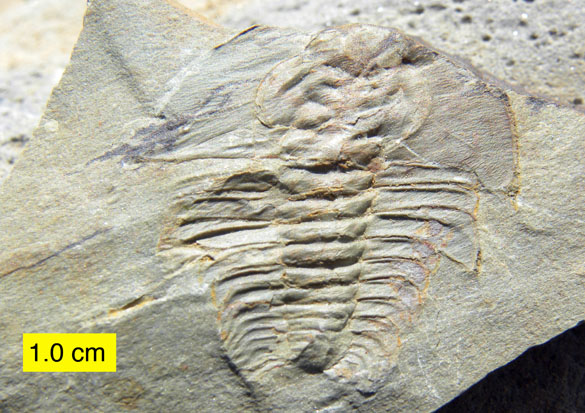
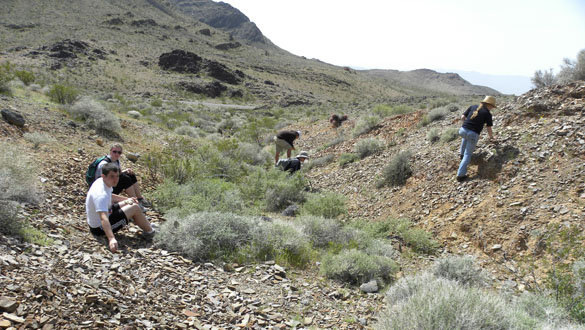
Just kidding about the trilobite requirement for a true field trip, but we must acknowledge a certain charm that comes only from these spiny little beasts. Thanks to my buddy Matthew James, we were directed to an especially fossiliferous set of outcrops of the Carrara Formation in the Nopah Range. The trilobites we collected there are Early Cambrian, roughly 540 million years old. Nick Fedorchuk found the whole specimen photographed above. Everyone collected cephala (“heads”) and the occasional brachiopod and hyolith. It was a very good afternoon for paleontologists!

Wooster students at work in what we now call "Trilobite Valley".

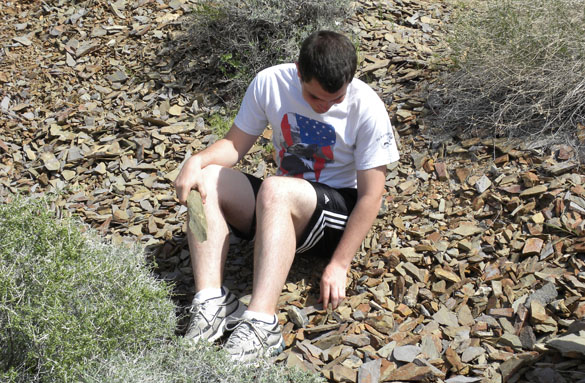
Travis Louvain finding good specimens.

The trilobites here are strained by tectonism, so they look "stretched" in one direction. Shelley Judge collected a set to use in her structural geology labs.

Posted in Uncategorized | Tagged , , | 2 Comments

A favorite stop: the Resting Spring tuff exposure

ZZYZX, CALIFORNIA–We’ve visited this roadside outcrop on California Highway 178 in the Resting Spring Range on each of our field trips to the Mojave Desert. Meagen Pollock may explain more about this fascinating outcrop later in the blog, but for now I can report that it is a “devitrified pumice tuff, welded tuff, and vesicular vitrophyre” dated by K-Ar methods at 9.5 million years old (Hillhouse, 1987). It is an excellent place for students to put their developing petrologic, stratigraphic and structural skills to the test.

Sarah Appleton on the tuff at Resting Spring Pass showing the zones of sintering.

Posted in Uncategorized | Tagged , | Leave a comment

A little vignette of desert ecology


ZZYZX, CALIFORNIA–While exploring the Amboy Crater lava fields on Wednesday, we noticed these small and very active “yellow” beetles. With a little research we discovered they are Desert Spider Beetles (Cysteodemus armatus) that feed on the nectar from a variety of flowers. As you might have guessed by now, the yellow color on the heads and abdomens of the beetles is actually from the pollen of a particular yellow flower blooming in abundance the day of our visit. These beetles turn out to be important pollinators for several flower species.

Some of the many flowers near Amboy Crater. I need my flower expert Mother's help to identify them!

Posted in Uncategorized | Tagged , | 1 Comment

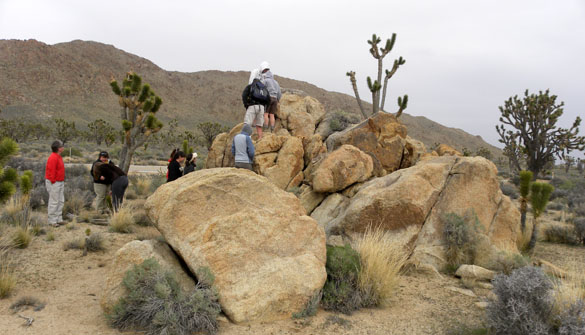
Back to granite on Cima Dome

A granite exposure near Teutonia Peak on Cima Dome. Note our jackets and hands in pockets!

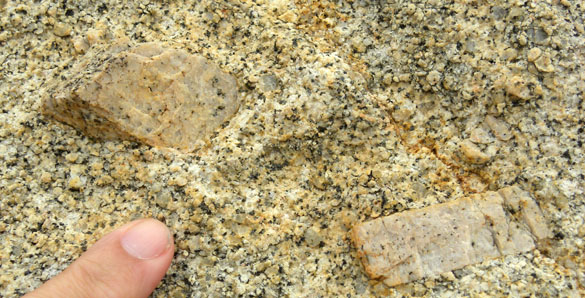
ZZYZX, CALIFORNIA–Our last stop of the rapidly-cooling day was on the huge Cima Dome east of Zzyzx in the Mojave National Preserve. The dome is so large (about 70 square miles) that it is impossible to detect when you are actually on it, but easily visible from miles away. It apparently is the eroded root of a granitic intrusion formed during subduction in the Jurassic to Cretaceous. The alkali granite exposed here is very similar to that of the Granite Mountains we saw yesterday.

Potassium feldspar crystals in the coarse alkali granite of Cima Dome.

The soil of Cima Dome is derived almost entirely from the underlying alkali granite.

Posted in Uncategorized | Tagged , , , | 2 Comments

A tuff afternoon

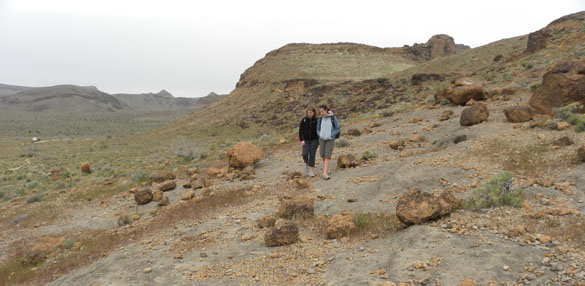
Lindsey Bowman and Becky Alcorn on the Hole-In-The-Wall tuff deposits.

ZZYZX, CALIFORNIA–After lunch we took a long drive south and east to the Hole-In-The-Wall visitor center and trail. Exposed here are diverse and colorful rocks called tuffs that were formed by pyroclastic eruptions from volcanoes roughly 18.5 million years ago. These eruptions of hot gases and ash swept the surrounding countryside depositing thick masses of complex rock. Plants and animals were incorporated in the ash flows, so we occasionally find charcoal in the tuffs as well as various other volcanic products.

A piece of charcoal from a burnt tree in a tuff at Hole-In-The-Wall.

Posted in Uncategorized | Tagged | Leave a comment