Wooster’s Fossil of the Week: an aberrant brachiopod (Permian of Texas)

Funny word to apply to a fossil: aberrant, meaning “deviating from the normal”. It’s an old-fashioned word rarely used these days, primarily because we have a hard time defining “normal”. It was the word used when I was introduced to the above brachiopod, though, so I employ it in honor of my old-timey professors.

On the left is the dorsal valve exterior and on the right the ventral valve interior of Leptodus americanus Girty 1908. (Both valves are broken.) This species is a member of the Family Lyttoniidae in the Order Productida, which some of my students may have just figured out. The large ventral valve relative to the reduced dorsal valve is the clue. The specimen was found in the Word Limestone (Wordian Stage, Guadalupian Series, Middle Permian System, about 265 million years old) in Hess Canyon, Texas. It is replaced by silica (“silicified”) and so was easily extracted from a block of limestone by dissolving away the calcium carbonate matrix.

These brachiopods, along with many other types, lived in extensive reefs in west Texas during the Permian. The ventral valve was cemented to other shells and extended out parallel to the substrate. The much smaller dorsal valve fit into the grooves, leaving much of the soft-part interior exposed. My professors said it was “like a leaf in a gravy boat” — and I had no idea what a “gravy boat” was then.

It is likely that Leptodus americanus had photosynthetic zooxanthellae embedded in its exposed mantle tissues. These are protists (most often dinoflagellates) that live inside the tissues of metazoans and provide them with nutrients and oxygen in return for carbon dioxide and a cozy place to live. Reef-forming corals are the best known animals to have such a mutualistic symbiotic relationship with zooxanthellae today. It would thus not be surprising to see a similar system with these reefal brachiopods.

Not so aberrant after all.

References:

Girty, G.H. 1908. The Guadalupian fauna. United States Geological Survey Professional Paper 58:1-651.

Williams, A. 1953. The morphology and classification of the oldhaminid brachiopods. Washington Academy of Sciences Journal 9: 279-287.

Posted in Uncategorized | Tagged , , , | Leave a comment

Wooster’s Fossil of the Week: an oreodont (probably from the Oligocene of Nebraska)

Oreodonts are extraordinarily common fossils in the Oligocene of North America. Just about every teaching fossil collection contains at least a couple oreodont skulls, most obtained during late Nineteenth-Century field trips to the Great Plains. Our specimen above is of the genus Merycoidodon Leidy, 1848. We know it is Oligocene in age (about 30 million years old), but we don’t know where it came from. (Always label your fossils with location and stratigraphy!) If I had to guess, I’d say it is from the Upper Brule Formation, White River Badlands, Nebraska, USA. (An easy call because most seem to come from there.)

Our Merycoidodon skull is a bit distorted by burial, but you can still see some characteristic features. There is a pit in front of the eye orbital. This may have housed a scent gland like that found in deer today. The teeth (close-up shown below) include impressive canines and a row of strong molars for tearing and grinding vegetation.

Merycoidodon (the name means “ruminating teeth”) was an artiodactyl (even-toed hoofed mammal) that lived in large herds from the late Eocene to the early Miocene, with peak abundance in the Oligocene. So far they are found only in North America. They looked a bit like large pigs, at least in their bodies, with heads that look rather doggy to me (see below). The adults averaged about a meter and a half long. The herds of these animals would have looked odd to our eyes because they were clearly not built for fast running.

Merycoidodon culbertsoni (Oligocene of North America). (From Nobu Tamura via Wikipedia.)

Leidy (1848) named these fossils Merycoidodon. However, in 1853 he referred to them by the new name Oreodon. Cope (1884) considered Merycoidodon a nomen nudum (meaning a “naked name”; a taxon inadequately named and thus invalid). Sinclair (1924) wrote that Merycoidodon was a nomen dubium (“a name of unknown or doubtful application”). Lander (1998) called the original name a nomen vanum (“available name consisting of unjustified but intentional emendations of previously published names”). I report this only to show you a bit of the legalism necessarily underlying taxonomy — the science of naming organisms. Taxonomy is a universal language in science and so it must have rigid laws to keep usage uniform. I think it is rather fun to sort out the histories of names and their validity, but most students understandably find it rather dull.

We now refer to this group of oreodonts by Leidy’s original 1848 name of Merycoidodon for two reasons: (1) The Law of Priority: the first name used to describe a taxon is the valid one if done properly; and (2) Oreodon turns out to also be a name in the taxonomic history of a fish genus, and we can’t have confusion like this.

References:

Lander, B. 1998. Oreodontoidea, p. 402-425 In: Janis, C.N., Scott, K.M. and Jacobs, L.L. (eds.), Evolution of Tertiary mammals of North America. Cambridge, Cambridge University Press.

Mones, A. 1989. Nomen dubium vs. nomen vanum. Journal of Vertebrate Paleontology 9: 232-234.

Stevens, M.S. and Stevens, J.B. 1996. Merycoidodontinae and Miniochoerinae, p. 498-573. In: Prothero, D.R. and Emry, R.J. (eds.), The terrestrial Eocene-Oligocene transition in North America. Cambridge, Cambridge University Press.

Posted in Uncategorized | Tagged , , , | Leave a comment

You’re never too young to be a geologist: Nursery School students visit Scovel Hall

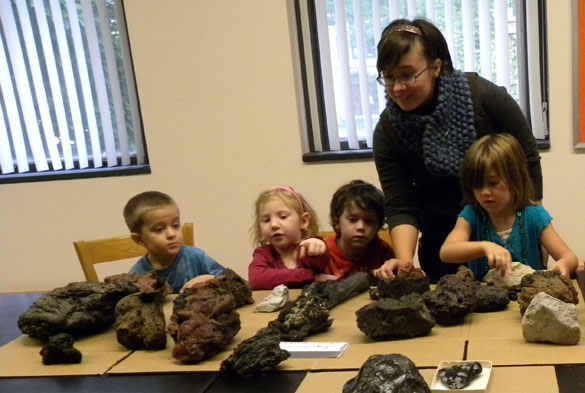
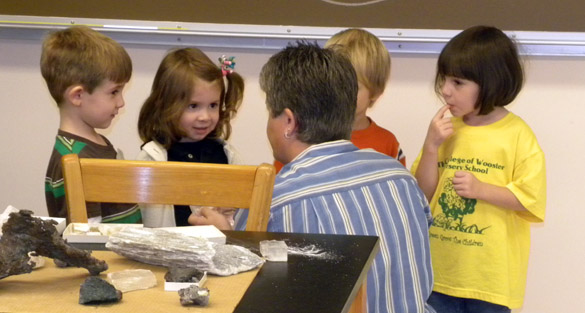
WOOSTER, OHIO–The Wooster Geologists have long had a special relationship with The College of Wooster Nursery School (where young children “actively construct their own knowledge of the world”). Every year our faculty and students talk to the children about rocks, fossils and dinosaurs. As you can imagine it is a most enjoyable — if a bit frantic — experience. For the past three years Professor Shelley Judge has been our primary faculty planner and organizer for these delightful events. Usually the kids walk up the hill from the nursery school about a block to Scovel Hall. There Shelley has exploration stations and, we hope, lots of college student volunteers to explain the materials.

Today the topic was simply “rocks”, and the children came to see and hold a variety of igneous, sedimentary and metamorphic samples. Shelley set it all up and we had two sessions of about 18 kids each march in line up to the lab. They went through the specimens enthusiastically, feeling which are the smoothest and which the roughest, how heavy some are compared to others, seeing the world through a crystal of calcite, and marveling at ancient giant shark teeth. They each got to try on a hardhat, look through a handlens, and wear safety googles (which they find oddly fun). Then they line up and march back to the nursery school, clearly having enjoyed the experience. As did we!

Kit Price ('13) showing some of our sedimentary rocks and fossils to the children.

Katharine Schleich ('12) explaining some extrusive igneous rocks.

Shelley Judge talking to some of the children about minerals. Notice how intently they listen to her. She has the touch!

Posted in Uncategorized | Tagged , | 2 Comments

A Midday Biology & Geology Field Trip

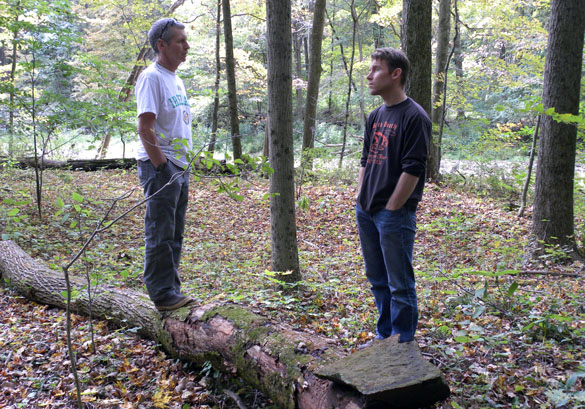
Geologist Greg Wiles and Biologist Rick Lehtinen in Spangler Park outside Wooster, Ohio.

WOOSTER, OHIO–Our colleague Rick Lehtinen in the Department of Biology had a great idea: how about a casual noon trip to the local Spangler Park to enjoy the plants, animals, rocks and streams? So Greg Wiles and I took him up on it and had a splendid couple of hours down in the gorge. We talked of ash trees, buried valleys, alluvial fans, salamanders and badgers. What an excellent break from grading!

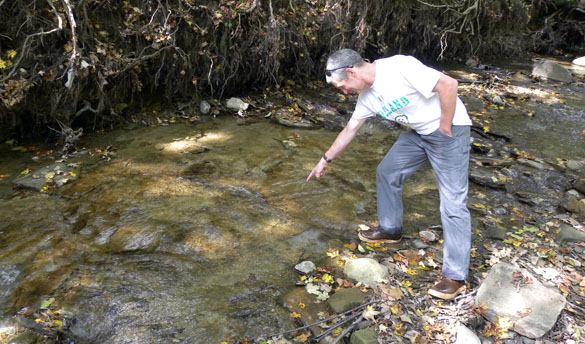
Dr. Wiles showing where the creek flow goes from supercritical to subcritical.

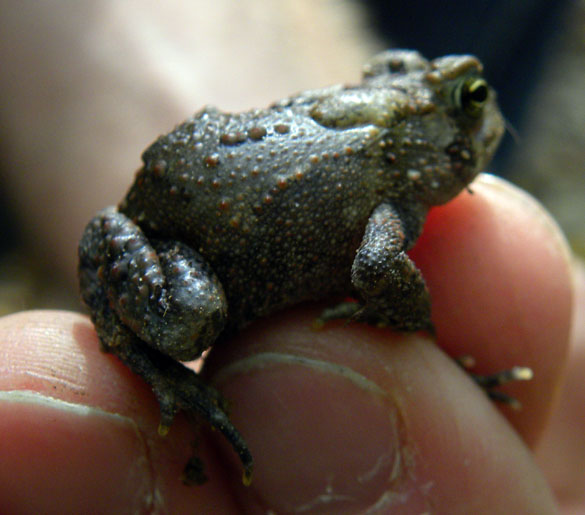
An American Toad found by Dr. Lehtinen.

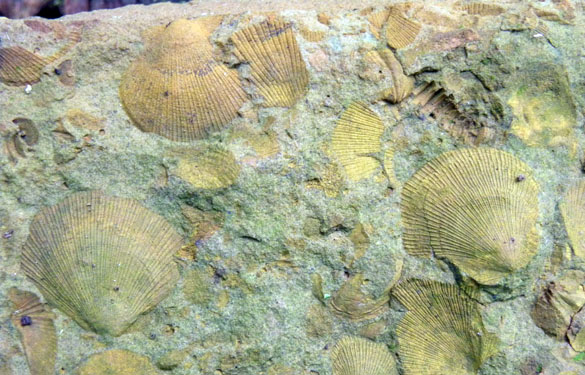
My contribution? An analysis of this beautiful set of bivalve, crinoid and brachiopod fossils from the Logan Formation (Mississippian).


Posted in Uncategorized | Tagged , , , , | 5 Comments

Wooster’s Fossil of the Week: a venerid bivalve (Upper Cretaceous of Jordan)

This summer I joined a team describing a shell bed in the Upper Cretaceous (lower Campanian, about 80 million years old) Wadi Umm Ghudran Formation exposed northeast of Amman, Jordan (at N 32° 09.241′, E 36° 12.960′, to be exact). I hope someday to visit Jordan, so this work may be my introduction.

The fossils are diverse, including oysters, corals, gastropods and a bivalve of the Family Veneridae shown above. I was struck by how similar this fossil is to its very common modern cousin Mercenaria mercenaria (shown below).

The modern clam shell above, by the way, was one dissected by Invertebrate Paleontology students last year.

These venerid clams are infaunal, meaning they live within the sediment. Thus when east-coasters go “clamming” on a beach they are digging up clams like this from the sand at low tide. They use short tubes (siphons) like watery snorkels to suck in seawater to be filtered through their gills for suspended food particles. Since they live in the sediment their shells are usually clean of encrusters or borers while alive. After death the shells are usually cycled up to the surface and then encrusted and bored as seen below. This is an interesting feature of the Jordanian fossil shell bed — some shells are articulated and clean as the shell at the top; others are disarticulated and heavily bored. Clearly some shells were buried alive and others died long before final internment.

Venerid bivalves are heterodonts, meaning they have “different teeth”. These are not teeth for eating but rather parts of the clam’s hinge structure that hold the valves together. The shapes and sizes of these teeth are used to sort these clams into genera and species. Again, as you can see below, the teeth of the Cretaceous clam are similar to those of the modern shell, but with enough differences to make them separate genera.

The Family Veneridae is entirely marine and includes over 500 living species, many of which are delicious, I’m told. The most common clam consumed in the USA is Mercenaria mercenaria, known as the hard clam or quahog. There are 55 extinct genera in this family, which appeared first in the Early Cretaceous (Cox et al., 1969; Canapa et al., 1996).

This rather plain and common fossil will be the key to deciphering the history of our shell bed in Jordan. Sometimes the most useful fossils are the least flashy.

References:

Canapa, A., Marota, I., Rollo, F. and Olmol, E. 1996. Phylogenetic analysis of Veneridae (Bivalvia): Comparison of molecular and palaeontological data. Journal of Molecular Evolution 43: 517-522.

Cox, L.R. et al. 1969. Treatise on Invertebrate Paleontology, pt. N, Bivalvia vol. 2. The Geological Society of America, Inc. and The University of Kansas.

Posted in Uncategorized | Tagged , , , | 2 Comments

Fossils in the Wild: Invertebrate Paleontology Field Trip

CAESAR CREEK LAKE, OHIO–The 2011 Invertebrate Paleontology class had a productive field trip on a beautiful Ohio day. Thunderstorms roamed the state, but we saw them only when we were comfortably on the bus.

We worked in the emergency spillway at Caesar Creek Lake in southwestern Ohio, roughly halfway between Cincinnati and Dayton. This site is maintained by the US Army Corps of Engineers as a fossil-collecting preserve. You obtain a free permit at the visitor center, agree to follow the rules, and extraordinary fossils await your picking. (Last time I was here it was very cold.)

The fossils are in the Arnheim, Waynesville, Liberty and Whitewater Formations of the Richmondian Stage in the Cincinnatian Series of the Ordovician System. These are shaly units with shell-rich limestones formed during storms. Brachiopods, bryozoans, crinoids, trilobites, clams, snails, nautiloids, corals — the whole Ordovician menagerie. Perfect for student collections and our later exercises.

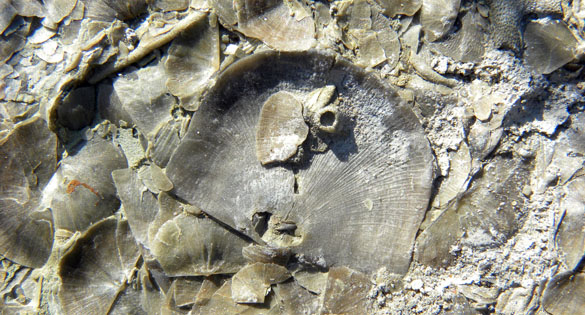
Brachiopod-rich storm layer in the Liberty Formation. Note the circular bryozoan attachment.

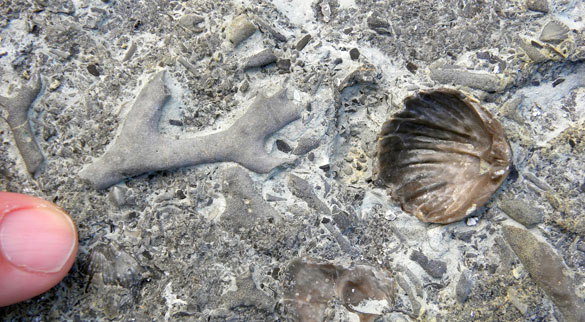
Bryozoan colony and brachiopod shell interior from the Waynesville Formation.

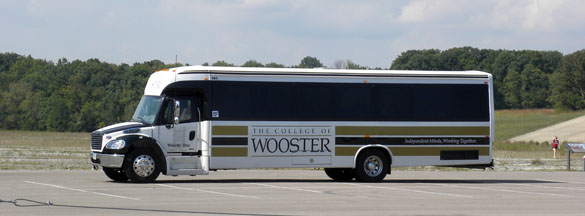
Our fancy bus. The design insures that the back seats are rather bouncy.

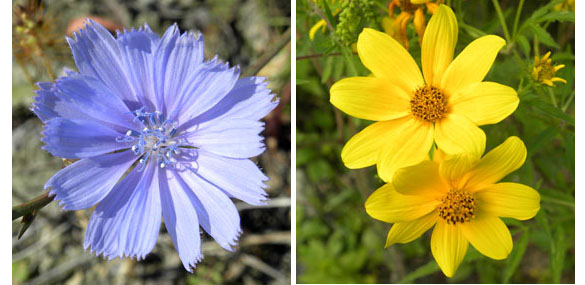
Last of the summer flower field photos! It was such a beautiful day.

Posted in Uncategorized | Tagged , , | 2 Comments

Wooster’s Fossil of the Week: A tabulate coral (Middle Devonian of New York)

This week’s specimen is from a group of fossils I gave my Invertebrate Paleontology students as “unknowns” to identify. Since it is their very first week of class I expected them to struggle, but many did remarkably well. (Congratulations to Lauren Vargo and Kit Price for correctly identifying it to the genus level, and to Lauren for hitting the species itself!)

Pleurodictyum americanum Roemer 1876 is pictured above with a view of its living surface. It is a tabulate coral belonging to the Family Favositidae, thus another type of “honeycomb coral” as we’ve discussed before on this blog. This particular species is notable because it is very common in the Middle Devonian of the northeastern United States (Pandolfi and Burke, 1989). Brian Bade collected this coral, along with hundreds of others, from the Kashong Shale exposed in Livingston County, New York. He generously donated it to the paleontological teaching and research collection at Wooster.

What is most interesting about these corals is that they are almost always found with an external mold of a elongate snail shell on the underside at their origin. The snail (more officially called a gastropod) is Palaeozygopleura hamiltoniae (Hall, 1860), and it is best known for its tight relationship with Pleurodictyum americanum. Brett and Cottrell (1982) published a detailed study of P. americanum and its associates, concluding that the coral preferred to encrust P. hamiltoniae shells but only when the snail itself was dead and gone and the shell was occupied by some other organism.
Pleurodictyum americanum underside showing an external mold of the gastropod Palaeozygopleura hamiltoniae.

Closer view of Palaeozygopleura hamiltoniae.

Pleurodictyum americanum was described by Carl Ferdinand von Roemer in 1876. Roemer was a German geologist (you probably guessed) who lived from 1818 to 1891 — a time interval encompassing some of the greatest changes in the Earth Sciences, from the primacy of Charles Lyell to the general acceptance of Darwinian evolution. Roemer was educated at Göttingen to be a lawyer, but in 1840 abandoned the legal profession for the much more exciting life of a geologist. He quickly obtained one of those new-fangled German PhD degrees in 1842 and set to work.
Roemer’s original 1876 drawings of Pleurodictyum americanum.

In 1845, Roemer traveled to the USA and studied the geology of Texas and other southern states. That must have been an adventure — the Battle of the Alamo was less than ten years before. It was during the American work that he began to describe Devonian fossils, including our coral species (Roemer, 1876). Roemer became a professor of geology, paleontology and mineralogy (another field in which he had significant accomplishments) at the Universty of Breslau, where he ended his career.

Carl Ferdinand von Roemer (1818 to 1891) at the University of Breslau (now the University of Wrocław in Poland).

References:

Brett, C.E. and Cottrell, J.F. 1982. Substrate specificity in the Devonian tabulate coral Pleurodictyum. Lethaia 15: 247-262.

Pandolfi, J.M. and Burke, C.D. 1989. Environmental distribution of colony growth form in the favositid Pleurodictyum americanum. Lethaia 22: 69–84.

Roemer, F. von. 1876. Lethaea geognostica: Handbuch der erdgeschichte mit Abbildungen der für die formationen bezeichnendsten Versteinerungen, I. Theil. Lethaea palaeozoica. E. Schweizerbartsche Verlagshandlung (E. Koch), Stuttgart, Germany.

Posted in Uncategorized | Tagged , , , | 6 Comments

Wooster Geologists begin the 2011-2012 school year

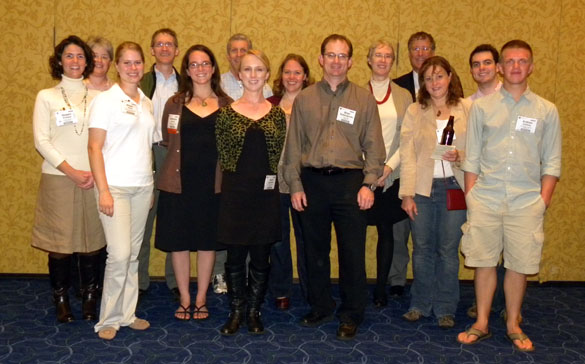
WOOSTER, OHIO–The cheerful group above is the Wooster Geology Club in our traditional start of the year group photograph. (The image was kindly taken by Danielle Reeder.) We are fewer than usual because an unprecedented number of our geology majors are overseas on off-campus adventures (seven juniors) and our beloved petrologist Meagen Pollock is on a semester research leave. An addition to our crew this year is the man in the upper left with a beard. He is Matt Curren, our new geological technician.

Here you can see happy students in the 8:00 a.m. Invertebrate Paleontology course enjoying their first taste of taxonomic rules and the problem of species. Or maybe they’re grinning because they just learned there is not a quiz this morning?

There are two significant changes in Scovel Hall for this year. We have a new X-Ray Laboratory under the supervision of Dr. Pollock, complete with a “clean room” for wet chemistry. (I know what the alumni are thinking: A clean room in Scovel? But yes, it really is!) We also have fancy new (and wonderfully silent) computer projection systems in our classrooms, as seen below. We are now very far beyond those old 35 mm slide projectors I grew up with.

Our courses have detailed webpages that you are encouraged to visit. You may also want to see our list of Geology Club events, including Independent Study presentations and outside speakers. Finally, you can follow this link to pdf versions of our annual reports, including our report for this past year and summer (see cover below). Patrice Reeder works very hard to produce these high quality documents.

It is going to be another eventful year for the Wooster Geologists. We again thank the generations that have gone before us to build this department, and the alumni and friends who support us so faithfully.

Posted in Uncategorized | Tagged , | 5 Comments

Wooster’s Fossil of the Week: A trilobite hypostome (Upper Ordovician of southern Ohio)

We had a familiar trilobite last week, so this week we’ll look at a poorly-known part of a trilobite: the hypostome. Above is an incomplete forked, conterminant hypostome of the large trilobite Isotelus. (Isotelus, by the way, is the state fossil of Ohio. Do you know your state fossil?)

Hypostome means “under mouth”. On trilobites it is found underneath the cephalon (head) near what we think was the mouth. They are not common in the fossil record. It is obvious from their color and composition that they are part of a trilobite, but most people don’t know about this little plate on the otherwise soft underside (the ventral side) of the animal. The hypostome is important in some new taxonomic schemes for sorting out the trilobites (Fortey, 1990), and they are useful for interpreting a particular trilobite’s feeding habits (Fortey and Owens, 1999).
Trilobite hypostome forms from Wikipedia (via Obsidian Soul). The small green plates are the hypostomes seen against the gray cephalon above. A – Natant: Hypostome not attached to doublure; aligned with front edge of glabella (shown in red broken lines). B – Conterminant: Hypostome attached to rostral plate of doublure. Aligned with front edge of glabella. C – Impendent: Hypostome attached to rostral plate but not aligned with glabella.

The hypostome of Isotelus is attached to the anterior edge of the skeleton (thus “conterminant”) and has two distally-directed prongs (making it “forked”). Hegna (2010) has recently suggested this hypostome with its unusual shape and terraced outer structure may have been used for grinding food rather than serrating it. Turns out our hypostome has a unique form among the common trilobites!

References:

Fortey, R.A. 1990. Ontogeny, hypostome attachment and trilobite classification. Journal of Paleontology 33: 529-576.

Fortey, R.A. and Owens, R.M. 1999. Feeding habits in trilobites. Palaeontology 42: 429–65.

Hegna, T.A. 2010. The function of forks: Isotelus-type hypostomes and trilobite feeding. Lethaia 43: 411-419.

Posted in Uncategorized | Tagged , , , | Leave a comment

Field-based Teaching in Northeastern Minnesota

NORTHEASTERN MINNESOTA – As part of the Cutting Edge workshop on Teaching Mineralogy, Petrology, and Geochemistry, I had the opportunity to participate in a field trip to the Midcontinent Rift System in northeastern Minnesota. You can imagine how exciting this was to an Ohio-based (outcrop-deprived) petrologist! Here’s a quick tour of some of the spectacular stops on the trip:

Keweenawan diabase dike intruding slates and greywackes of the Thomson Formation.

Layering in the Lower Troctolite Zone of the Duluth Complex.

Folding in Archean greywackes of the Lake Vermilion Formation.


Multiple generations of folding in the Soudan-type Banded Iron Formation.

Basaltic pillow in the Ely Greenstone with exquisitely preserved glassy textures in the hyaloclastite rims.

Lichen-covered columnar joints in basalt flows of the North Shore Volcanic Group.

A large plagioclase crystal (showing striations) from an anorthosite xenolith.

Learning about the fantastic geology of northeastern Minnesota was only one of our primary goals. The other was to discuss strategies for field-based teaching and learning. There are countless reasons for bringing our students to the field, including two that I consider most important: (1) the field challenges students to exercise their higher-order critical thinking skills (making observations and dealing with complexity); and (2) the field inspires students to learn and be curious of the natural world. The field trip provided an opportunity for “a collection of North America’s greatest geoscience educators”* to share effective teaching ideas for helping students achieve these goals. I’ve compiled a short list of useful tips that I took away from the trip:

  • Enhance the social learning environment – Encourage students to learn something about each other by asking them to line up in order of first name or longitude of their place of birth. Establishing a community enhances peer-to-peer learning, which is a powerful instructional practice in the field.
  • Set and assess goals – For every field trip (and every stop), set specific learning goals, then ask How do we accomplish these goals? How do we know we’ve accomplished these goals? Learning goals and teaching activities will vary with audience and setting. Consider the following example: the learning goal of one particular field trip stop was to observe and describe volcanic features of an outcrop of mafic metavolcanic flows. For the activity, we were provided with an outline of the outcrop and asked to map the distribution of volcanic features from one end to the other. At the end, we compared maps and discussed similarities and differences. The conversation helped us describe the volcanic features we used to define the different units and to determine the stratigraphic “up” direction.
  • Connect the classroom to the field – We’ve all held large maps against the vans to use as visual aids when explaining the geologic setting, but why not laminate poster-sized photomicrographs or phase diagrams to enhance the discussion? By directly applying field observations to concepts they’ve learned in class, students will learn to transfer content knowledge to different settings.
  • Don’t neglect the affective domain – An honorable learning goal is to inspire a sense of awe in students. We certainly had several stops that were breathtakingly beautiful and “reminded all of us why we love geology.” I’m sure most of us can recall a particular field experience that motivated us to pursue geology as a major. Sometimes, it’s the “fun” stops that have the greatest impact.
  • Technology can enhance student learning – One person suggested recording podcasts that students could listen to in the vans between field trip stops. Another person mentioned that smartphones or iPads could be used to take and annotate images of outcrops, which can be loaded onto a wiki later for a collaborative learning project. (The idea probably works equally well for paper photos). On the field trip, we used a portable XRF to measure and compare the compositions of different rock units.


The BIF was one of the stunning outcrops where the field trip leaders allowed us to be excited and explore before trying to discuss the geology.


Geologists and their toys: playing with the pXRF.

If you have ideas for effective field-based teaching practices or would like to share your experiences, please comment!

*Directly quoted response from field trip leader J. Goodge when a passer-by asked “What is this?”

Posted in Uncategorized | Tagged , , , , , , | 7 Comments