


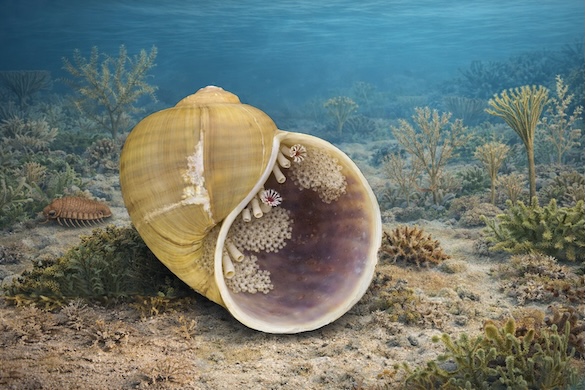
 My Estonian friend and colleague Olev Vinn led a team reviewing the ecological innovation of organisms encrusting the interiors of mollusk shells in the Ordovician. It is yet another example of the extraordinary diversification of marine organisms in this period. The image above is a reconstruction of bryozoans and cornulitids in an empty snail shell on an Ordovician seafloor. Our paper is just out as early access in Scientific Reports (Vinn et al., 2026).
Abstract:
In all modern seas, empty mollusc shell interiors are often heavily encrusted by cryptic invertebrates, whereas globally in the Cambrian, all shell interiors of molluscs and other invertebrates remained free of encrustation, though cryptic organisms themselves occurred in other types of cavities. The colonization of cryptic surfaces within empty shells constitutes a global event and an important ecological innovation in Ordovician benthic marine ecosystems, marking the beginning of a new ecological niche. The earliest colonization in mollusc shells by cryptic invertebrates occurred in the Middle Ordovician, while heavily encrusted shell interiors are known since the Late Ordovician. The taxonomic composition of Ordovician cryptic communities in gastropod, bivalve, and nautiloid shells is generally similar, though substrate architecture influenced encruster abundance and body size rather than overall community structure. The major expansion of cryptic ecological niches occurred during the Ordovician biodiversification, driven by the increase in predation pressure, the diversification of encrusting organisms, and a general increase in the size of mollusc shells.
Reference:
Vinn, O., Wilson, M.A., Tinn, O., Lang, L., Isakar, M. and Toom, U. 2026. Colonization of empty shells by cryptic fauna: a global event and important ecological innovation in Ordovician benthic ecosystems. Scientific Reports (early access); https://doi.org/10.1038/s41598-026-62638-5.
