Sunday at the University of Tartu Natural History Museum — this time as tourists

Tartu, Estonia — Bill Ausich and I returned to the Natural History Museum today to tour the public exhibits. It was hard to not make it into a study trip, though, for our research. I suppose since our “work” is so enjoyable it is difficult to separate it from a holiday. Above, for example, is a display of our favorite rhombiferan, Echinosphaerites aurantium of the Estonian Upper Ordovician.

There is a display about the Kalana Lagerstätte that we are studying.

Here is the museum description of the Lagerstätte.

And a close-up of some crinoids (“meriliilia”, sea lilies) from the Kalana.

It is a fun museum with a very thorough geology section, including meteorites you can touch (a favorite of mine). It has what is now an old-fashioned style of emphasizing actual specimens that Bill and I appreciated. There is a large biology section with much taxidermy and mounted skeletons. One of the featured exhibits is a rare “rat king” (see below), which you must look up!

Posted in Uncategorized | Tagged , , , , | Leave a comment

Saturday at the Estonian National Museum (plus a street festival)

Tartu, Estonia — This morning Bill Ausich and I walked to the new Estonian National Museum, shown above. It has a most unusual elongated building constructed on an abandoned secret Soviet airbase for bombers (Raadi Airfield). It follows an old runway with the revetments still in place. It is striking.

Parts of the Soviet base are still preserved, including these concrete fence posts.

This is an old Soviet air force garage on the way to the museum. This base was so secret that the entire city of Tartu was closed to foreigners. Now Bill and I stroll the grounds. We did the same in a once-secret Soviet missile base on Saaremaa.

The front entrance of the Estonian National Museum.

I don’t have a lot to show you in the museum itself, since it is mostly about fold and cultural history (which was fascinating). Bill and I appreciated the digital signs. They appear first in Estonian, like this one. We were issued special language cards, though.

When we pass the “English” card across the sensor, the text is instantly translated! Very clever.

Across the road from the museum is an upside-down house. It is apparently quite the tourist attraction, but we passed.

Back in the city center, in fact in front of our hotel, was a street festival. It had live music, fantastic food, and large, happy crowds.

There were lots of fried fish stands, with fish from the local lakes and the Baltic.

Here is Bill waiting for a meal. Impressively, by 10 pm the festival was over, and the streets completely clear the next morning. This is a very efficient, sensible country!

Posted in Uncategorized | Tagged , | 2 Comments

Back to work in the University of Tartu Geology Department

Tartu, Estonia — Today Bill Ausich and I returned to the geology lab on the university campus to continue our work on the Kalana Lagerstätte crinoids. There is Bill above working on specimens.

I spent most of the day working with this beautiful Leica photomicroscope (model S9i). It is the most intuitive photomicroscope I have ever seen. The images are superb. I want.

Here I am at the microphotography station, looking wistfully outside.

We don’t have anything new to report today, so here’s an image of one of the best Kalana crinoids.

This is my favorite specimen because it is squashed in a way that separated the calyx plates to make them easier to see.

The calyx is on the left side of this specimen. The pinnules from the arms are preserved so well here they look like hair. Note the small angular fossil just below the crinoid on the right. These are common in the Lagerstätte, often appearing to be attached to crinoids. We think they may be green algae, possibly like the modern Hydrodictyon but marine — and with larger cells. Another mystery in this fossil assemblage.

We’ve now completed a week in Tartu. The Kalana crinoid project has gone especially well. Thank you to graduate student Viirika Mastik who collected most of the Kalana crinoids, and to her supervisor Oive Tinn. They have helped us immensely in the lab.

Posted in Uncategorized | Tagged , , | Leave a comment

Starting work in the University of Tartu Natural History Museum

Tartu, Estonia — Today Bill Ausich and I began our work in the University of Tartu Natural History Museum. Our most knowledgeable and helpful host is chief geology curator Mare Isakar. This museum is just a short walk from our hotel.

This is one of the collections rooms in the paleontological research part of the museum. Here is where I examined Ordovician bivalves and gastropods for bryoimmurations.

One of our goals is to study encrusters on specimens of the nearly spherical Late Ordovician rhombiferan echinoderm Echinosphaerites aurantium. Mare Isakar kindly set out dozens of specimens for us to study, a small subset of which is shown above.

Here is Bill at work scanning through a drawer of Echinosphaerites.

One of the encrusted Echinosphaerites skeletons. The black, branching, carbonaceous encruster is the graptolite Thallograptus sphaericola (“sphere-dweller”).

Posted in the museum is this figure by Öpik (1925) showing his idea of an Echinosphaerites community with encrusting graptolites. We want to test his hypothesis that the graptolites encrusted living rhombiferans as shown. My hypothesis is that the graptolites lived instead on dead, cemented skeletons. Armin Aleksander Öpik (1898-1983) was a prominent and productive Estonian paleontologist. Like many Estonian scientists of his generation, his career was bifurcated by World War II.

Several characters from Estonia’s scientific past watched us work. This is Constantin Grewingk (1819-1887). Ohio paleontologists will recognize him as the namesake of the rugose coral Grewingkia.

Here is Friedrich Schmidt (132-1908), considered the founder of Estonian geology. Both Grewingk and Schmidt were Baltic Germans.

The public part of the museum includes this exhibit on “Secrets of Ancient Sea”. You may recognize some familiar Ordovician characters in this scene. Bill and I intend to visit the public exhibits here on Sunday.

Thank you again to Mare Isakar for setting us up so efficiently for our research!

Posted in Uncategorized | Tagged , , , | Leave a comment

Back to the paleontology lab in Tartu, Estonia

Tartu, Estonia — Disconcertingly it says “chemistry”, but there really is a geology department inside this building on the University of Tartu campus.

The Geology Department is part of the Institute of Ecology and Earth Sciences. We are very impressed with their facilities and friendly academics.

Here again is the lab room loaned to us for our stay. Bill is working in the back. The crinoid-rich specimens from the Kalana Lagerstätte at the Kalana Quarry (Silurian, Llandovery, Aeronian) are spread out through the room. We are very fortunate to have such space.

This is my workstation with my trusty laptop. The Leica microscope is fantastic.

We are examining the crinoids preserved on this dolomicritic limestone slabs that were carefully collected by university staff from Kalana Quarry in central Estonia. The crinoids are quickly apparent because their beautiful hair-like pinnulate arms are visible.

I’ll write more paleontological details later, but here is the part-counterpart of the best specimen of what will be a new crinoid taxon. From the bottom is the cylindrical stem, followed upwards by the conical calyx, and then the long arms with thin extensions called pinnules. You can also see some black smears of carbonaceous material on the right. These specimens are compressed and mostly decalcified. Their preservation is still a bit mysterious to us.

This is why we’re here so far from home!

Here is an image of the Kalana Quarry, where the Lagerstätte is found, from this wonderful Estonian geology website.

Posted in Uncategorized | Tagged , , | Leave a comment

Fieldwork in Estonia, with a bonus visit to Narva

Tartu, Estonia — Today Bill and I had a spectacular geology and culture field trip in northeastern Estonia. As you can see in the images, the weather was excellent, if a little warm. Our Estonian hosts took us from Tartu to several places north and east to the border with Russia. Our fieldwork in an oil shale quarry is shown above, but first our journey there —

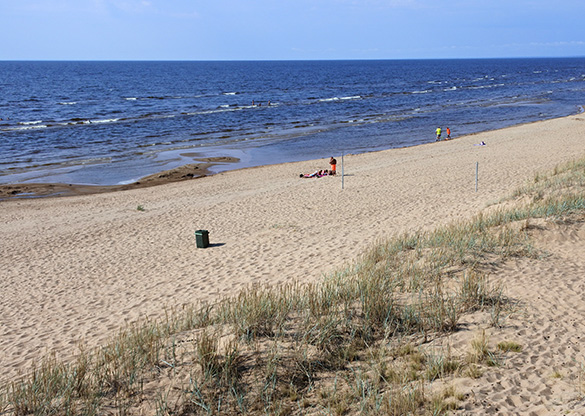
Lake Peipsi (or Lake Peipus) is near Tartu. It is one of the largest freshwater lakes in Europe, with the Russian border running down its center. We stopped briefly for this view. It looks like one of North America’s Great Lakes from here. There is much history along these shores.

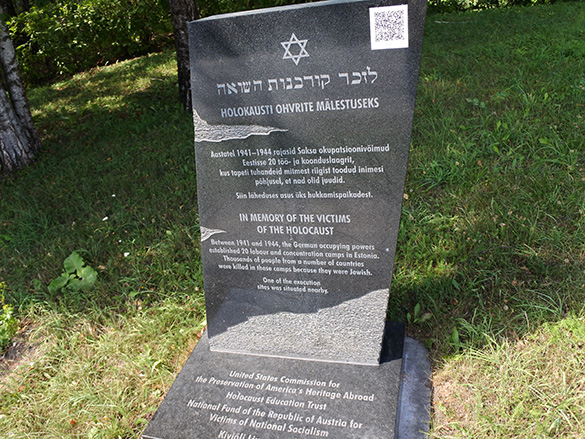
This is the Kiviõli Concentration Camp Holocaust Memorial near our collecting site today. The 20th century history of this region, especially during World War II, is notably grim and brutal. Relatively little has been published on the German concentration camps in Estonia.

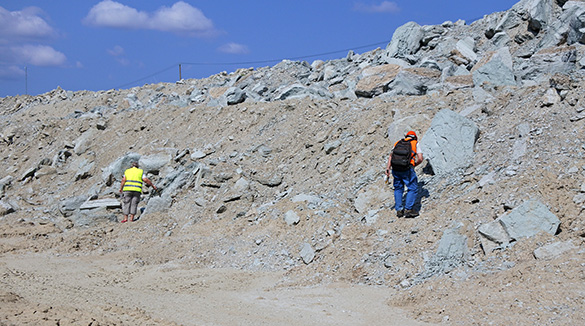
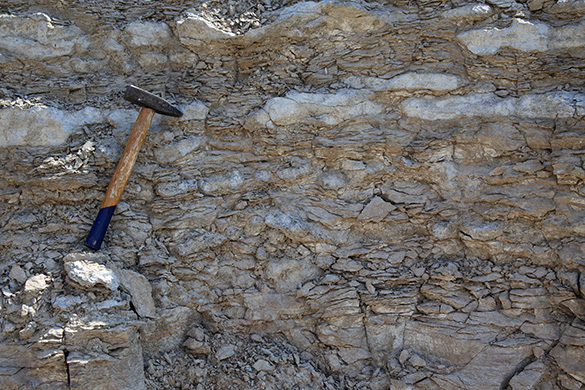
This is the oil shale mine we visited near Põhja-Kiviõli in northern Estonia. The oil shales, in the form of kukersite, are the brown units in the top half of the outcrop. The shales are dug from these pits and then separated from the limestones, which appear light gray. The pits fill quickly with water, so there are massive pumps continually working nearby.

A closer view of an oil shale outcrop. These units are Late Ordovician in age (Sandbian) and nearly unique to Estonia. They are very rich in organic material — up to 55% of the rock. The oil shales are used in a variety of ways for energy and petroleum products.

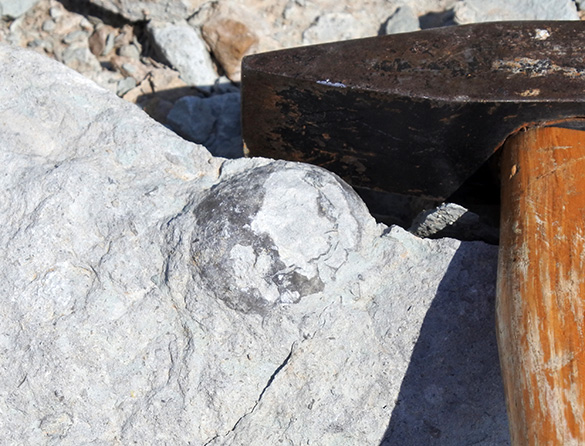
Finding specimens of the spherical rhombiferan echinoderm Echinosphaerites was one of our goals for this trip. Here is one in limestone. The best are those that are in the oil shale because they pop free of the matrix. We didn’t find very many, though.

Giant bryozoans were surprisingly common in the oil shales. This is the base of a large trepostome. We found many of these bryozoans with beautiful borings. It was a good collecting site.

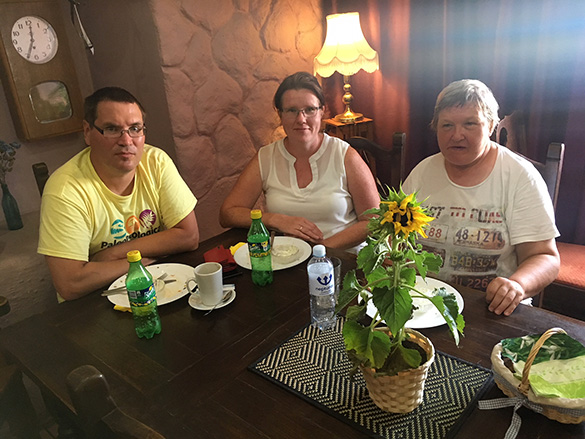
Here are our delightful Estonian hosts at lunch following fieldwork. From left to right: Olev Vinn (a colleague since 2006), Ingrid Vinn, and Mare Isakar.

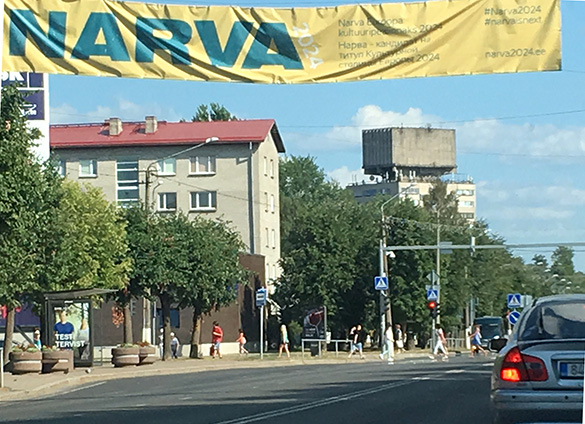
Much to our surprise we were able to go to the storied easternmost Estonian city of Narva. This was very much a treat. Narva sits along the Narva River, which is the border with Russia. The city has a high concentration of Russian-speakers and a distinct Estonian-Russian culture. Its history has been, needless to say, complex even to present times.

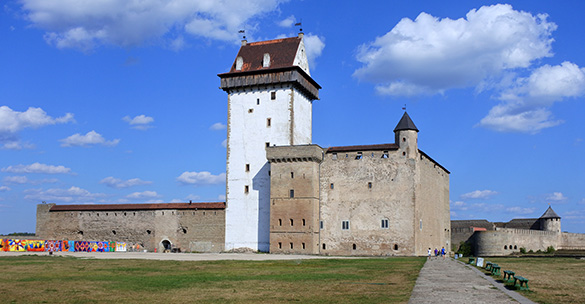
This is Hermann Castle, also called Narva Castle, the focus of our visit. Hermann Castle is the blocky, high structure. To the right is visible another castle on the other side of the Narva River (see below).

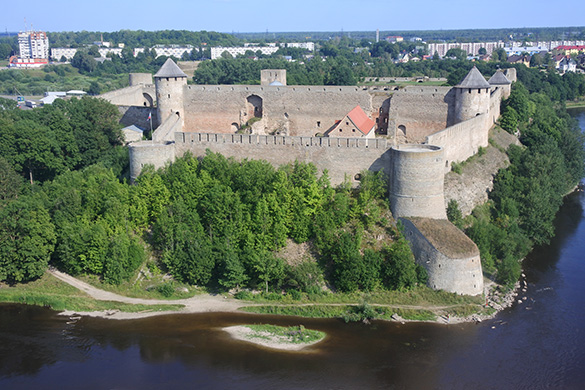
This is that Russian castle opposite the Hermann Castle on the castle on the other bank of the Narva River. It is the Ivangorod Fortress. It makes for quite a striking boundary at the western edge of Russia.

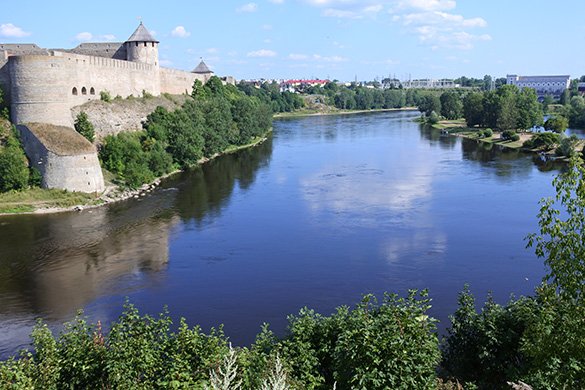
The Narva River between the two castles, looking upstream. The Ivangorod Fortress is on the left. This is effectively the boundary between East and West in Europe.

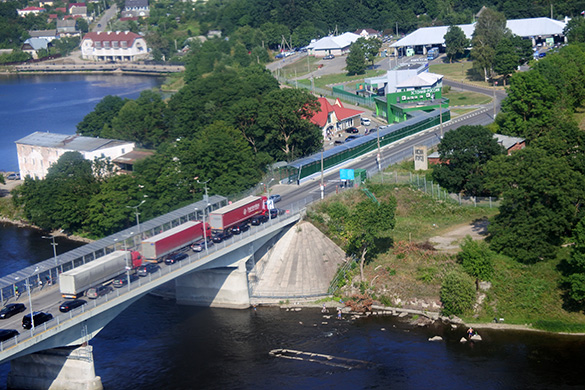
The Narva border crossing bridge between Estonia on the left and Russia on the right. This is the view from the top of the Hermann Castle. At this point my phone gave me a message: “Welcome to the Russian Federation”.

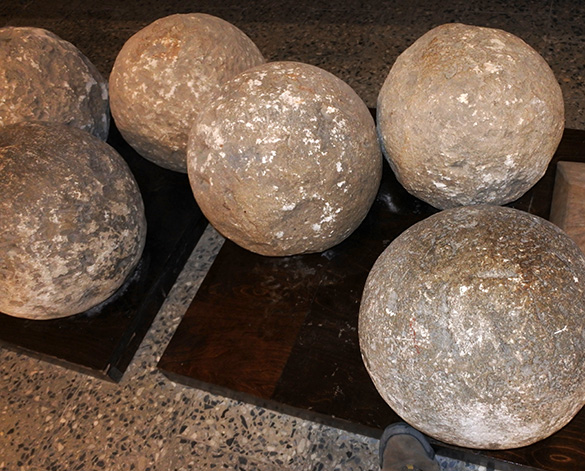
The interior of the Hermann Castle is a museum. I thought these stone cannon balls were geologically interesting, considering that earlier this summer I saw their equivalents in Wales. Note my foot for scale.

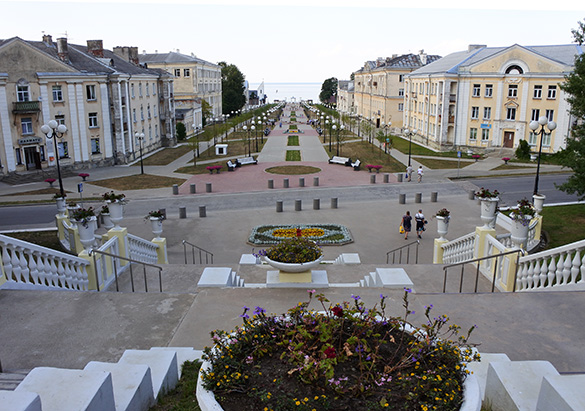
On the way back to Tartu, we visited the town of Sillamäe on the Baltic coast. During Soviet times factories in Sillamäe extracted uranium oxides from local oil shales and then from other ores mined throughout the Soviet Empire. Because of the high concentration of scientists and engineers, this town was built with, shall we say, higher architectural and aesthetic standards than the usual Soviet constructions. It was a “closed town” forbidden to foreigners or even most Estonians.

This is a 1987 statue in Sillimäe celebrating its atomic achievements. By then this town produced almost 100,000 tons of uranium oxides for Soviet nuclear weapons and energy plants. It all stopped in 1989, and when Estonia reclaimed the area two years later there were serious contamination problems to solve. [Update: Cheryl Rofer, Los Alamos National Laboratory (retired), added a comment and a link to her story about the clean-up: Averting a Baltic Sea Disaster. It is an excellent read!)

What a rich trip this was. Thank you again to Olev, Ingrid and Mare.

Posted in Uncategorized | Tagged , , , , | 4 Comments

Starting work in Estonia

Tartu, Estonia — Ah, fossils at last! Bill Ausich and I are here to explore several topics, but the main one is describing the crinoids in a Silurian (Aeronian) Konservat Lagerstätte at Kalana Quarry in central Estonia. Much more on this later, but above is one of the crinoids, from the stem to the calyx to the pinnulate arms. The preservation is very odd, with most of the original calcite dissolved away and considerable carbonization and, maybe, some recrystallization. (Much of the list of preservation modes we teach!)

We’re working in a beautiful teaching lab at the University of Tartu. We have plenty of space to lay out the specimens collected by the geologists here. (These particular quarry beds are no longer accessible.) The microscopes are new and the best student models I’ve seen.

Today was mostly orientation for us in the lab. After dinner we walked down to the Emajõgi River, which runs through the campus and has been very important in Estonian history. Its name means “Mother River”. Beautiful.

Posted in Uncategorized | Tagged , , | Leave a comment

First full day in Estonia for the intrepid paleontologists

Tartu, Estonia– Bill Ausich and I arrived exhausted but safely in this old university city last evening. Fortunately we had this gorgeous Sunday to recover and adjust to the seven-hour time difference. We explored the neighborhood around our hotel (“V-Spa Hotell”). This is the city hall building. We had dinner under the umbrellas. It is hot here, with “extreme high temperature” warnings and forest fires to the north.

This statue memorializes the Estonian War of Independence from the Russian Empire (and soon to be Soviet Union) in 1918-1920. If you follow the link you’ll see how complicated these events were. This year Estonia is celebrating a century since it declared independence. Tragically, it has had less than fifty years of actual independence because of Soviet, then German, then Soviet successive occupations.

Posted in Uncategorized | Tagged , | Leave a comment

Concluding 2018 summer research in the Tree Ring Lab

Summer 2018 research in the Tree Ring Lab has come to a close. The group of five students worked on a variety of projects, learning about the climate and history of Ohio and Alaska, and the application of different dendrochronological techniques and statistical analyses. They also gained experience effectively conveying their research to others and writing official reports of their findings.

The summer research team on their last day working together (Left to right: Greg Wiles, Nick Wiesenberg, Victoria Race ’19, Juwan Shabazz ’19, Kendra Devereux ’21, Josh Charlton ’19, and Alexis Lanier ’20).

AMRE students with a sampled oak tree at Brown’s Lake Bog in Wooster, Ohio (Alexis Lanier ’20, Juwan Shabazz ’19, and Kendra Devereux ’21).

The AMRE team accomplished a lot during the eight weeks they were here on campus. Their research started with the principles of dendrochronology, when they learned how to count individual tree rings and measure their widths under the microscopes. From here, the team learned how to run this data in different programs like COFECHA and ARSTAN. This process allowed them to date many historical structures across Northeast Ohio such as Gingery Barn and Miller House and Barn. You can find a full list on the TRL’s reports page.

AMRE students with Nick Wiesenberg collecting samples from historical structures at Sonnenberg Village in Kidron, Ohio.

Alexis and Kendra visiting one of the historical structures at Sonnenberg Village.

The AMRE students also learned how to take these chronologies and make hypotheses regarding past climate by uploading the data to Climate Explorer and running various correlations with other datasets.

We were fortunate enough to go out in the field and personally collect most of the data that we worked with this summer. These eventful trips included a lot of tree coring and required lots of bug spray. Some of the AMRE group’s favorites trips included Stebbin’s Gulch and Brown’s Lake Bog.

Stebbin’s Gulch at the Holden Arboretum (Left to right: Josh Charlton ’19, Juwan Shabazz ’19, Alexis Lanier ’20, Kendra Devereux ’21, and Dr. Wiles).

Juwan with the machete, ready to clear a path for the rest of the team at Brown’s Lake Bog.

Lining up to cross the moat at Brown’s Lake Bog after a weekend of strong thunderstorms.

Kendra Devereux ’21 with the sample bag at Barnes Preserve in Wayne County.

Josh Charlton ’19 coring a tree at Stebbin’s Gulch in the Holden Arboretum.

The other two summer researchers working in the Tree Ring Lab this summer, seniors Victoria Race and Josh Charlton, have been working with tree ring data collected from Alaska. Their work focuses on the modeling of Columbia Glacier located in Prince William Sound, Alaska. They are currently working on an abstract to submit to the upcoming GSA conference this fall. Stay tuned for more information regarding their project!

AMRE students with Victoria Race ’19 and Arrow at Brown’s Lake Bog.

Special thanks to the National Science Foundation, the Sherman Fairchild Foundation and the AMRE program for helping to make this research possible. Enjoy the rest of your summer!

Posted in Uncategorized | Tagged , , , , , , , , , , , , , , , , , , , , | 1 Comment

Wooster and Ohio State paleontologists return to Estonia

Bill Ausich (Ohio State University Academy Professor) and I begin a long journey today from Ohio to the delightful nation of Estonia. (I’ve posted a map above in case you’ve forgotten the location of this Baltic country.) We were last in Estonia in the cool summer of 2012, where we had a fantastic combined team of Wooster and OSU students. This time it is just Bill and me with a variety of research goals.

Here is the renowned Professor Ausich as we wait for a transatlantic flight in Newark, New Jersey. (I think he looks like Teddy Roosevelt.) Our first stop is Stockholm, Sweden, and then a flight to Tallinn, Estonia. From there we will take a bus to Tartu, Estonia.

Off we go. More posts later!

Posted in Uncategorized | Tagged | Leave a comment