The Miracle of Wireless

Somehow I stumbled upon a wireless connection in my Moscow hotel room this morning. I shall post quickly before it vanishes. It disappears now and then, but I’ve thus far been able to retrieve it.

First, a couple of images from my recent neighborhood:
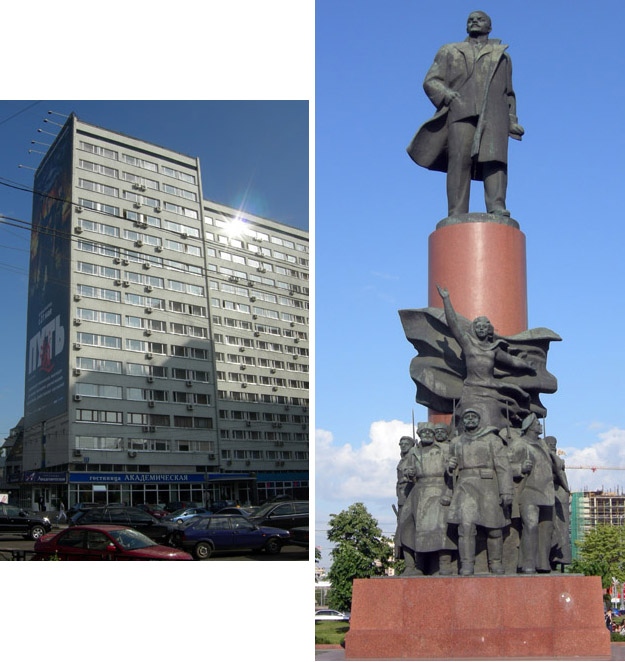
My hotel on the left.  On the right is some statuary they forgot to knock down.

My hotel on the left. On the right is some statuary they forgot to knock down.

Yesterday afternoon I arrived in the airport and met my new friend Andrei Dronov from the Russian Academy of Sciences. It was a bit of a trick because he sent me a photo of his face for me to recognize and I learned quickly that there are many Russian faces like his at the airport! But I found him and we set off for the city center. Riding the Metro was an adventure in itself. It was like being shut up in a rocket and blasted into the darkness, although maybe a bit faster and noisier. It all worked out, though, even while schlepping 57 pounds of equipment.

The tiny bit of Moscow I’ve seen in the last few hours is very much like any megacity, save for the Cyrillic signs. The traffic is extraordinary, and the noise from it lasts through the night. There is plenty of food available from stalls on the streetsides. The blocky Stalinist buildings (like my hotel) are relieved by the occasional pre-Revolution stonework and the bright golden-domed churches. There is a streetcar system just outside my room which looks ancient, but it is fast and apparently efficient.

This evening I go with Andrei by train to St. Petersburg and then the Volkhov region to the southeast of the city. He describes our lodgings there as a “field camp”. It is an unfinished house taken over by geologists because of its prime position on a famous Ordovician outcrop. I doubt very much I will be posting through wireless from there!

My goal on this trip is to explore the Lower Ordovician hardgrounds and fossils to test some hypotheses I’ve developed over the years in other regions.  These Russian rocks are among the best exposed earliest Ordovician in the world.  I also want to see how feasible it will be to bring Independent Study students to these sites.

Posted in Uncategorized | Tagged , | Leave a comment

Wooster Geologist in Russia

My first day in Russia.  I’m in Moscow hotel lobby with only this cranky connection to the Internet, but I’m here.  Tomorrow I leave with my colleague Andrei Dronov for work in the St. Petersburg region on the Lower Ordovician.

I wish I could post some of my great photos of Moscow, but they willl have to come later.  I’ve already had adventures in the Metro and buying food.  All is well.  The geology will come when I can connect my computer to the Internet — which may not be for two weeks!

Posted in Uncategorized | Tagged , | 7 Comments

Urban Dinosaurs

My last geological fieldwork (if we can call it that) in Israel on this trip was to examine the Upper Cretaceous limestones and dolomites exposed in Jerusalem. I far prefer my rocks be found in pristine wilderness areas with only bird songs in the background, but the right rocks, of course, can be anywhere. Sometimes, then, we have to work with traffic zooming by, sirens wailing, blasts of car exhaust, and schoolchildren offering to hammer the rocks for us.

The coolest location was in the moshav of Beit Zeit, just five minutes from downtown Jerusalem. (A moshav is a type of cooperative agricultural community, although in this case heavily urbanized.) A beautiful trackway of ornithomimosaur dinosaur footprints is exposed on a bedding plane of Lower Cenomanian limestone.

combinedbeitzeit052709

The site is of great importance because thus far these are the only dinosaur tracks known in the entire Middle East. The local community purchased the land and erected a protective roof over the trackways. They had a mural painted showing what the area may have looked like in the Cretaceous, installed a custom-made life-size dinosaur model on the bedding plane, and made the area into an educational park. You can see for yourself what happened later. The surrounding fence was too low, so it became a drug hangout, vandals spray-painted the mural and then broke the dinosaur into bits. (The crater where the dinosaur stood is just visible in the photo.)  This natural wonder was simply too accessible to the public.  There are plans to protect the site more thoroughly, and then reconstruct the displays.

I was able to collect a small piece of the limestone bedding plane for analysis back in Wooster. My hypothesis is that the limestone is a marine hardground which cemented very soon after the dinosaurs waded across it, thereby preserving the prints. A thin-section of the rock may show if it had these early cements.

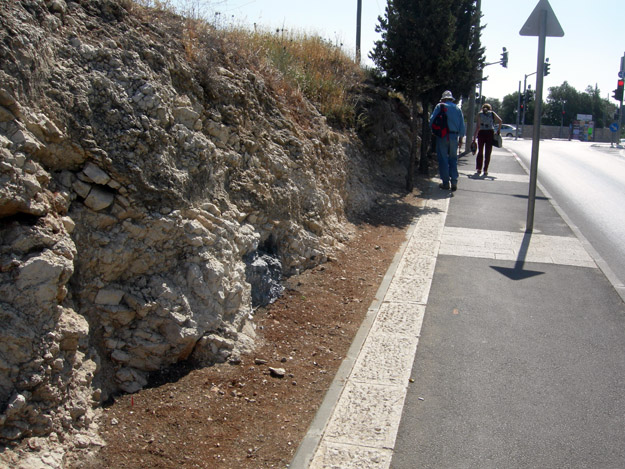
The rest of our urban geological work was on the streets of Jerusalem. Rocky outcrops are common because the city is built on several steep hills which have been quarried for thousands of years. We were able to correct the geological map in some places because of new exposures, and I gathered several ideas for future projects.

Mizzi hilu ("sweet rock"), a lithographic biomicrite member of the Judea Group (Turonian).

Mizzi hilu ("sweet rock"), a lithographic biomicrite member of the Judea Group (Turonian).

Posted in Uncategorized | Tagged , , , , , , | 2 Comments

The Drawbacks of Working in the Golan Heights

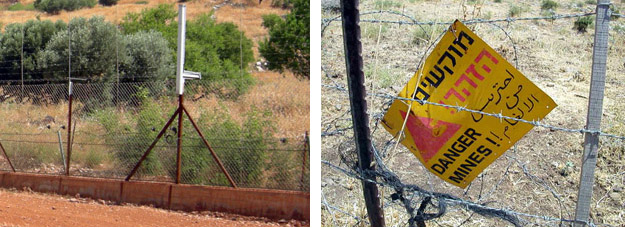
combined052609Today we could visit only one Jurassic site in the Golan. The others were in a militarily sensitive area to which we were not admitted, even after a long conversation with the commanding officer and classic geological special pleading. (“But our American guest, a famous geologist, has come thousands of miles just for these important rocks!”)

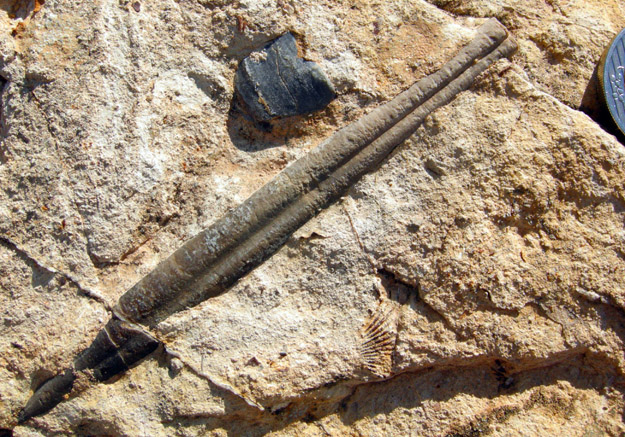
So, the fossil of the day will be a Jurassic belemnite from the top bed of the Zohar Formation. These are among the simplest of fossils (basically a calcite dart) but they are remnants of sophisticated cephalopods which are relatives of the modern squid. The fossil belemnite “guard” acted as a stiffening and weighting device inside the soft body.

Belemnite from the Jurassic Zohar Formation.  Note sliver of coin on the right for scale.

Belemnite from the Jurassic Zohar Formation near Neve Atif, The Golan. Note sliver of coin on the right for scale.

Posted in Uncategorized | Tagged , , , | 3 Comments

Fieldwork in the Golan Heights

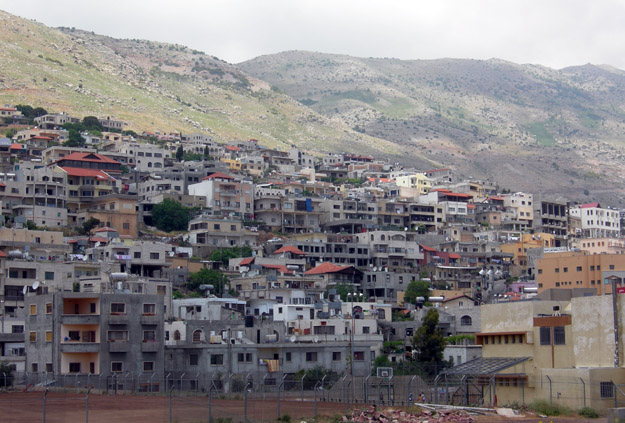
I finally got out into the field today. My Israeli colleagues and I left Jerusalem early in the morning and arrived about noon in the Druze village of Majdal Shams on the slopes of Mount Hermon. It is a lovely place with steep hillsides and extraordinary views over green valleys filled with cherry and apple orchards. (I’ll write another post sometime about the complicated politics here, including a long lunchtime lecture I tolerantly received from a Druze man about all the problems in the world coming from “America and the West”. It may have been a good thing that I didn’t quite understand what he was saying until it was explained to me later!)

Part of Majdal Shams seen from the town center and facing Mount Hermon.

Part of Majdal Shams seen from the town center and facing Mount Hermon.

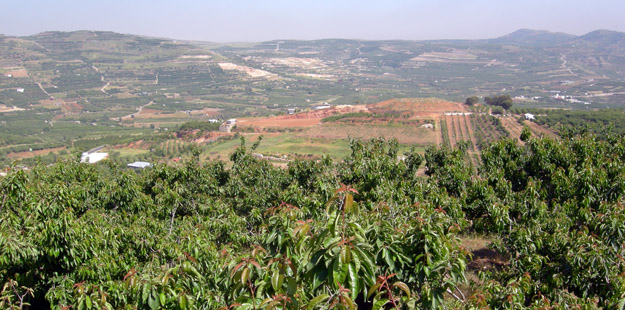
One of the cultivated valleys near Majdal Shams.

One of the cultivated valleys near Majdal Shams.

Our goal today was to examine three marine Jurassic formations (from bottom to top in the geological fashion): the Zohar (mostly limestone), Kidod (mostly shale), and Beersheva (mostly limestone). I had two primary questions: What indications can we find in these rocks of the water depth when they were deposited? What was the intensity of bioerosion of the corals and sponges in these units? Both questions are part of larger studies placing these rocks in context with the rest of the known Jurassic world. This region was on the equator when these units were formed, so we have an unusual opportunity to study Jurassic equatorial ecological conditions.

As is often the case in paleontology, we found some of the best fossils at the boundaries between formations. The top of the Zohar and bottom of the Kidod have wonderful ammonites, belemnites, bivalves, and brachiopods, some appearing to show patterns of microbioerosion. The top of the Beersheva has massive corals and sponges which are thoroughly bored by bivalves, some of which are still in the crypts they excavated for themselves.

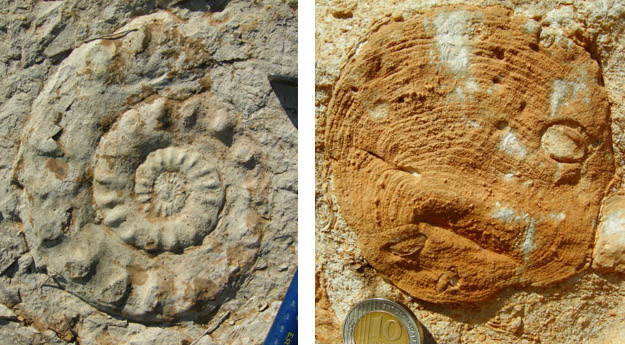
On the left is a very large ammonite we found in the top of the Zohar Formation.  Note the hammer for scale.  On the right is a closer view of a partially silicified coral from the top of the Beersheva with holes drilled in it by bivalves, some of which are still in place.

On the left is a very large ammonite we found in the top of the Zohar Formation. Note the hammer for scale. On the right is a closer view of a partially silicified coral from the top of the Beersheva with holes drilled in it by bivalves, some of which are still in place.

All the indications we could find showed that the limestone units were clearly shallow water deposits. The thick shales of the Kidod were laid down in deeper waters well below wave base. Much more work is required, though, before we can come to any conclusions. This is a reconnaissance trip to sort out potential projects for Wooster Senior Independent Study students and my own research. I now see many opportunities here.

Posted in Uncategorized | Tagged , , , , , , | 2 Comments

Geological Survey of Israel Headquarters

The campus of the Geological Survey of Israel (GSI) may not look like much from the outside, but it is a world class scientific institution. It has about 100 employees, most of whom are Earth scientists. The buildings and grounds of the headquarters are understated in part because they are a section of an old Mandate-era British military base, and also because they are embedded within an ultra-orthodox neighborhood one block away from Mea Shearim. (I would have included a photograph of a street scene, but I learned my lesson earlier when I was observed removing a camera from my pocket and was very much chastised.)

combinedsignbuildings052409

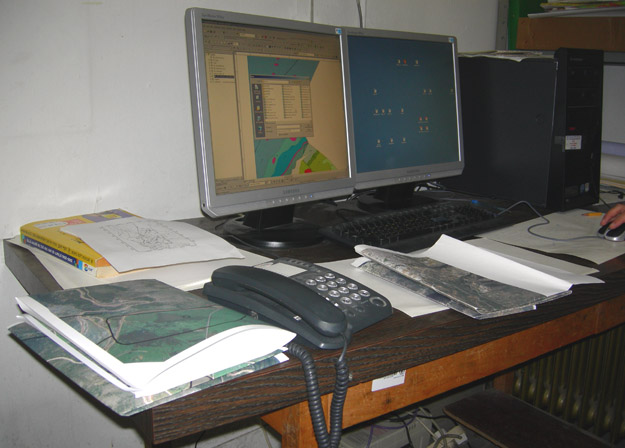
Our preparations for this week’s fieldwork include using Geographical Information Systems (GIS) software and hardware to create custom maps. We selected the best aerial imagery available and superimposed on it the known geological information, especially the contacts between stratigraphic units.

A GIS station in the GSI offices.  (I know: GIS, GSI ...)  On the left-hand corner of the table is our growing pile of printed orthophotos with superimposed geological information.

A GIS station in the GSI offices. (I know: GIS, GSI ...) On the left-hand corner of the table is our growing pile of printed orthophotos with superimposed geological information.

Finally, in case anyone wonders if I’m eating well enough, you can see from this last image that I’m doing just fine.

jerusalemmcdonalds052409

Posted in Uncategorized | Tagged , , | 2 Comments

Walls in Jerusalem

Our faculty colleagues on the Hales Fund trip to China have posted on their blog a wonderful photographic blog essay of their encounter with the Great Wall of China. It gives me an excuse to show some cool walls I’ve encountered lately on this trip. All of these structures are made from one of the limestone varieties of Jerusalem Stone.

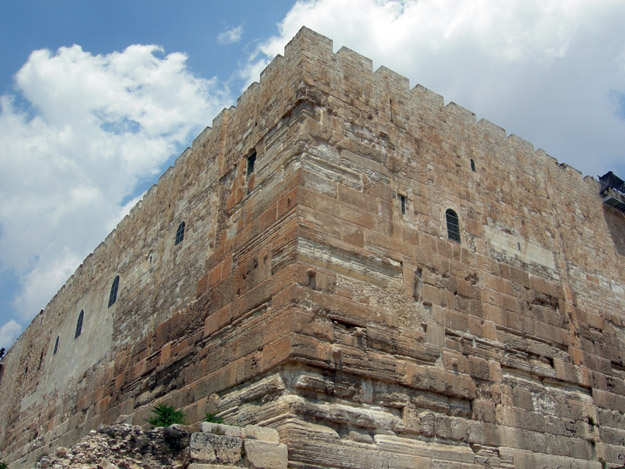
Southwest corner of the retaining wall for the Temple Mount.  The massive lower blocks were carved and emplaced during the reign of King Herod the Great (37 - 4 BCE).

Southeast corner of the retaining wall for the Temple Mount. The massive lower blocks were carved and emplaced during the reign of King Herod the Great (37 - 4 BCE).

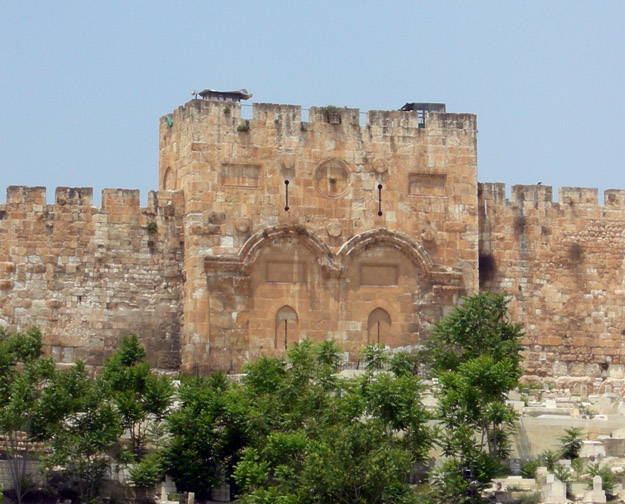
Golden Gate (Bab el-Rahma) in the eastern city wall.  Jewish tradition is that the Messiah will pass through this gate into Jerusalem.  Possibly for that reason the Muslim rulers in the 7th Century closed it up and placed a graveyard in fron of it.

Golden Gate (Bab el-Rahma) in the eastern city wall, another construction during Herod the Great's reign. Jewish tradition is that the Messiah will pass through this gate into Jerusalem. Possibly for that reason the Muslim rulers in the 7th Century closed it up and placed a graveyard in front of it.

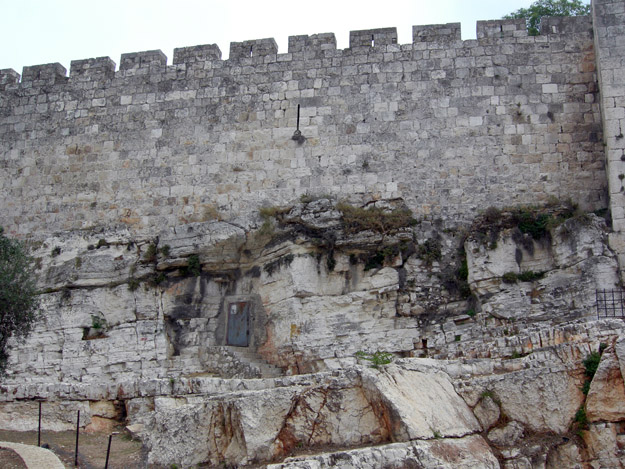
Middle of the north city wall.  This is the side of the walled city most vulnerable to invaders, so the height of the wall was enhanced by quarrying out the limestone beneath it.  The door leads into one of many subsurface quarries underneath this part of the Old City.

Middle of the north city wall. This is the side of the walled city most vulnerable to invaders, so the height of the wall was enhanced by quarrying out the limestone beneath it. The door leads into one of many subsurface quarries underneath this part of the Old City.

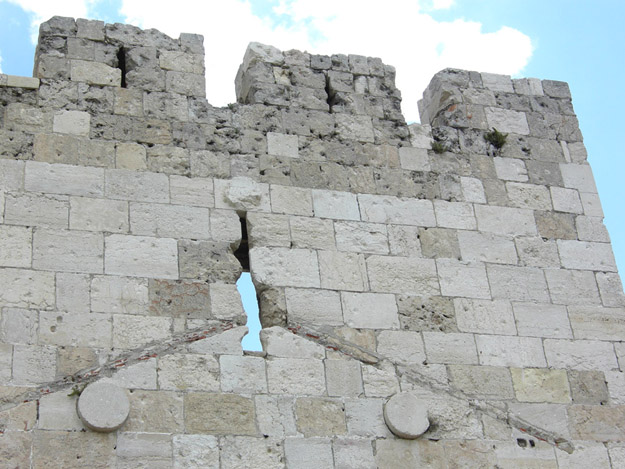
The stones atop Jaffa Gate on the western side of the city walls shows bullet and shell scarring from the 1948 War of Independence.  Jordanian troops held the Old City and the Israelis were desperate to relieve the Jewish Quarter inside.

The stones atop Jaffa Gate on the western side of the city walls show bullet and shell scarring from the 1948 War of Independence. Jordanian troops held the Old City and the Israelis were desperate to relieve the Jewish Quarter inside.

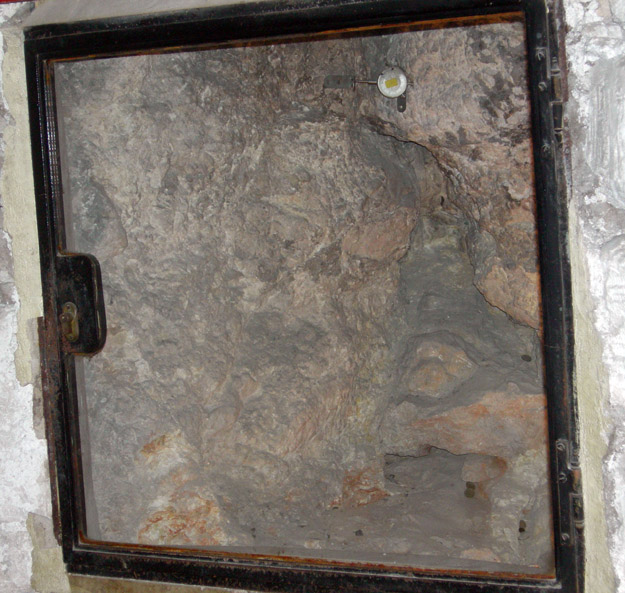
A bit of limestone wall exposed in the Chapel of Adam inside the Church of the Holy Sepulchre.  Christian tradition is that this is the burial place of Adam, which was supposed to be directly below the crucifixion site of Golgotha.  The crack you see in the rock was believed by early Christians to have been formed during the earthquake upon the death of Jesus.  Archaeologists suggest that it was a pre-existing crack in an old quarry.  What I found interesting was that someone has placed a strain meter across the crack!  Any movement of the rock here will not be good news for the Church of the Holy Sepulchre.

A bit of limestone wall exposed in the Chapel of Adam inside the Church of the Holy Sepulchre. Christian tradition is that this is the burial place of Adam, which was supposed to be directly below the crucifixion site of Golgotha. The crack you see in the rock was believed by early Christians to have been formed during the earthquake upon the death of Jesus. Archaeologists suggest that it was a pre-existing crack in an old quarry. What I found interesting was that someone has placed a strain meter across the crack! Any movement of the rock here will not be good news for the Church of the Holy Sepulchre.

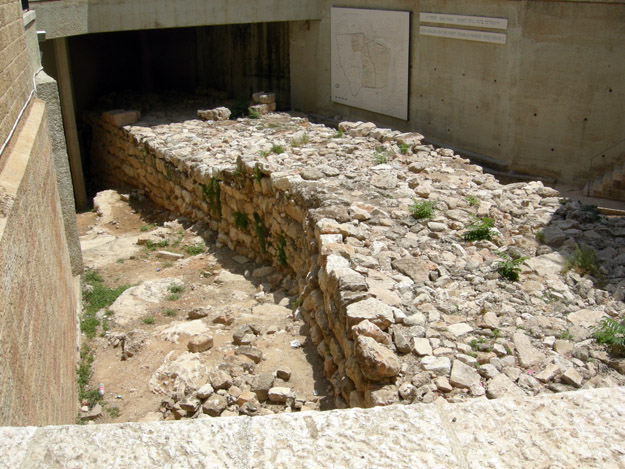
The "broad wall" is a remnant of an 8th Century BCE fortification built by King Hezekiah to expand the size of Jerusalem.  It was uncovered while Israeli engineers were clearing the debris in the Jewish Quarter after it was liberated in 1967.

The "broad wall" is a remnant of an 8th Century BCE fortification built by King Hezekiah to expand the size of Jerusalem. It was uncovered while Israeli engineers were clearing the debris in the Jewish Quarter after it was liberated in 1967.

Posted in Uncategorized | Tagged , , | 2 Comments

Jerusalem Stone

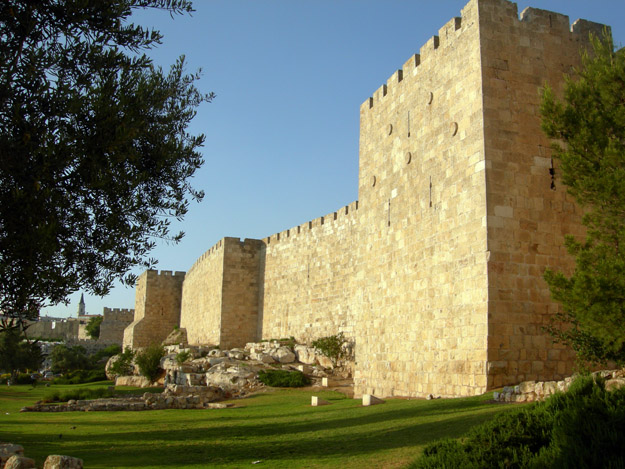
Jerusalem is indeed the “city of gold” when the sun rises or sets on it. The slanting rays give the beautiful stonework on the facings of its buildings a golden glow. Since the British captured the city in World War I, it has been the law that all buildings must be faced with Jerusalem Stone, which is a mix of Late Cretaceous limestones and dolomites quarried in this part of the Judean Hills.

City wall near the Jaffa Gate lit by the setting sun.

City wall near the Jaffa Gate lit by the setting sun.

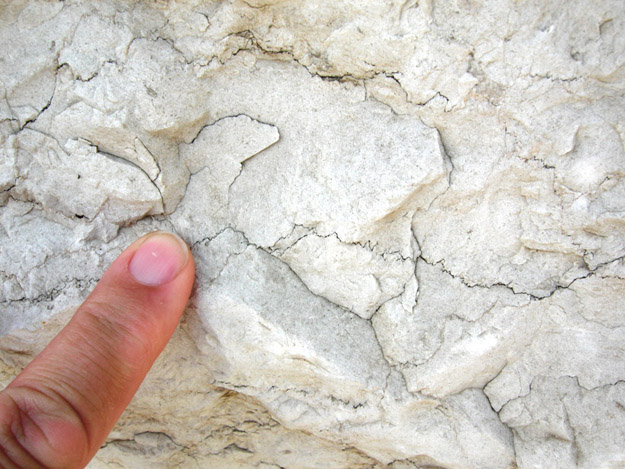
The most beautiful and durable of the stone types is called meleke. It is a Turonian (Late Cretaceous) biomicrite with numerous stylolites (jagged lines showing internal pressure dissolution), some trace fossils, and occasionally numerous molds of fossil mollusks.

Close-up of the meleke variety of Jerusalem Stone.

Close-up of the meleke variety of Jerusalem Stone. Finger is on a small stylolite.

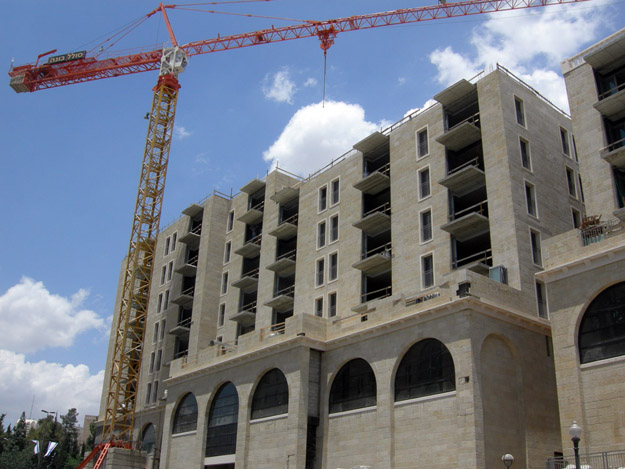
The local stone can be easily seen in outcrops on the north side of the Old City where the walls were built directly atop old quarry sides. The present quarries are now mostly in the West Bank and are very busy supplying stone for new construction throughout Jerusalem.

New construction in western Jerusalem using Jerusalem Stone.

New construction in western Jerusalem using Jerusalem Stone.

Posted in Uncategorized | Tagged , , | 2 Comments

More Jerusalem Sounds

Here is a Muslim call-to-prayer recorded at noon in the Old City. There are several muzzeins calling at the same time from various minarets.

Posted in Uncategorized | Tagged , , | Leave a comment

Some Israeli Street Music

It is not the highest quality, but here is a-bit-of-israeli-street-music! It is from this evening’s city-wide (and loud) party. Meagen requested it, and I’m doing my best to post it in the way she did hers.

Posted in Uncategorized | Tagged , , | 1 Comment