The Åland Islands

skerries062009
There is an exquisite archipelago of thousands of  islands between Finland and Sweden.  I took a six-hour ferry ride this morning from Turku in southwestern Finland to Mariehamn, capital of the Åland Islands, where I am spending a day and an evening.  Most of the islands are formed of a brilliant red Precambrian granite, polished smooth on the top by glaciation.  Scraggly pine trees grow in the cracks they can find in the bedrock, reminding me of the terrain in the High Sierra just below tree line.
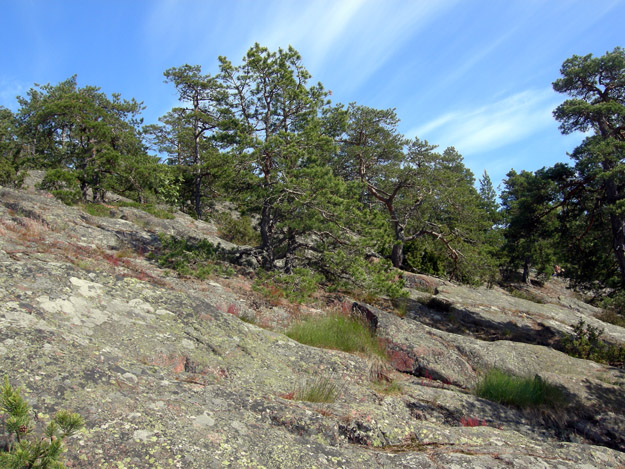
N 60.08276°, E 19.93422°

N 60.08276°, E 19.93422°

A close look at the granite shows a wonderful mix of potassium feldspars, clear quartz, and flecks of biotite.  The weathered surfaces are thickly covered with colorful lichens, which are symbiotic associations of algae and fungi.

combinedgranite062009

These islands have an unusual political history.  They are populated almost entirely by Swedish-speakers, yet are a province of Finland.  Various international agreements in the 19th and 20th Century gave the islanders autonomous status within Finland and, most famously, completely demilitarized the islands, a status they managed to retain through two world wars and the Cold War.  They have their own government with a premier and parliament, they fly their own flag, and they print their own stamps.
combinedstamps062009

And there you see the attraction Åland has for a geologist.  Any place that features geology on its stamps deserves a visit!

Posted in Uncategorized | Tagged , , | Leave a comment

Wooster Geology Major = Featured Bagpiper

Check out the recent Daily Record Article on Palmer Shonk, a senior geology major and bagpiper who led Wooster delegates into the All-America City competition in Tampa, FL. Way to go, Palmer!

Posted in Uncategorized | Tagged , , , , | Leave a comment

Another Beautiful Montana Day

We have beautiful weather again here in Montana. The CUR meeting is moving along swiftly and we’re all working hard to accomplish as much as possible in the short time that we have. Some committees managed to take advantage of the warmth and sunshine this afternoon by holding their discussions on the lawn. Fortunately, mine was one of them! Soon, we’ll head back indoors to vote on issues like the merger of CUR with NCUR (National Conference on Undergraduate Research). I bet you thought they were one in the same, didn’t you? Well, they may be soon! Until then, I’ll be reading about the most influential leaders in undergraduate research (as the newest member of the CUR Fellows Committee) and enjoying the sweet, fresh Montana air.

Plaque detailing the journey of Lewis and Clark

A plaque detailing the expedition of Lewis and Clark.

View of Baldy Mountain from the steps of my dorm.

View of Baldy Mountain from my dorm (sigh).

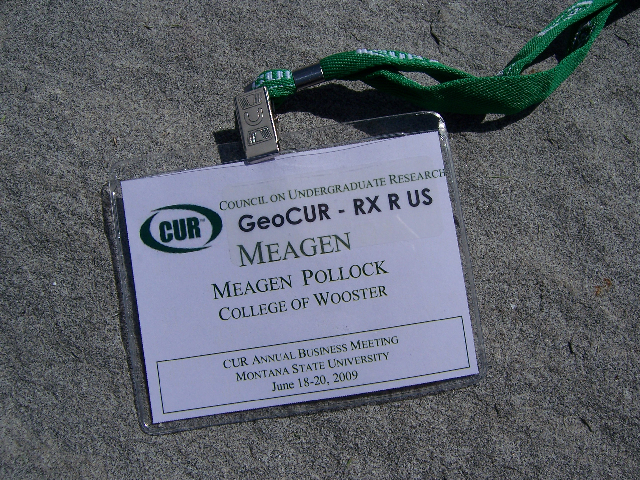
The sticker on my nametag shows how infinitely cool geologists are

The sticker on my nametag shows how infinitely cool geologists are

Posted in Uncategorized | Tagged , , , | 3 Comments

Wooster Geologist in Bozeman, MT

Promoting undergraduate research doesn’t always mean that we’re trekking across some exotic landscape sampling rocks with our students. Sometimes, it means tackling difficult issues through in-depth conversations with faculty who mentor undergraduate researchers in a variety of settings. That’s why I’m here in Bozeman, MT. I’m on the campus of Montana State University at the Council on Undergraduate Research (CUR) business meeting. Even the gorgeous weather didn’t distract us from setting an ambitious agenda. We’re going to spend all day tomorrow talking about issues that impact undergraduate research, such as how to advocate for funding, how to convey the benefits of undergraduate research to a broader audience (e.g., policy makers, administrators, institutions), and how best to address the needs of the geoscience research community. CUR’s mission is to support and promote high-quality undergraduate student-faculty collaborative research and scholarship. Undergraduate research is rapidly becoming main-stream pedagogy, and it’s thrilling to be a member of the organization that is paving the way.
100_5627b

Posted in Uncategorized | Tagged , , | Leave a comment

A Wooster Geologist in Helsinki

I’m between geological field trips right now. I left Russia by train through Karelia to Helsinki, Finland. It was a remarkable trip through woods and villages, with the swampy environs of St. Petersburg giving way to higher and drier ground where ribs of granite occasionally showed. Next week I go to Spitsbergen in the Arctic to look at a Jurassic sequence for a few days, and then I meet two Wooster students, Palmer Shonk and Rob McConnell, and an Ohio State University paleontologist, Bill Ausich, in Estonia where we will work in the Silurian with our Estonian colleague Olev Vinn.

Helsinki is, of course, a highly cultured city with many attractions. I don’t want to minimize those, but since this is a geology blog, we must note the gorgeous granite mounds which dot the city.
helsinkigranite061809
They were polished smooth on their upper surfaces by Pleistocene (and Holocene) glaciers, which left classic striations showing the direction of ice movement. The Finnish Parliament building is in the background.
glacialstriations061809

Tomorrow I leave by train for the ancient city of Turku on the southwestern coast of Finland, and then the Aland Islands for a quick look. It’s a tough job, but someone has to do it.

Posted in Uncategorized | Tagged , , , | Leave a comment

Thoughts on Future Wooster Geology Research in Russia

I was very impressed by the Ordovician rocks I saw in the Leningrad Region on this past trip.  I had seen parts of the Ordovician System in Estonia nearby, but not to this extent nor this particular facies.  My model for Ordovician rocks had been based too strictly on those I’ve worked with in North America.  Now I realize that the environmental conditions and faunas were significantly different on the ancient continent of Baltica — enough to produce unexpected trace fossils, especially on and in the hardgrounds.  My perspective was changed, and thus the kinds of questions my students and I will be addressing in the next few years.

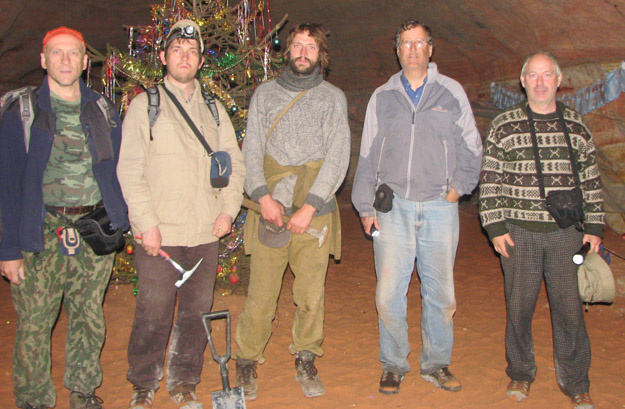
Nikolai, Sergei, Andrei, me, and my host Andrey in the Sablino Mines. I really don't know why there was a decorated Christmas tree in this cavern!

Nikolai, Sergei, Andrei, me, and my host Andrey in the Sablino Mines. I really don't know why there was a decorated Christmas tree in this cavern.

My Russian host, Andrey Dronov, was extremely generous and patient, freely sharing with me his scientific thoughts and his passion for Russian history and culture.  I could not have asked for better.  Remarkably, I met him for the first time on this expedition.  My other Russian colleagues were great fun, and they also taught me much about Russia and its geology.

I learned that field geology in Russia is difficult and certainly could not be done without a knowledgeable Russian host.  Every outcrop was farther, muddier, steeper and more overgrown than I expected.  In fact, we looked at outcrops American geologists would have given up on years ago.  If the rocks were there, we found them by hacking through the vegetation and digging them out with shovels.

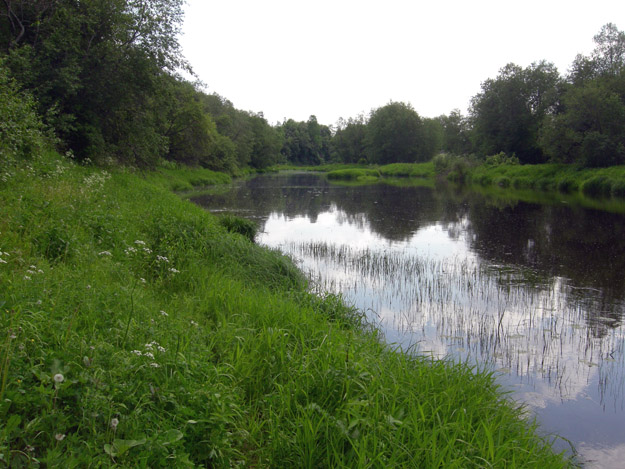
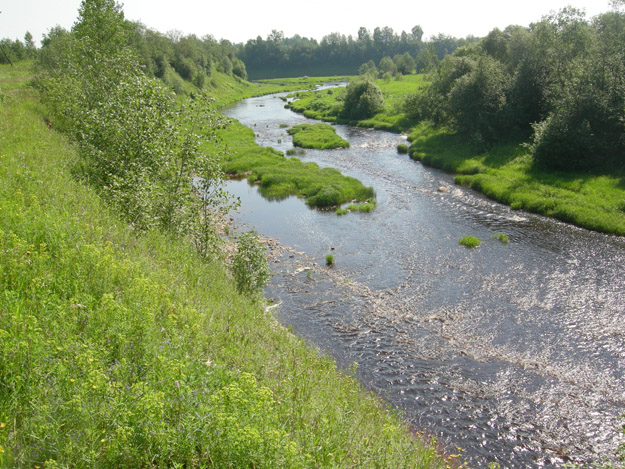
Do you see the outcrops of limestone along the banks of the Lynna River?  Neither do I.  They are there, though, and Andrey and I found them with an epic jungle journey.

Do you see the outcrops of limestone along these banks of the Lynna River? Neither do I. They are there, though, and Andrey and I found them with an epic jungle journey on our last field day.

The major catch to doing Independent Study work in Russia for a student is that we could not take specimens back to Wooster.  We could, though, work in the geological lab facilities at the Academy of Sciences in Moscow, collecting enough data and images to keep a student busy for a year back home.  I would look forward to showing a student these unusual rocks and fossils, and I now know how better to prepare for work in Russia!

Posted in Uncategorized | Tagged , , , | 2 Comments

A Wooster Geologist in St. Petersburg, Russia

spskyline061609

I am absolutely stunned by the beauty of this city.  The ornate architecture and building colors combined with the water and changing skies, all marinated in more historical drama than any city should bear, is overwhelming.  I can’t imagine a more different Russian city from Moscow.  I have been privileged to see the sights here as a guest with personal narrative tours.  It is quite the place to emerge into after all those field days.  Our field house is only four hours by train from the city center, yet it seems thousands of kilometers away now.

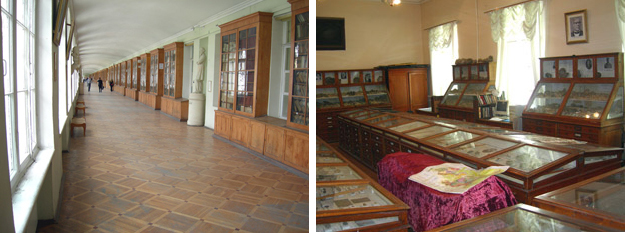
My work here with Andrey is to look at his collection of Ordovician limestone and fossil samples at the University of St. Petersburg.  That task alone is in an impressive setting.  His office is in the Twelve Colleges building, which was designed by the Italian architect Trezzini and completed in 1742.  It is an extraordinarily long set of twelve connected buildings, all linked by a Mediterranean-style corridor.

My morning walking commute on the left, and the entrance to the Twelve Colleges building on the right.

My morning walking commute on the left, and the entrance to the Twelve Colleges building on the right.

The collections are in a classic old European cabinet room dominated by portraits of generations of geologists and filled with glass-topped sets of drawers.

Twelve Colleges corridor on the left; paleontological collections on the right.

Twelve Colleges corridor on the left; paleontological collections on the right.

After studying the specimens, Andrey took me on a long walk through the city.  Our first stop was the living quarters and laboratory of the university’s most famous professor, Dmitry Mendeleev.  We had a personal tour of this amazing man’s place, complete with stories of his life.  Not only did he develop the periodic table of the elements, but he was also an engineer, economist … and geologist!  He recognized the future value of petroleum and worked on ways for Russia to efficiently use its oil resources.  We then continued across three islands making up the most historical part of the city, seeing all that we could.  With the white nights extending the afternoon light, that was quite a bit.

St. Isaac's Cathedral

St. Isaac's Cathedral

On the next day I made my own trip to see a famous ship I’ve long dreamed of boarding: the Cruiser Aurora.  This is the ship that signaled the beginning of the Bolshevik Revolution in 1917 by broadcasting a speech by Lenin and then firing a shot from its forward gun which started the storming of the Winter Palace.  It is also a veteran of the Russo-Japanese War and served throughout WWI and WWII.

The Cruiser Aurora

The Cruiser Aurora

Posted in Uncategorized | Tagged , , | Leave a comment

Out of the Russian Woods

ST. PETERSBURG, RUSSIA–This Wooster geologist has emerged from the field. I’m now in beautiful St. Petersburg working at the university. I hope I can get more stable access to the Internet soon so I can post the many blogs I wrote while deep in the Russian countryside. Beautiful places, and I’ve had a rapid immersion course in Russian culture! My blog entries are posted by the date I wrote them, so it means you have to scroll back to June 4 for the beginning of this set.

Posted in Uncategorized | Tagged , | 1 Comment

Last Field Day in Russia

NEAR KHAMONTOVO, LENINGRAD REGION, RUSSIA–Last night we had our last group dinner (shashlyk — essentially shish kebab — and delicious brown bread) and lively conversation (most of which I missed, of course, but still enjoyed).  There were over a dozen toasts, my favorite being “to ideas”.  This went on until about 1:30 a.m.
lastgroupdinner1_061209lastgroupdinner2_061209
Nikolai, Sergei and Andrei packed up and left in the morning for the long drive back to Moscow.  Andrey and I then sorted out our notes and specimens and did some last fieldwork in the local area.  Since we arrived by train and Nikolai left with the car, we were confined to sites we could walk to from the field house.  The weather is now spectacular, very warm and without a cloud in the sky.  A good time to be a field geologist.  (Not that every time isn’t a good time, but some are better than others!)  Tomorrow afternoon we leave on the 4:00 p.m. train to Volkhov with a connection to St. Petersburg.

Lynna River as it meets the Sass near the field house.

Lynna River as it meets the Syas near the field house.

Posted in Uncategorized | Tagged , | Leave a comment

From Spring to Summer in One Hour

NEAR KHAMONTOVO, LENINGRAD REGION, RUSSIA–Yesterday’s light rains in the morning gave way wonderful sun, as I described earlier.  Then a massive thunderstorm, almost as large as those in Ohio, crashed through and dropped probably an inch of rain in just a few minutes.  The sunlight reappeared after it passed along with much higher temperatures.  Now it is sultry and Russian men are appearing along the river in those skimpy little swimsuits, if any at all.  Bees have become evident, along with black flies.  This morning irises opened up their buds for the first time along the riverbank.  Even the mud has hardened along the steep path to the outhouse, which I thought would never happen.

The many faces.

Because I don’t have a mirror (having an old Silva compass instead of a Brunton), I’ve been taking a photograph of my face every morning just to make sure I didn’t have something like, say, a giant zit between my eyes.  Now a selection of these images from early in the fieldwork to late shows how the weather has changed.  At first I didn’t want to leave the house before I had to, it was so cold (and I still had the down jacket on).  Then I went outside in the down jacket, then in a lighter windbreaker, and finally with  just a shirt.

Posted in Uncategorized | Tagged | 1 Comment