Recent Comments
- Mark Wilson on A Tradition Continues: Richmond, Indiana – Paleoecology, Fall 2025
- Mark Wilson on Possible Linkages Between Climate and Human History in Ohio (the 4.2 yr. ka interval)
- Greg Wiles on A new paper on James Parkinson’s neglected 19th century contributions to crinoid paleontology
- Todd Starkey on New Paper on the Dawn Redwood (Metasequoia) Trees of Wooster Ohio
- Mark Wilson on Snuffboxes! Team Dorset has a project
Meta
-
Recent Posts
- A Tradition Continues: Richmond, Indiana – Paleoecology, Fall 2025
- Muscle scars in tiny conical fossils: A new paper describing the musculature of Devonian tentaculitids from Armenia and what they mean for the biology and evolution of the group
- Possible Linkages Between Climate and Human History in Ohio (the 4.2 yr. ka interval)
- A spotty Middle Ordovician trilobite from Estonia: A new paper describing an ancient parasitic infection
- A new paper on James Parkinson’s neglected 19th century contributions to crinoid paleontology
Blogroll
Other Links
Wooster Links
Tags
- Alaska
- basalt
- British Columbia
- Cambrian
- Carboniferous
- climate
- climate change
- Cretaceous
- Devonian
- England
- Estonia
- Fossil of the Week
- fossils
- France
- GSA Meeting
- history
- Iceland
- ichnology
- Independent Study
- Indiana
- Israel
- Italy
- Jurassic
- Kentucky
- lava
- limestone
- Miocene
- Mojave Desert
- Negev
- Ohio
- Ordovician
- paleoclimate
- pillow lava
- Pleistocene
- Pliocene
- Russia
- Sicily
- Silurian
- tree ring
- UK2015
- undergraduate research
- Utah
- Wooster
- Wooster Geology
- Yorkshire
Archives
- December 2025
- November 2025
- October 2025
- September 2025
- August 2025
- July 2025
- June 2025
- May 2025
- April 2025
- March 2025
- February 2025
- January 2025
- December 2024
- September 2024
- July 2024
- June 2024
- May 2024
- April 2024
- March 2024
- January 2024
- December 2023
- November 2023
- October 2023
- September 2023
- August 2023
- July 2023
- June 2023
- May 2023
- April 2023
- March 2023
- February 2023
- December 2022
- September 2022
- August 2022
- July 2022
- June 2022
- May 2022
- April 2022
- March 2022
- February 2022
- January 2022
- December 2021
- November 2021
- October 2021
- August 2021
- June 2021
- May 2021
- April 2021
- March 2021
- February 2021
- January 2021
- December 2020
- November 2020
- October 2020
- September 2020
- August 2020
- July 2020
- May 2020
- April 2020
- March 2020
- February 2020
- January 2020
- December 2019
- November 2019
- October 2019
- September 2019
- August 2019
- July 2019
- June 2019
- May 2019
- April 2019
- March 2019
- February 2019
- January 2019
- December 2018
- November 2018
- October 2018
- September 2018
- August 2018
- July 2018
- June 2018
- May 2018
- April 2018
- March 2018
- February 2018
- January 2018
- December 2017
- November 2017
- October 2017
- September 2017
- August 2017
- July 2017
- June 2017
- May 2017
- April 2017
- March 2017
- February 2017
- January 2017
- December 2016
- November 2016
- October 2016
- September 2016
- August 2016
- July 2016
- June 2016
- May 2016
- April 2016
- March 2016
- February 2016
- January 2016
- December 2015
- November 2015
- October 2015
- September 2015
- August 2015
- July 2015
- June 2015
- May 2015
- April 2015
- March 2015
- February 2015
- January 2015
- December 2014
- November 2014
- October 2014
- September 2014
- August 2014
- July 2014
- June 2014
- May 2014
- April 2014
- March 2014
- February 2014
- January 2014
- December 2013
- November 2013
- October 2013
- September 2013
- August 2013
- July 2013
- June 2013
- May 2013
- April 2013
- March 2013
- February 2013
- January 2013
- December 2012
- November 2012
- October 2012
- September 2012
- August 2012
- July 2012
- June 2012
- May 2012
- April 2012
- March 2012
- February 2012
- January 2012
- December 2011
- November 2011
- October 2011
- September 2011
- August 2011
- July 2011
- June 2011
- May 2011
- April 2011
- March 2011
- February 2011
- January 2011
- December 2010
- November 2010
- October 2010
- September 2010
- August 2010
- July 2010
- June 2010
- May 2010
- April 2010
- March 2010
- February 2010
- January 2010
- December 2009
- November 2009
- October 2009
- September 2009
- August 2009
- July 2009
- June 2009
- May 2009
“Overcoming Resistance to the Reality of Evolutionary Change in Nature”
PORTLAND, OREGON–This was the very direct title of an inspiring panel discussion today at the Geological Society of America meeting. It was sponsored by the Paleontological Society and included some of the strongest voices in the endless Evolution Wars:

From the left, Randy Olson (scientist-filmmaker best known for the movie "Flock of Dodos" and the great book "Don't Be Such a Scientist"), Ray Troll (extraordinary artist with evolutionary themes), Roger Thomas (Paleontological Society Secretary and moderator), Judge John E. Jones (at the podium), Jeremy Jackson (hidden, alas, by that podium), and Kevin Padian (paleontologist, star witness in the Dover Trial, and professor at the University of California, Berkeley).
The lessons that emerged for me from the riveting conversations: (1) The communication of science to the public is an essential part of the role of a scientist; (2) Most scientists are not very good at it; (3) All scientists can learn to be better communicators; and (4) It is not too late but we have a lot of work to do. Jeremy Jackson made the strong point that evolution is part of life around us and can be made immediately relevant to any audience, but that it takes time and effort. Randy Olson emphasized that scientists need to make much better use of media sources. Ray Troll showed how humor and cool art can have an enormous influence on public perceptions of science. Kevin Padian encouraged us to address the “middle 50%” of the public which is open to learning and making their own decisions, and that we need to control the agenda of the debate and the use of our own scientific terms. Judge John E. Jones, besides being a heroic and wise judge in the Dover Trial, showed us that rational argument well presented really does make a difference. All agreed that the issues go beyond evolution in this country to include other sciences, history, literature, art and civics.
It was a pleasure to see that three of the questions from the audience were asked by Wooster paleontologists: Tricia Kelley, Lisa Park and John Sime. Very good questions, too, which received thoughtful answers.
Much to do, and soon.
AWG Breakfast
I was fortunate enough to have a ticket to the sold-out Association for Women Geoscientists (AWG) breakfast. How inspiring it is to be surrounded by women and men who support and promote female geoscientists! After a heartfelt series of stories from students and colleagues, Dr. Anita Grunder (Oregon State University) was awarded the AWG Outstanding Educator Award. Dr. Grunder’s impact on women geoscientists is significant and tangible, which challenged me to think about the ways that I can contribute to this cause.

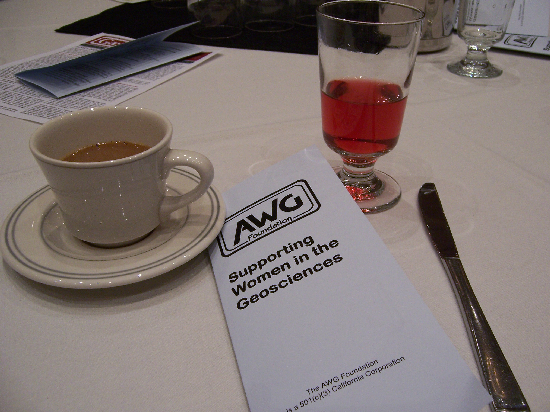
Coffee and juice at the AWG breakfast. I would have taken a picture of the food, too, but I ate it all and my plate was cleared before I remembered to pull out my camera. Trust me, it was delicious!
AWG promotes women in all fields of geology at all stages of their careers. They offer numerous scholarships, awards, and resources for students. They also hold gatherings to help their members develop strong support networks. At my table, I spoke with women who began their careers as chemists and realized, after working in the field for several years, that their passion was geology. We were joined by other female faculty and AWG leadership. I was glad to see that a couple of Wooster grads took advantage of the opportunity.

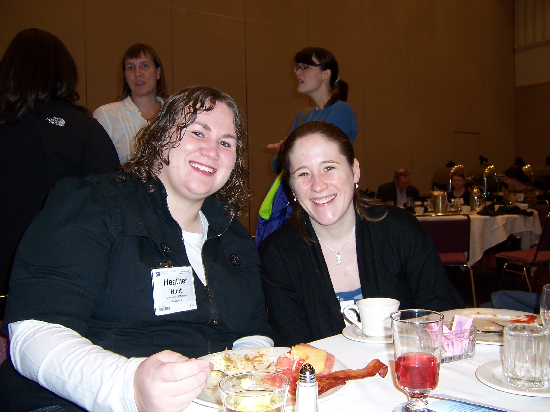
Heather Hunt '09 (left) and Elyssa Krivicich '09 (right) at the AWG Breakfast.
Although it was unintended, this picture exemplifies the strength of the networking opportunities provided by AWG. Above Heather’s right shoulder is Kim Hannula, author of one of my favorite geoblogs and a geology professor at a liberal arts college in the Rockies. Sitting at the table behind Elyssa’s left shoulder is LeeAnn Srogi (center), a new collaborator of mine from West Chester University, who I am co-leading a field trip with at the 2010 Northeastern/Southeastern GSA meeting.
Digital Geology at #GeoPort
This post is for my Instructional Technology Fellows. #GeoPort is the GSA Portland twitter hash tag, so you can follow what people are saying about the meeting. GSA also posts meeting updates on its own twitter feed and facebook page. If you prefer to read blogs, check out the GSA Portland blog roll, which includes our own Wooster Geologists blog.
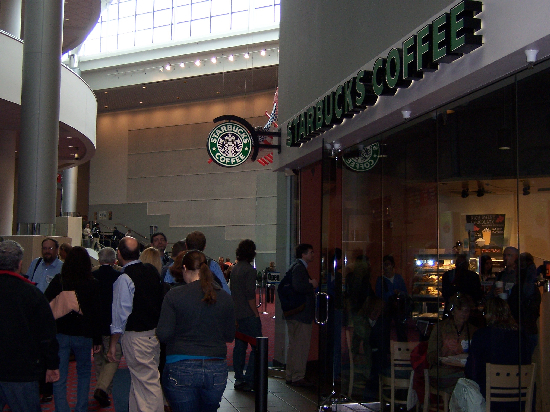
After an important afternoon stop (see Figure 1), I attended an inspiring session on digital innovations in the geosciences. Talks focused on the digital revolution, OneGeology, GigaPan, and Google Earth. The advantages of writing my field notes with a Smart Pen and geotagging my field photos made me wonder why I haven’t been doing these things all along! Thanks to Kyle House, Ian Jackson, M. Lee Allison, Declan De Paor, Ron Schott, and all of the other presenters who so graciously shared their insights and ideas.

Figure 1. The Starbucks in the conference center is arguably the busiest spot in the entire building.
Posted in Uncategorized
Tagged digital revolution, GeoPort, geotagging, GigaPan, google earth, GSA Meeting, Smart Pen
1 Comment
First Wooster talk at the 2009 GSA meeting
PORTLAND, OREGON–By now I’ve given over 35 talks at annual Geological Society of America meetings, but I still get as nervous as I did as a graduate student. The cavernous room, the high quality of the previous presentations, the people coming in and sitting expectantly — it all comes to an exquisite tension as I hear the speaker before me say, “And in conclusion …”. We don’t read from a text or even use notes in these 15-minute sessions. It all comes from the slides and our desperate hope that we remember what to say at each. Somehow the adrenaline kicks in as you step up to the podium. The words flow and the slides become old friends with stories which must be told.
I’m in that magical post-talk phase of the meeting this evening with no more performance pressure. I can now happily share a few slides from our presentation, along with happy memories of the field and lab work:
First Wooster poster presentation of the 2009 GSA annual meeting
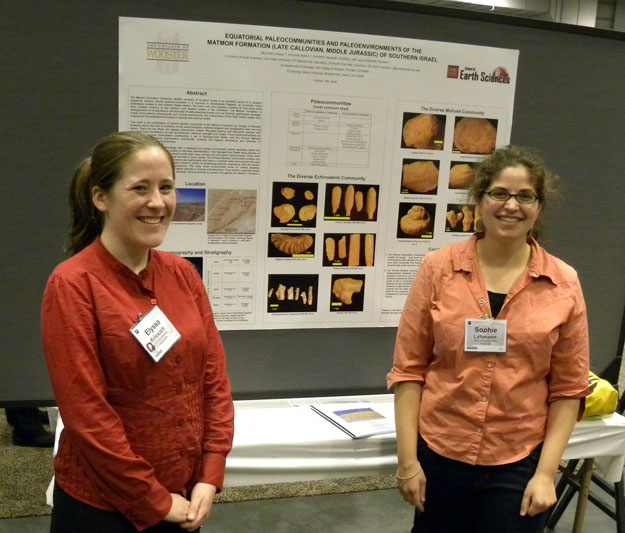
Elyssa Belding Krivicich (’09) and Sophie Lehman (’08) cheerfully presenting their poster on Jurassic marine paleoecology in Israel at the Geological Society of America meeting in Portland.
Conservation Paleobiology Short Course

PORTLAND, OREGON–The Paleontological Society has a free short course program it runs on the day before the GSA meeting officially begins. When I began my career the topics were always about some taxonomic group such as “Brachiopods”, “Mollusks”, “Plants” and the like. The purpose was to gather a dozen or so experts on the topic and bring the participating paleontologists up to speed on the latest ideas and discoveries. As you might imagine, as useful as these sessions were, they often became dull recitations of anatomy and classification schemes.
This began to change about a decade ago with short course topics which were more interdisciplinary and not taxa-specific. We began to talk about issues such as predation, paleoecology, preservation, evolution — subjects which appealed to all paleontologists by cutting across differences within the field and foregoing systematic details. These sessions have been very successful, keeping hyperactive paleontologists in their seats most of the day. (As with all geologists, they would rather be in the lobby telling stories and making summer field plans.)
Yesterday’s short course was titled “Conservation Paleobiology”. There was some confusion as to what this title meant before it started (is it about preserving specimens in collections? saving paleontological localities from destruction?), but once it began it was clear this would be a different course from all those which preceded it. Karl Flessa of the University of Arizona (and one of the short course leaders) invented the term for the “application of paleoecological and geochemical techniques to the analysis of the prehistoric and historic skeletal remains of species threatened with extinction.” In other words, the concept is to make paleontology and paleontologists important players in the attempts to limit environmental degradation and preserve ecosystems in this time of climate change, overuse of resources, pollution and overpopulation. Those who study the history of life have much to contribute to understanding current extinctions and other ecological changes. In the more irreverent words of Karl: “Let’s put the dead to work”.
The presentation I found most impressive was by Jeremy Jackson of Scripps Institution of Oceanography (and a bryozozoologist of great note, I might add!). In his talk entitled “Historical ecology for the paleontologist”, he emphasized how much our baselines of what we expect to be “normal” for an ecosystem have shifted “beyond recognition from their formerly pristine state”. This shifting began with the first human interactions with the environment. The only way to deduce what “natural” ecosystems really were is through the fossil record. We have altered every environment on Earth to extraordinary degrees, each time shifting our baselines of what we thought it was like in some Edenic past. It was not a happy talk, that’s certain, but it did clearly lay out what contributions paleontologists must make to pull us back from the brink.
Wooster Geologists at the Annual Meeting of the Geological Society of America
PORTLAND, OREGON–Every year the Wooster geology faculty and many of our students travel to the annual meeting of the Geological Society of America to share our research and learn from our colleagues. As with most professions, these conventions are times to reconnect with old friends and make new ones. Wooster students also meet potential graduate advisors and collect more information and ideas for their Independent Study projects. We all especially enjoy seeing Wooster geology alumni at a gathering on Monday night.
We plan to post blog entries here about our experiences at this meeting. I arrived in Portland this evening because the paleontologists traditionally have a short course on the Saturday before the GSA convention officially begins. Most of the department will fly in tomorrow afternoon.
Minerals Outreach – Cornerstone Elementary
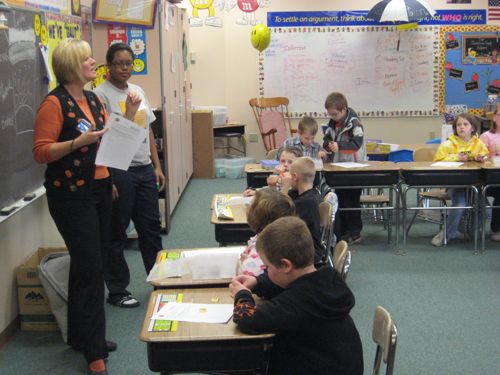
- Geology Club members Lashawna, Kelly, Bridget and Phil worked with two third grade classes at Cornerstone Elementary School to sharpen up the students mineral and rock identification skills.

- Mrs. Gaut goes over the ground rules for the mineral and rock identification exercise. Lashawna looks on.

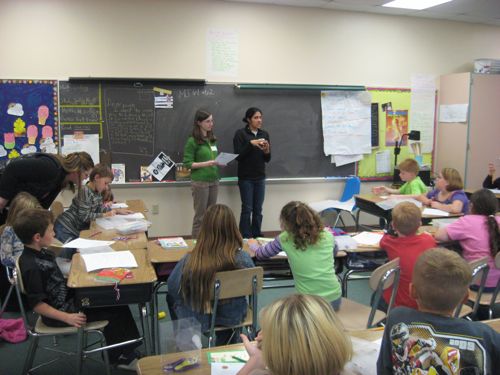
Bridget and Kelly go over the basics of the three rock types and how they form.

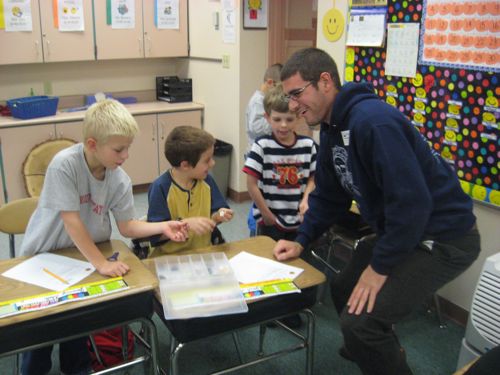
Phil troubleshoots a mineral id by these two gentlemen.

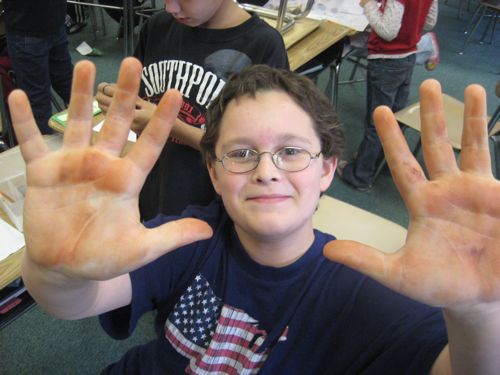
This 3rd grader extends the concept of the streak test by covering his entire two hands in hematite.
Environmental Geology Fieldtrip – Soils/Geologic History and Groundwater

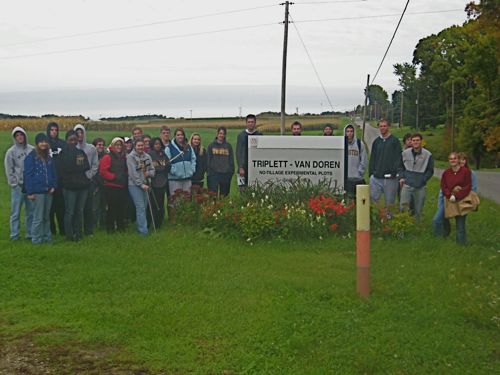
The class at the No-Till experimental plots at the OARDC in Wooster. Students took soil cores from plots that were conventionally tilled and those that have not been tilled for 50 years. The soil structure and organic content in each of the soil cores clearly showed the differences in the farming practices.

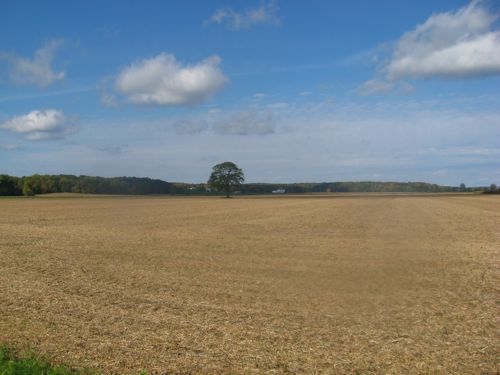
Richa took this spectacular shot of a recently-harvested soybean field. This shows the lake plain from Lake Killbuck and the underfit Killbuck River. The view to the north looks up the Killbuck Spillway. This field was stripped of a foot of fertile topsoil during the 1969 flood.

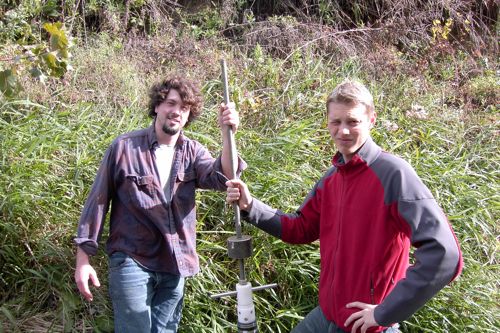
Rob and Palmer pose with coring device that they used to recover a sediment core from the bottom of the Killbuck River where is has downcut into the blue lake clays. The blue clay is the confining layer of the Wooster buried valley aquifer.

Mike from the Wooster water plant explains the challenges of keeping Wooster supplied with clean groundwater.