


Guest Bloggers – SEAK25: On the third and final day in Angoon, we split into two groups. One climbed Hood Bay Mountain to extract high-elevation mountain hemlock cores, the other kayaked to Turn Point, searching for and coring culturally modified trees (CMTs).
The CMTs at Turn Point are Sitka Spruce that have distinct scars with hack marks, evidence of previous Tlingit generations harvesting sap and fire starter. These CMTs are of heightened interest because a new hydroelectric power plant is soon to be built, and its road will require the removal of many trees in Turn Point. High school students in Angoon have already worked to preserve the CMTs by creating photogrammetric renderings. This work will prevent the information from there valuable trees, which connect locals to their lineage, from being lost altogether. We hoped to contribute to the effort by extracting cores to investigate their growth and date the scars using tree rings.
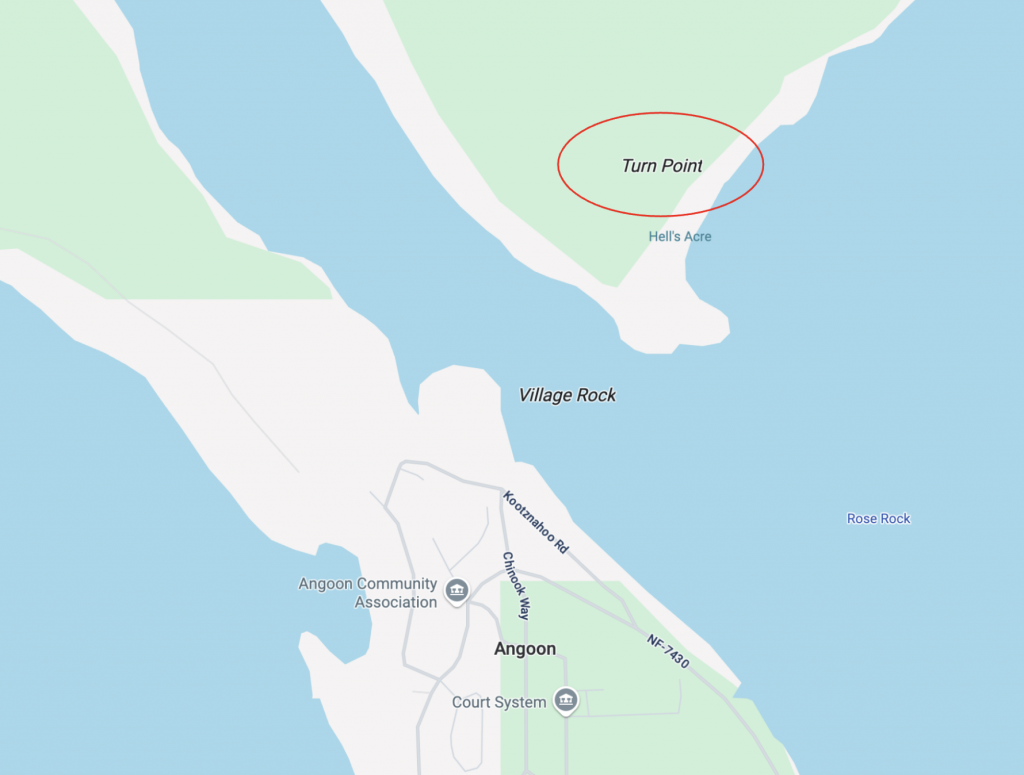
A map showing Turn Point in relation to Angoon. Turn Point will be the site of a hydroelectric plant for power generation for Angoon, which is now powered by a diesel generator.
We embarked on this mission in the morning, leaving from the seaplane dock on kayaks. We had to cross the Stillwater Anchorage inlet and saw a pack of seals and an immature bald eagle on the way.
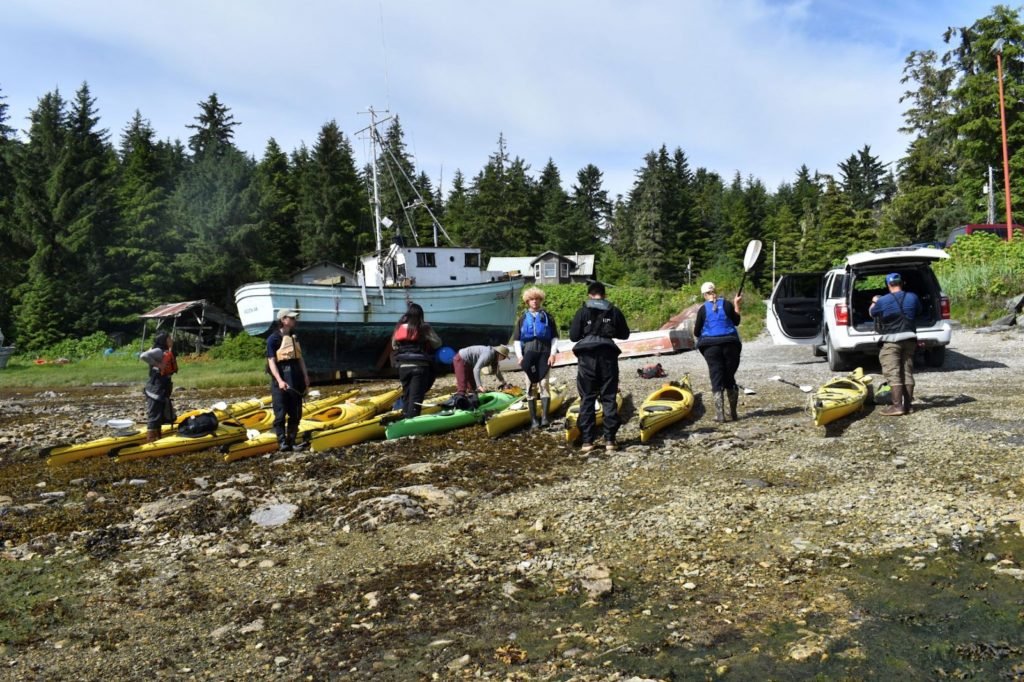
The crew getting ready for the crossing.
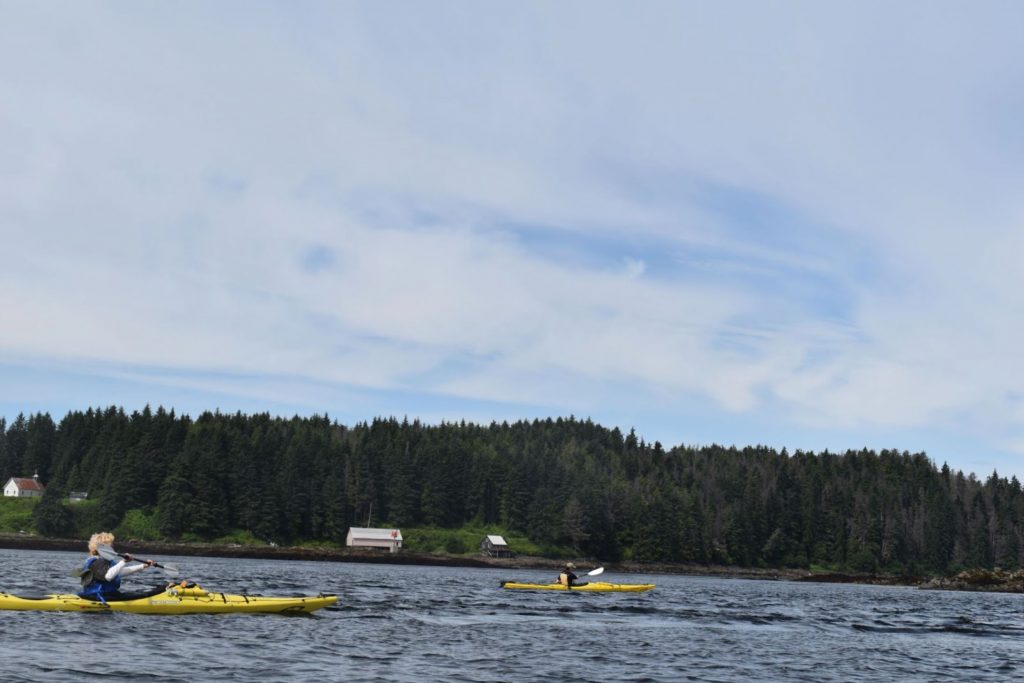
Dexter and Landon crossing the Inlet.
We arrived after thirty minutes of paddling and quickly got to work. Finding the CMTs was rather challenging. Cody and Angel, high schoolers who had worked on the CMTs previously, were a part of the team, and they showed us the location of the CMTs athough we still struggled to trudge through the muddy terrain. We began by extracting five cores from each tree: one in the scar, one above the scar, one on the opposite side from the scar, and one on each side ninety degrees around the tree from the scar. For each tree, we hoped to be able to crossdate the scar core with the other cores, allowing us to obtain its age (the age of the scarring of the trees). Once we started coring, though, we realized that mst of the scar surfaces were too rotted for direct sampling. However, we tried coring next to the scars, and we noticed that roughly at the depth of the scar, the core became extremely sappy – in many cases, so sappy that we could not continue boring. We attribute this to a key spruce defense mechanism – when harmed, the wound is flushed with sap. This worked perfectly to the Tlingit’s advantage, allowing them to easily collect sap, and to ours as well, hopefully allowing us to effectively date the scars without actually coring into them. Essentially, the sap is a proxy for the scar. We adjusted our strategy to take two cores from each CMT, one just to the left of the scar, and one just to the right. By the end of the day, we cored around 15 CMTs.
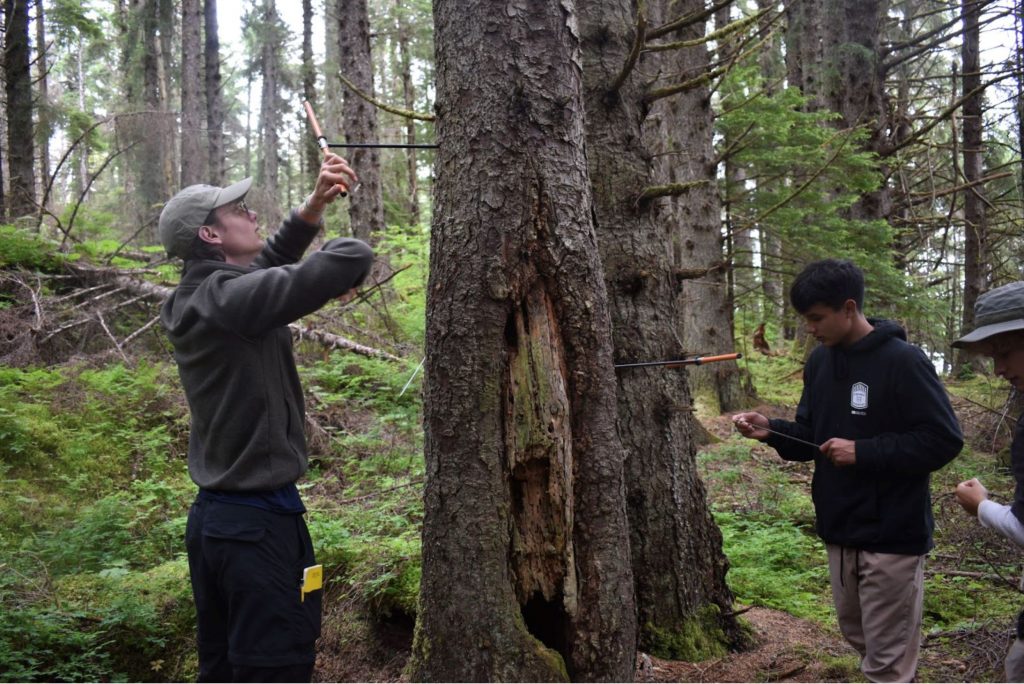
Cody, Landon, and Dexter extracting cores.
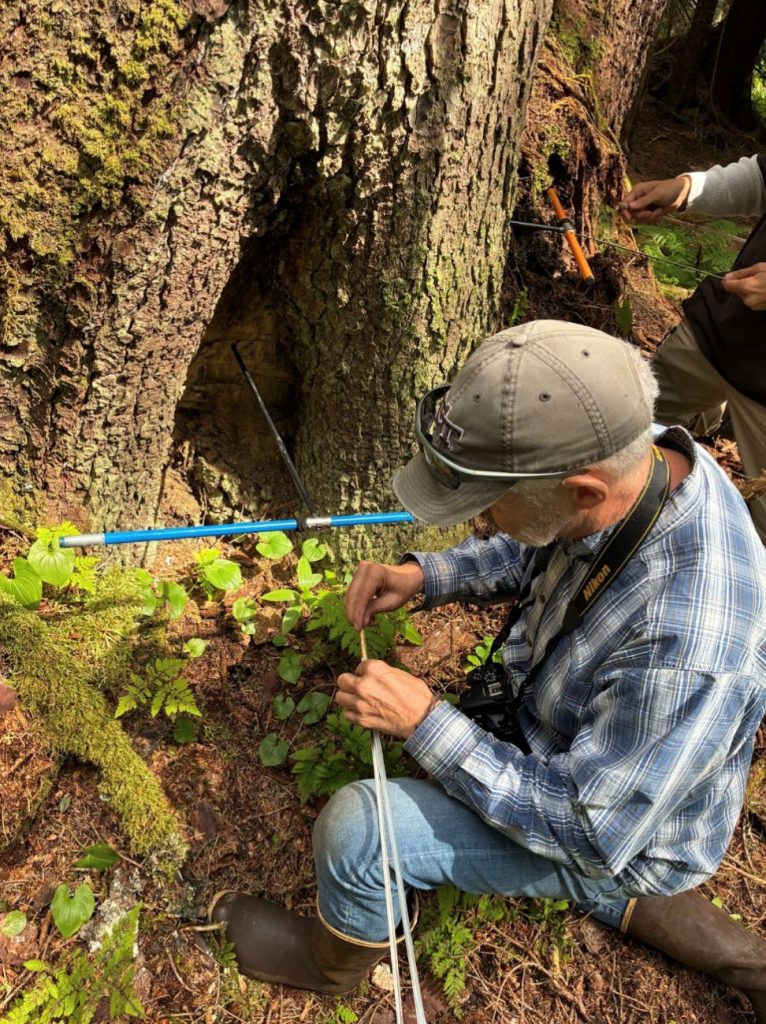
Dr. Wiles extracting a core.
After a long day of coring, we returned to the kayaks and began the journey back across the inlet. This paddle was difficult, as the tide was heartily fighting our strokes. Fortunately, many of us still managed to join the bull kelp club, a distinctive organization constituted of those who have eaten raw bull kelp. It was salty and very slimy.
The extracted cores must dry for a couple of weeks, but will be processed at the Wooster tree ring lab. Upon obtaining dates and results from further analysis, the information will be shared with the Alaska Youth Stewards, contributing to and expanding upon their work with the CMTs.
The work of Keck SEAK25 is funded by the Keck Geology Consortium and the National Science Foundation.