Recent Comments
- Mark Wilson on Wooster’s Fossil of the Week: How to make brilliant acetate peels, with a Jurassic coral example
- Nuy on Wooster’s Fossil of the Week: How to make brilliant acetate peels, with a Jurassic coral example
- Mark Wilson on Wooster’s Fossil of the Week: A pentamerid brachiopod from the Lower Silurian of New York
- Paul Hernday on Wooster’s Fossil of the Week: A pentamerid brachiopod from the Lower Silurian of New York
- Mark Wilson on Dating a Cabin from Pittsburgh
Meta
-
Recent Posts
- Voices in the Trees: Update on the Alaska Youth Stewards and The College of Wooster Tree-Ring Lab Collaboration at Five Years
- Dr. Nicolás Young – Our 44th Annual Osgood Speaker
- Dating a Cabin from Pittsburgh
- A new paper describing the feeding apparatus of Silurian cornulitids from China: More evidence supporting placement of this group in the lophophorates
- Paleoecology (2025) and New Displays in Scovel Hall
March 2026 S M T W T F S 1 2 3 4 5 6 7 8 9 10 11 12 13 14 15 16 17 18 19 20 21 22 23 24 25 26 27 28 29 30 31 Blogroll
Other Links
Wooster Links
Tags
- Alaska
- basalt
- British Columbia
- Cambrian
- Carboniferous
- climate
- climate change
- Cretaceous
- Devonian
- England
- Estonia
- Fossil of the Week
- fossils
- France
- GSA Meeting
- history
- Iceland
- ichnology
- Independent Study
- Indiana
- Israel
- Italy
- Jurassic
- Kentucky
- lava
- limestone
- Miocene
- Mojave Desert
- Negev
- Ohio
- Ordovician
- paleoclimate
- pillow lava
- Pleistocene
- Pliocene
- Poland
- Russia
- Sicily
- Silurian
- tree ring
- UK2015
- undergraduate research
- Utah
- Wooster
- Wooster Geology
Archives
- March 2026
- February 2026
- January 2026
- December 2025
- November 2025
- October 2025
- September 2025
- August 2025
- July 2025
- June 2025
- May 2025
- April 2025
- March 2025
- February 2025
- January 2025
- December 2024
- September 2024
- July 2024
- June 2024
- May 2024
- April 2024
- March 2024
- January 2024
- December 2023
- November 2023
- October 2023
- September 2023
- August 2023
- July 2023
- June 2023
- May 2023
- April 2023
- March 2023
- February 2023
- December 2022
- September 2022
- August 2022
- July 2022
- June 2022
- May 2022
- April 2022
- March 2022
- February 2022
- January 2022
- December 2021
- November 2021
- October 2021
- August 2021
- June 2021
- May 2021
- April 2021
- March 2021
- February 2021
- January 2021
- December 2020
- November 2020
- October 2020
- September 2020
- August 2020
- July 2020
- May 2020
- April 2020
- March 2020
- February 2020
- January 2020
- December 2019
- November 2019
- October 2019
- September 2019
- August 2019
- July 2019
- June 2019
- May 2019
- April 2019
- March 2019
- February 2019
- January 2019
- December 2018
- November 2018
- October 2018
- September 2018
- August 2018
- July 2018
- June 2018
- May 2018
- April 2018
- March 2018
- February 2018
- January 2018
- December 2017
- November 2017
- October 2017
- September 2017
- August 2017
- July 2017
- June 2017
- May 2017
- April 2017
- March 2017
- February 2017
- January 2017
- December 2016
- November 2016
- October 2016
- September 2016
- August 2016
- July 2016
- June 2016
- May 2016
- April 2016
- March 2016
- February 2016
- January 2016
- December 2015
- November 2015
- October 2015
- September 2015
- August 2015
- July 2015
- June 2015
- May 2015
- April 2015
- March 2015
- February 2015
- January 2015
- December 2014
- November 2014
- October 2014
- September 2014
- August 2014
- July 2014
- June 2014
- May 2014
- April 2014
- March 2014
- February 2014
- January 2014
- December 2013
- November 2013
- October 2013
- September 2013
- August 2013
- July 2013
- June 2013
- May 2013
- April 2013
- March 2013
- February 2013
- January 2013
- December 2012
- November 2012
- October 2012
- September 2012
- August 2012
- July 2012
- June 2012
- May 2012
- April 2012
- March 2012
- February 2012
- January 2012
- December 2011
- November 2011
- October 2011
- September 2011
- August 2011
- July 2011
- June 2011
- May 2011
- April 2011
- March 2011
- February 2011
- January 2011
- December 2010
- November 2010
- October 2010
- September 2010
- August 2010
- July 2010
- June 2010
- May 2010
- April 2010
- March 2010
- February 2010
- January 2010
- December 2009
- November 2009
- October 2009
- September 2009
- August 2009
- July 2009
- June 2009
- May 2009
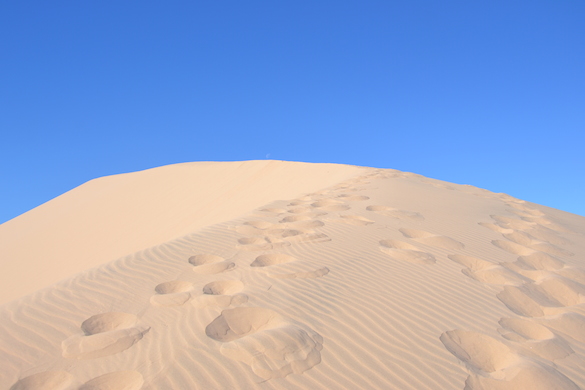
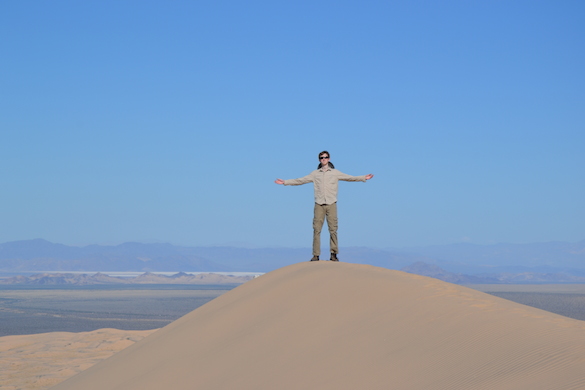
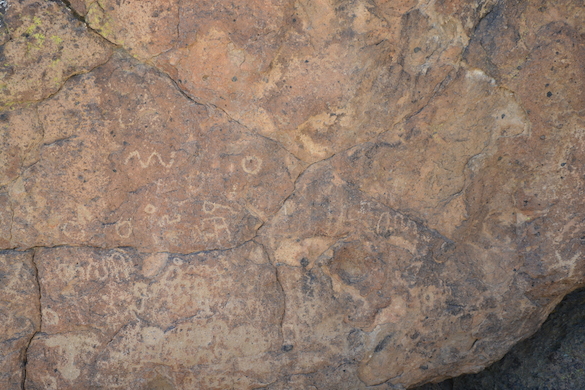
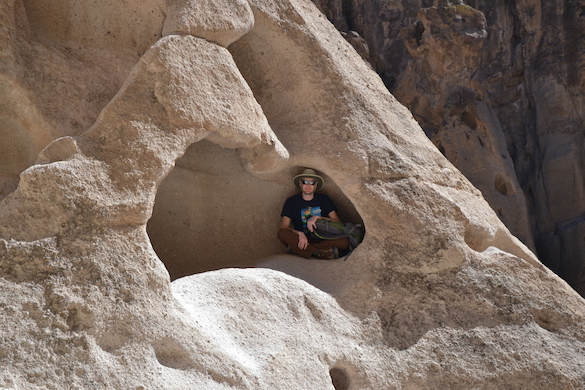
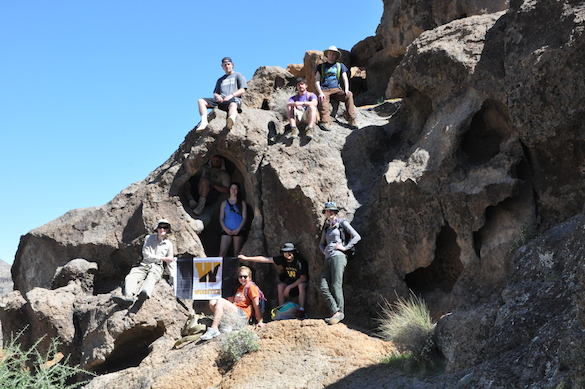
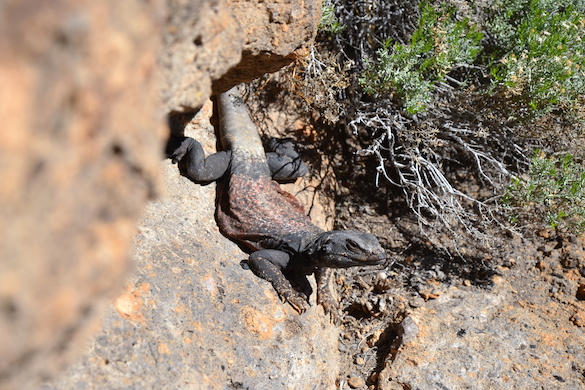
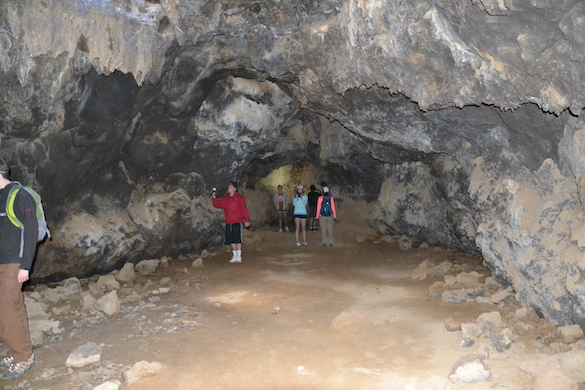
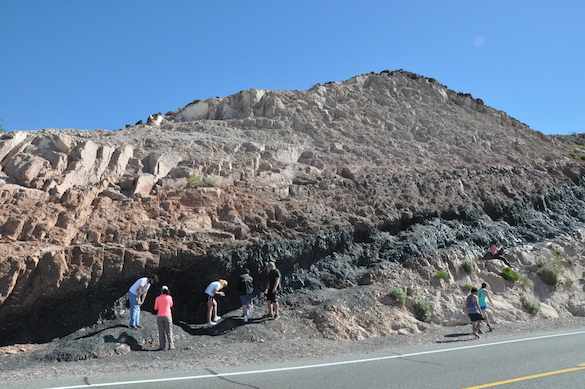
Days Five and Six – Mojave 2015
Posted in Uncategorized
Tagged dunes, fault, Hole in the Wall, Kelso Dunes, lava tube, Mojave Desert, resting springs, tafoni, trilobite, tuff
2 Comments
Wooster’s Fossil of the Week: A new crinoid genus from the Silurian of Estonia
It is my pleasure to introduce a new Silurian crinoid genus and species: Velocrinus coniculus Ausich, Wilson & Vinn, 2015. The image above is a CD-interray lateral view of the calyx (or head), with the small anal plate in the middle-top. (This will make more sense below.) The scale bar is 2.0 mm, so this is a small fossil. It was captured by the Crinoid Master himself (my friend and colleague Bill Ausich) from the Middle Äigu Beds of the Kaugatuma Formation (Upper Silurian, Pridoli) at the Kaugatuma Cliffs of Saaremaa Island, Estonia. It is described in the latest issue of the Journal of Paleontology. Here’s a link to the abstract. (This is the first issue produced by Cambridge University Press, so we’re honored to be part of publishing history.)
Here is another view of the calyx, this time looking laterally at the E-ray.
This figure explains the calyx views we see above. It is a plate diagram of Velocrinus coniculus. Imagine it as what the crinoid would look like if we could separate all its preserved ossicles and lay them out. The radial plates are black; the anal plate is shown stippled and marked with an “X”; the other letters indicate the particular rays. The artwork, and the images above, are from Bill Ausich.
The genus Velocrinus is defined this way in the paper: “Crotalocrinitid with a calyx cone shaped, lacking stereomic overgrowths, comprised of relatively large plates; infrabasals not fused, visible in lateral view; two anal plates; primaxil minute, not visible in lateral view; fixed brachials present; free arms not laterally linked; anus on tegmen; (nature of tegmen plating unknown).” This certainly is opaque to most readers. Trust us — it separates this new genus from all described before. Velocrinus is derived from the Latin term velo, which means to cover or conceal (think “veil”). It refers to the tiny primibrachials, which are not visible in lateral view. The species name coniculus refers to the cone-shaped calyx.
Velocrinus coniculus is known only from the Kaugatuma Cliffs locality on Saaremaa Island. This is one of my favorite outcrops in Estonia. The extensive bedding-plane exposures are rare in the region. They show hundreds of holdfasts (essentially roots) of crinoids, some very large. The deposit was a relatively high-energy carbonate sand shifting through a forest of tall crinoids rooted in the sediment. Palmer Shonk (’10) did an excellent Senior Independent Study with rocks and fossils we collected from this place. The site shown above, by the way, was the location of a Soviet amphibious landing in November 1944.
This is a close look at a bedding plane of Middle Äigu Beds of the Kaugatuma Formation. The crinoid stems are robust and abundant. Oddly enough, we’re still not sure what genus is represented by the large stems and holdfasts. The calyx of Velocrinus coniculus is far too small to have been associated with them. I suppose this means we need another expedition to Estonia!
This is the 1000th post in the Wooster Geologists blog.
References:
Ausich, W.I., Wilson, M.A. and Vinn, O, 2012. Crinoids from the Silurian of western Estonia. Acta Palaeontologica Polonica 57: 613–631.
Ausich, W.I., Wilson, M.A. and Vinn, O, 2015. Wenlock and Pridoli (Silurian) crinoids from Saaremaa, western Estonia (Phylum Echinodermata). Journal of Paleontology 89: 72-81.
For Our Wooster Family
Days Three and Four – Mojave 2015
Day three was spent examining the sedimentology, structure and paleontology, and a bit of the wildlife biology at Owl Canyon. We even stopped at the Payless Shoestore in nearby Barstow (Dr. Wilson’s hometown).
The wildlife was the desert tortoise.
The first stop the next day was the Granite Mountains.
Students (above) discussed the possibility of magma mixing and the enclaves of mafics.

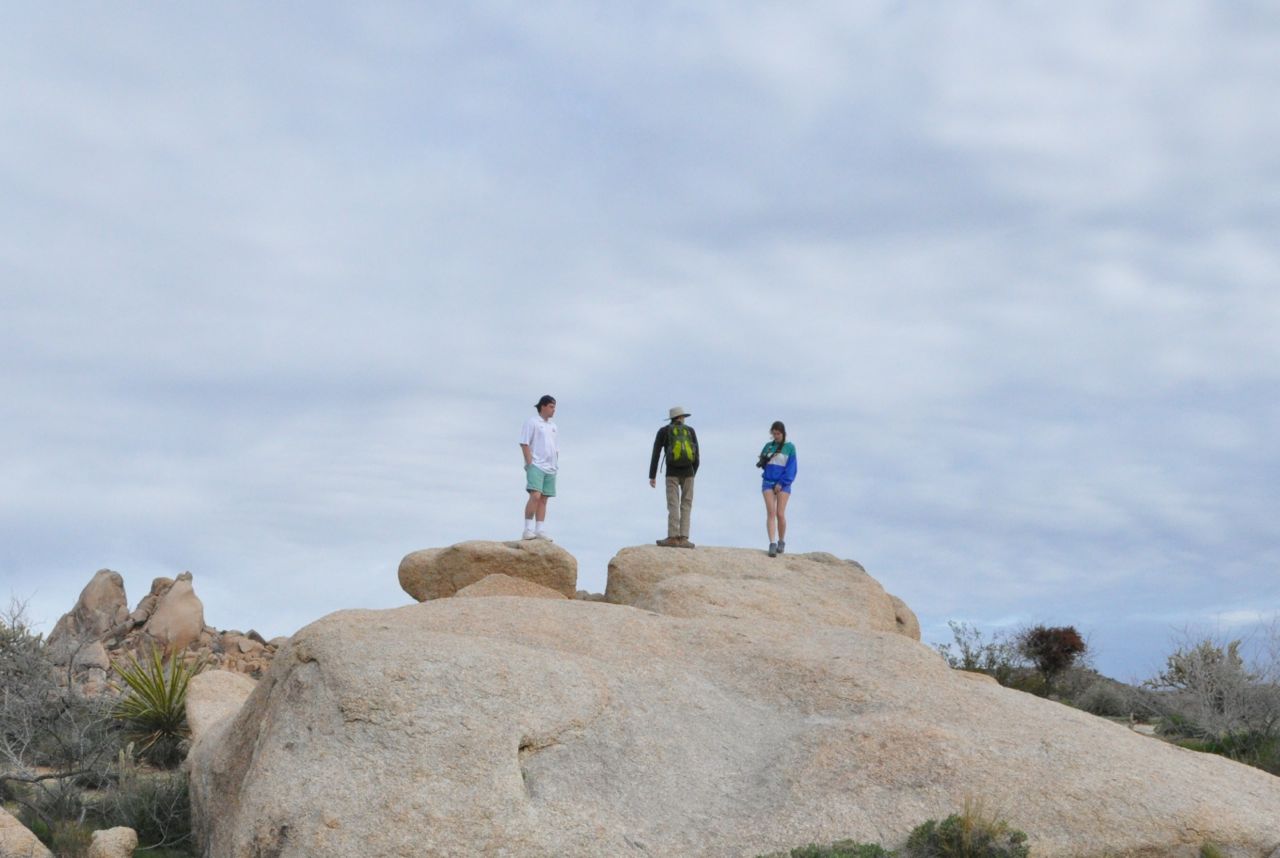
The group on a large sphere of granite.

The next stop was Amboy Crater – a large basaltic cinder cone with associated lava flows. This is a view of the cone looking from the inside out as Nick secures the perimeter.
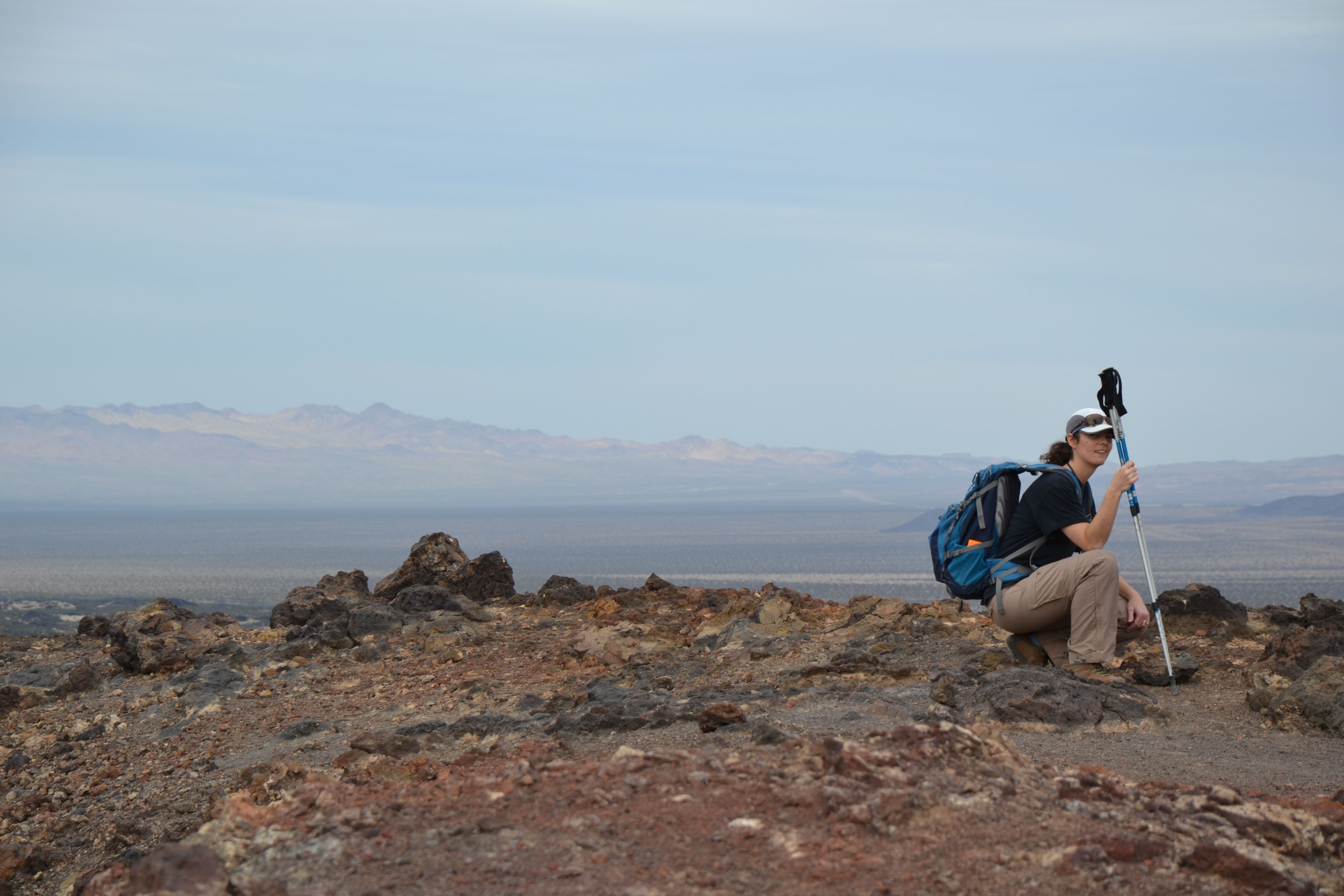
Dr. Pollock was in her element on the ridge of basalt.

Dr. Judge explains to the group how during a time of tectonic extension large-scale folding can develop. This was the last stop of the day at Calico Ghost Town.

The tight ptigmatic folds are almost isoclinal – almost.

Using some sticks found on the side of the parking lot – Dr. Judge folds the earths crust at the location along a strike-slip fault, where the fault makes a bend.
Zach Downes was up early taking a photo of the sunrise across Soda Lake – our home playa.
The First Two Days in the Mojave
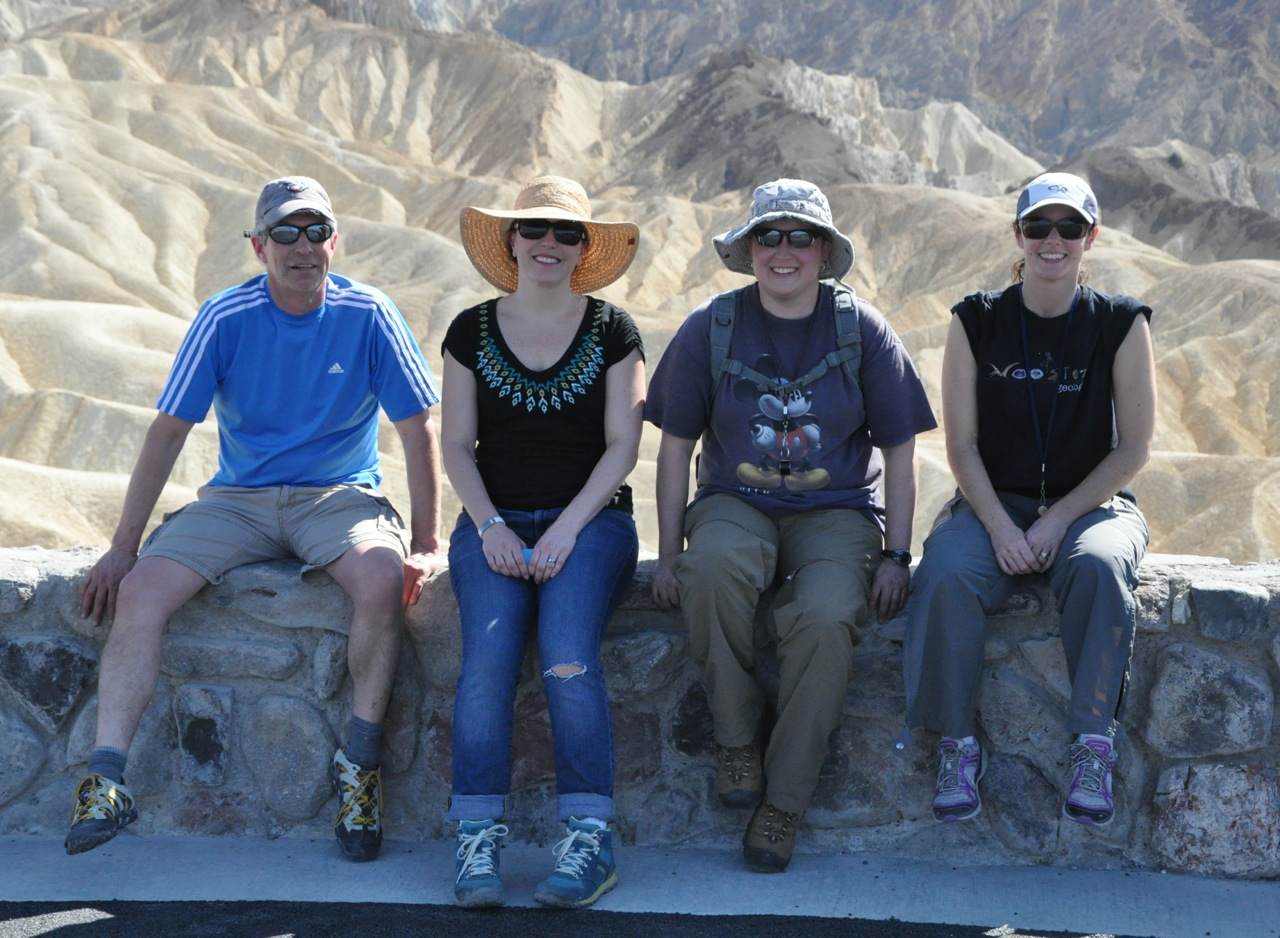
Nine students and five faculty and staff are part of Desert Geology 2015, a week-long fieldtrip to the Mojave Desert. Here the nine students, joined by Cam Matesich (Wooster ’14) gathered at an overlook of Death Valley (Dante’s View). Cam joined the group on the second day to guide us through various sites and share his experiences working with Park hydrologists as part of GSA’s GEOCORP Program. We are missing desert expert and usual trip leader Dr. Wilson, and Patrice Reeder this year and greatly thank them for getting the trip organized and sending us off on the right foot.

After flying into Las Vegas on the first day the group approaches the red rocks of Red Rock Canyon.
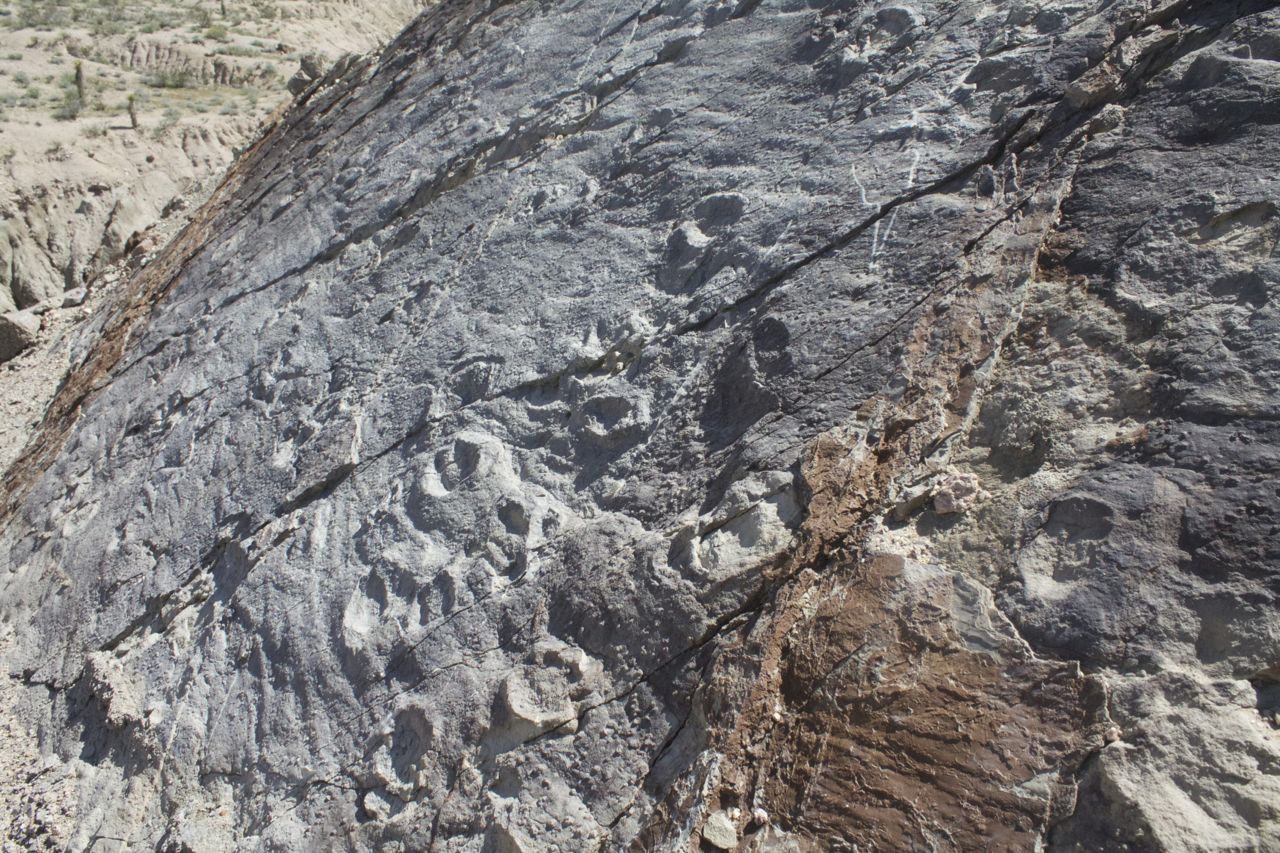
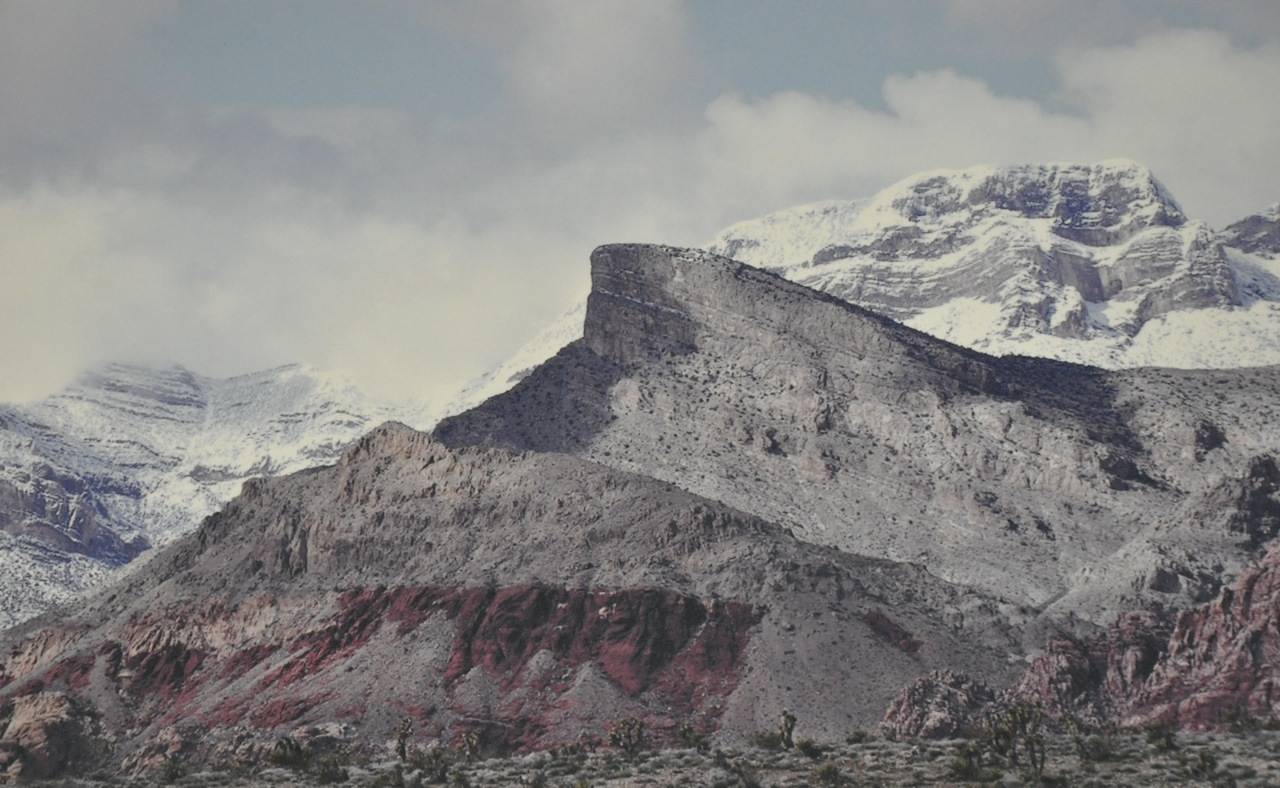
At Red Rocks the group puzzled over the Keystone Thrust Fault that brought gray Paleozoic Limestones on top of the Mesozoic red sandstones.

A winter view of the same Keystone Thrust – photo courtesy of the Red Rock Canyon Visitor Center.
The photographer takes a break.
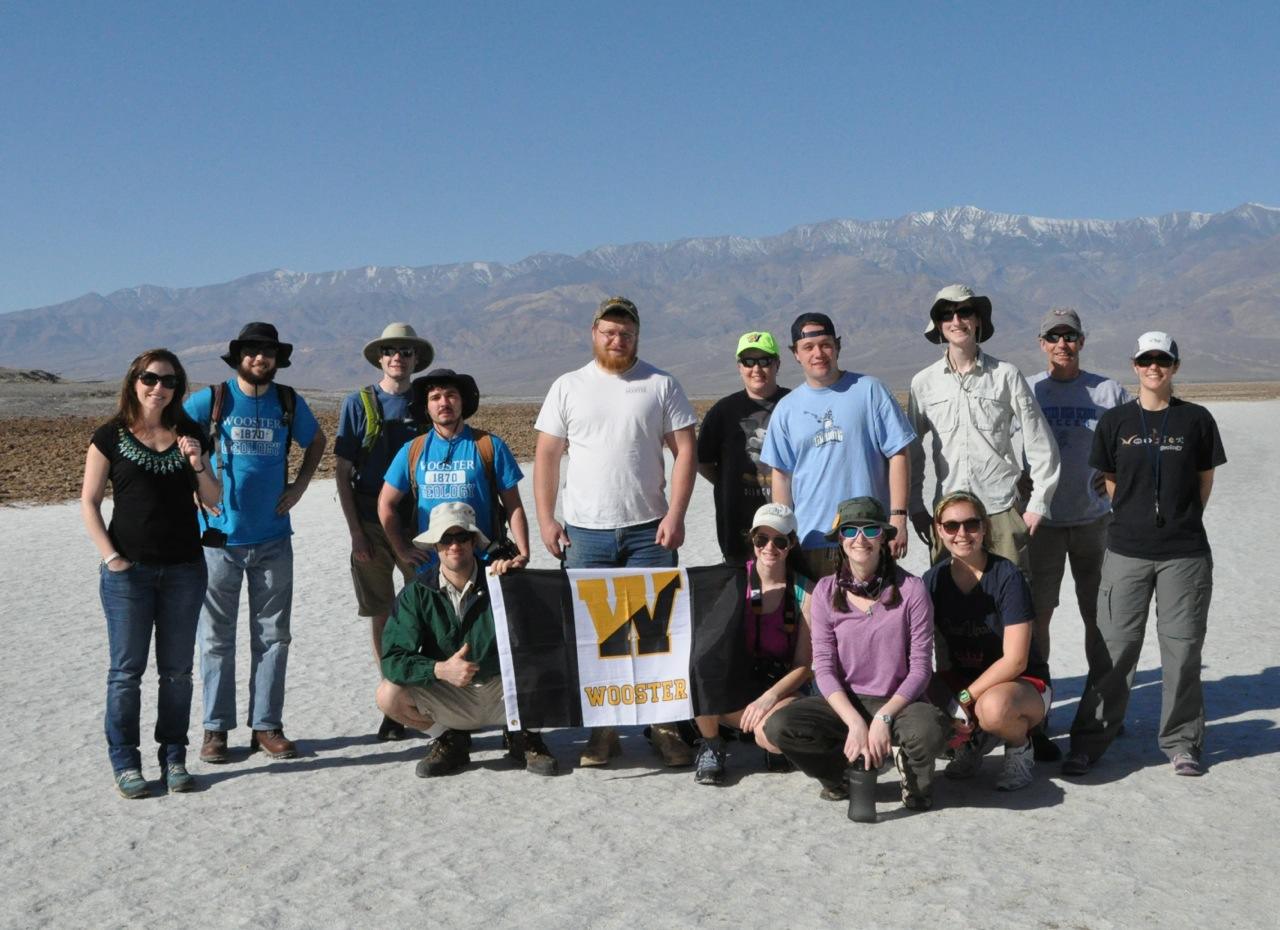
Day two – The full group at Badwater in Death Valley. Lowest point in the Western Hemisphere.

Cam explains the spring and groundwater flow in Death Valley and how the park monitors and restores the hydrologic landscape in the Park.

The group strikes a pose on the Devils Golf Course – Death Valley.

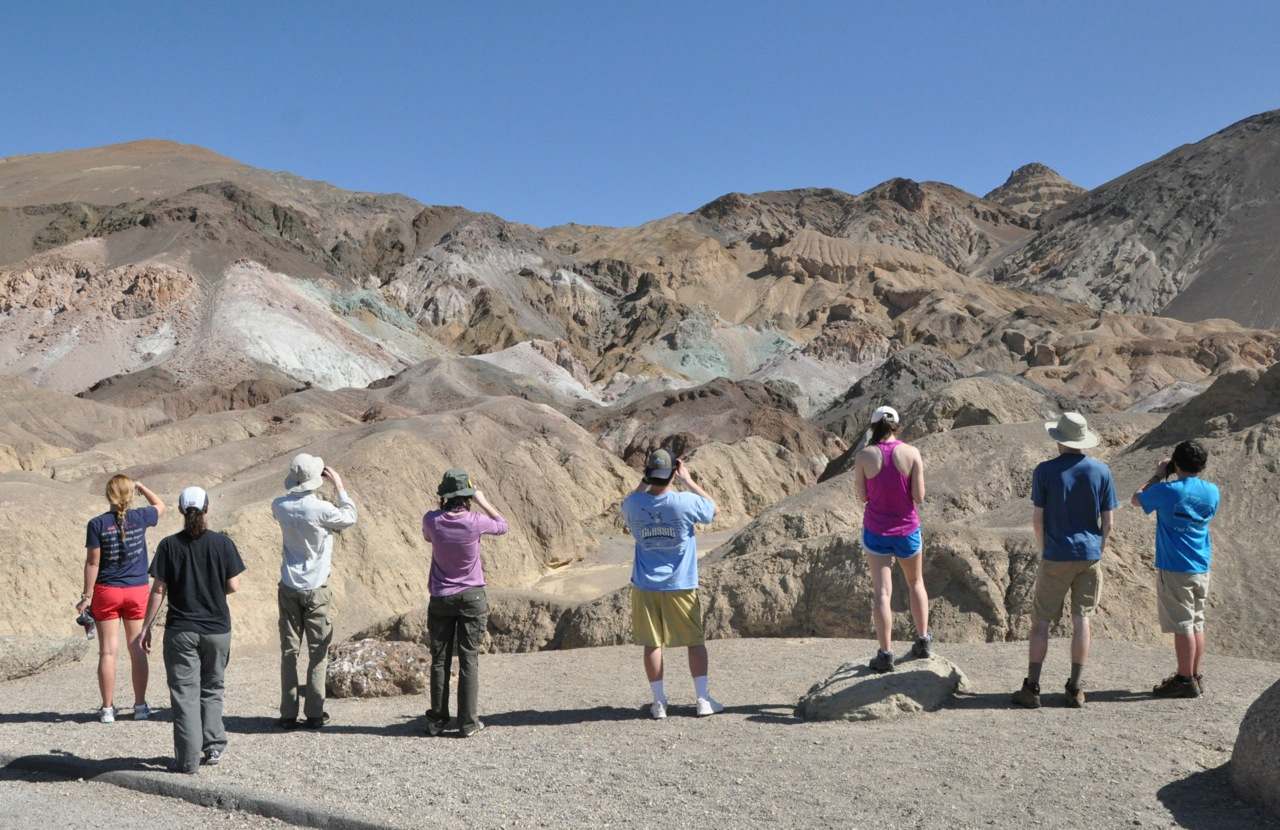
Along Artists Drive in Death Valley photographers go to work.

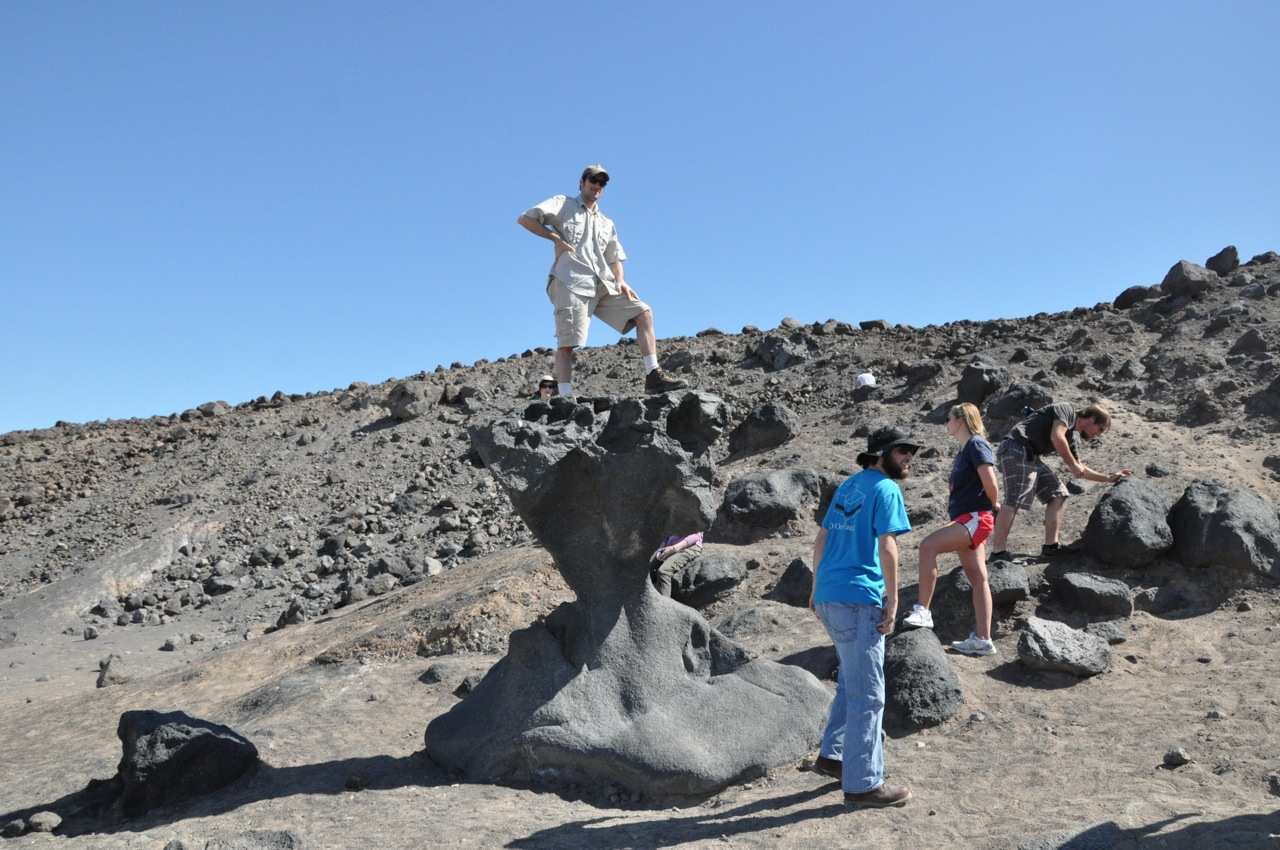
Nick strikes a pose on top of a weathered basalt boulder.

Caitlin, the staff hydrologist, explains the hydrology of a large diameter well in a gravel wash.
Wooster’s Fossil of the Week: A lucinid bivalve from the Middle Jurassic of southern Israel
Above is a specimen of the lucinid bivalve Fimbria sp. from the Matmor Formation (Middle Jurassic) of Makhtesh Gadol in southern Israel. I collected it in 2007 while working with Meredith Sharpe (Wooster ’08) as she pursued the fieldwork for her Independent Study project. It is a nice specimen in part because of its preservation. A closer look (below) shows very fine detail of the shell exterior.
The shell is no longer present, though. It was originally composed of the mineral aragonite, which was dissolved away, leaving an external mold that later filled in with very fine crystals of calcite. The sculpture of the shell is exquisitely reproduced; in some places even so well as to show growth lines. Many aragonitic bivalves and gastropods are preserved this way near the top of the Matmor Formation.
Lucinid bivalves are still common today in the sea. The shell shown above is a modern Fimbria fimbriata from the Solomon Islands. They are infaunal, meaning they live burrowed in the sediment. Since they were not genetically endowed with long siphons, they use the foot to create mucus-lined tubes to the surface for access to seawater. Lucinids have an endosymbiotic relationship with sulfide-oxidizing bacteria in their gill tissues. They have a hemoglobin type that transports hydrogen sulfide to autotrophic bacteria, which in turn provide the bivalves with nutrition and enable them to survive in a variety of environments, from near deep-sea hydrothermal vents to shallow seagrass meadows.
Johann Karl Megerle von Mühlfeld (1765-1842) named Fimbria in 1811. I very much wish I had a portrait to go with that magnificent name. Megerle von Mühlfeld worked at the Naturhistorisches Museum in Vienna through the eventful Napoleonic years. He is best known for his pioneering work with insects, but he also curated the mollusk collections, which led to his description of the new Fimbria.
References:
Anderson, L.C. 2014. Relationships of internal shell features to chemosymbiosis, life position, and geometric constraints within the Lucinidae (Bivalvia), p. 49-72. In: Experimental Approaches to Understanding Fossil Organisms. Springer Netherlands.
Megerle von Mühlfeld, J.K. 1811. Entwurf eines neuen System’s der Schalthiergehäuse. Gesellschaft Naturforschender Freunde zu Berlin, Magazin 5: 38-72.
Monari, S. 2003. A new genus and species of fimbriid bivalve from the Kimmeridgian of the western Pontides, Turkey, and the phylogeny of the Jurassic Fimbriidae. Palaeontology 46: 857-884.
Morton, B. 1979. The biology and functional morphology of the coral-sand bivalve Fimbria fimbriata (Linnaeus, 1758). Records of the Australian Museum 32: 389-420.
Taylor, J.D. and Glover, E.A. 2006. Lucinidae (Bivalvia)–the most diverse group of chemosymbiotic molluscs. Zoological Journal of the Linnean Society 148: 421-438.
Wooster’s Fossil of the Week: Star-shaped crinoid columnals from the Middle Jurassic of southern Utah
Just a quick Fossil of the Week post. Above we see isolated columnals (stem units) of the crinoid Isocrinus nicoleti (Desor, 1845) found in the Co-Op Creek Member of the Carmel Formation (Middle Jurassic), Kane County, southern Utah. Greg Wiles recently received them as part of a donation to our department collections. They have such perfect star shapes that I had to share them here. For the full analysis, see my previous entry on columnals like these preserved in a limestone from the same location.
References:
Baumiller, T.K., Llewellyn, G., Messing, C.G. and Ausich, W.I. 1995. Taphonomy of isocrinid stalks: influence of decay and autotomy. Palaios 10: 87-95.
Tang, C.M., Bottjer, D.J. and Simms, M.J. 2000. Stalked crinoids from a Jurassic tidal deposit in western North America. Lethaia 33: 46-54.
Wooster’s Fossil of the Week: A molded brachiopod from the Lower Carboniferous of Ohio
We haven’t had a local fossil featured on this blog for awhile. Above is an external mold of the spiriferinid brachiopod Syringothyris typa Winchell, 1863, from the Logan Formation (Lower Carboniferous, Osagean, about 345 million years old) of southeastern Wooster, Ohio. The outcrop is along the onramp from north Route 83 to east Route 30. Older Wooster geologists may remember this area was called “Little Arizona” because of the large roadcuts made for a highway bypass that was never completed. That original outcrop was destroyed several years ago, but the same rocks are exposed in this new section. This is the area where Heather Hunt (’09) did her Senior Independent Study work, and long before her Brad Leach (’83) worked with the same fossils.
The Logan Formation is primarily fine sandstone, with some subordinate conglomerates, silts and shales. It was likely deposited in the proximal portion of a prodelta at or below wavebase. The fossils in the Logan are mostly these large Syringothyris and the bivalve Aviculopecten, along with scattered crinoids, gastropods, bryozoans, nautiloids and ammonoids. This fauna needs more attention. Funny how the fossils in your own backyard are so often ignored.
This brachiopod was first buried in sediment and then the shell dissolved away, leaving an impression behind. Since it is an impression of the exterior of the shell, it is called an external mold. Curiously, all the external molds (and the internal molds as well) in the local Logan Formation have an iron-rich, burnt orange coating much finer than the fine sand matrix. This means that details are preserved that are of higher resolution than the matrix alone would allow. In the case of this fossil, that coating extended down into long, narrow borings in the shell, casting them (see below).
These borings are odd. Most of them are parallel to the ribs (plicae) of the brachiopod, and appear to have been excavated from the shell periphery towards its apex. This was in the opposite direction of brachiopod shell growth. I suspect they were made by boring annelid worms that started at the growing edge of the shell where the mantle ended. These traces need attention, like most other aspects of this local fossil fauna.
References:
Ausich, W.I., Kammer, T.W. and Lane, N.G. 1979. Fossil communities of the Borden (Mississippian) delta in Indiana and northern Kentucky. Journal of Paleontology 53: 1182-1196.
Bork, K.B. and Malcuit, R.J. 1979. Paleoenvironments of the Cuyahoga and Logan formations (Mississippian) of central Ohio. Geological Society of America Bulletin 90 (12 Part II): 1782-1838.
Leach, B.R. and Wilson, M.A. 1983. Statistical analysis of paleocommunities from the Logan Formation (Lower Mississippian) in Wayne County, Ohio. The Ohio Journal of Science 83: 26.
Posted in Uncategorized
Tagged Carboniferous, Fossil of the Week, fossils, Ohio, Wooster
Leave a comment
Wooster’s Fossil of the Week: Sponge and bivalve borings from the Miocene of Spain
This week we have a rather unimposing limestone cobble, at least from the outside. It was collected way back in 1989 by my student Genga Thavi (“Devi”) Nadaraju (’90) as part of a Keck Geology Consortium field project in southeastern Spain. It comes from the Los Banós Formation (Upper Miocene) exposed near the town of Abanilla. The holes are borings excavated into the carbonate matrix by marine animals. This cobble was tossed about in a coral reef complex that was part of the ancient Fortuna Basin.
Seeing the cobble in cross-section makes it much more interesting. (Geologists love their rock saws!) We now see two categories of borings: one is large and flask-shaped, and the other a small network of spherical cavities. The large borings were produced by bivalves that tunneled into the limestone to make living chambers (domichnia) from which they could filter-feed. As the bivalve grew, the hole became deeper and wider. There was no escape — making and living in a boring like this is a lifetime occupation. These bivalve borings are classified as the trace fossil Gastrochaenolites lapidicus Kelly and Bromley, 1984. The smaller borings were made by clionaid demosponges that used acid to create a series of connected chambers, also for filter-feeding. These sponges could only penetrate about ten mm or so before their filtering became ineffective, so they are confined to the outer periphery of the cobble. The sponge borings are given the trace fossil ichnogenus Entobia Bronn, 1837.
On the inside surface of the largest boring (right side), encrusting tubes of a serpulid worm are just visible. This serpulid was also a filter-feeder. It took advantage of the cozy hole after the bivalve borer died and decayed. It is called a coelobite, or cavity-dweller. Serpulids would have had a rough time cementing to the outside of the cobble as it rolled around in this high-energy environment.
References:
Bronn, H.G. 1834-1838. Lethaea Geognostica (2 vols., Stuttgart).
Kelly, S.R.A. and Bromley, R.G. 1984. Ichnological nomenclature of clavate borings. Palaeontology 27: 793-807.
Mankiewicz, C. 1995. Response of reef growth to sea-level changes (late Miocene, Fortuna Basin, southeastern Spain). Palaios 10: 322-336.
Mankiewicz, C. 1996. The middle to upper Miocene carbonate complex of Níjar, Almería Province, southeastern Spain, in Franseen, E.K., Esteban, M., Ward, W.C., and Rouchy, J.-M., eds., Models for carbonate stratigraphy from Miocene reef complexes of the Mediterranean regions: Tulsa, SEPM (Society for Sedimentary Geology), p. 141-157.
Nadaraju, G.T. 1990. Borings associated with a Miocene coral reef complex, Fortuna basin, southeastern Spain. Third Keck Research Symposium in Geology (Smith College), p. 165-168.
Taylor, P.D. and Wilson, M.A. 2003. Palaeoecology and evolution of marine hard substrate communities. Earth-Science Reviews 62: 1-103.
Wooster’s Fossil of the Week: A Pleistocene octocoral holdfast from Sicily
My Italian colleague Agostina Vertino collected this beautiful specimen from the Pleistocene of Sicily and brought it to Wooster when she visited five years ago. It is the attaching base (holdfast) of the octocoral Keratoisis peloritana (Sequenza 1864). Octocorals (Subclass Octocorallia of the Class Anthozoa) are sometimes called “soft corals” because of their organic-rich, flexible skeletons. They are distinguished by polyps with eight tentacles, each of which is pinnate (feathery). Octocorals include beautiful sea fans and sea whips that require a hard substrate for stability. This particular holdfast is on a small slab of limestone.
The genus Keratoisis is known as the “bamboo coral” because it looks jointed like stalks of the plant. I collected fragments of Pleistocene Keratoisis branches during my visit to Sicily last year.
Giuseppe Seguenza (1833-1889) named the species Keratoisis peloritana. He was a Sicilian natural historian with broad interests, especially in geology. Although educated as a pharmacist, he found geology much more exciting on the volcanically active islands of the Mediterranean. He eventually became a professor of geology at the University of Messina (where the bust of him shown above resides). Italian sources say Seguenza received the famous Wollaston Medal from the Geological Society of London, but that does not appear to be true. Instead it appears that he was given “the balance of the proceeds of the Wollaston Fund” as a donation at the time the medal was awarded to Thomas Huxley (in 1876). The records of the society say that “the stipend of an Italian professor was too small to enable him to prosecute his palaeontological researches as fully as he could desire” (Woodward, 1876). Giuseppe Seguenza died in Messina at 56 years old.
References:
Di Geronimo, I., Messina, C., Rosso, A., Sanfilippo, R., Sciuto, F., and Vertino, A. 2005. Enhanced biodiversity in the deep: Early Pleistocene coral communities from southern Italy. In: Cold-Water Corals and Ecosystems, p. 61-86. Springer: Berlin, Heidelberg.
Fois, E. 1990. Stratigraphy and palaeogeography of the Capo Milazzo area (NE Sicily, Italy): clues to the evolution of the southern margin of the Tyrrhenian Basin during the Neogene. Palaeogeography, Palaeoclimatology, Palaeoecology 78: 87-108.
Langer M. 1989. The holdfast internodes and sclerites of Keratoisis melitensis Goldfuss 1826 Octocorallia in the Pliocene foraminifera marl Trubi of Milazzo Sicily Italy. Palaeontologische Zeitschrift 63: 15-24.
Woodward, H. 1876. Reports and proceedings, Geological Society of London. Geological Magazine 13: 181-182.
Posted in Uncategorized
Tagged Fossil of the Week, fossils, Italy, Pleistocene, Sicily
Leave a comment