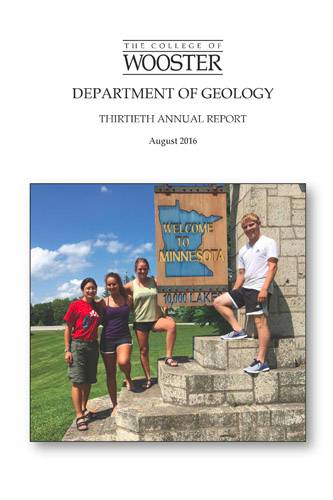
Wooster Geologists in Minnesota

Team Minnesota with MW 585Four students, Geological Technician Nick Wiesenberg and Professor Mark Wilson (me!) have just completed eight days of geological fieldwork in the Upper Ordovician of southeastern Minnesota as part of Wooster’s Senior Independent Study program. The students are, from the left, Etienne Fang, Nikki Bell, Rachel Wetzel, (me), and Dean Thomas. We have blog posts for each day of the expedition, which have now appeared after we arrived home. Because the entries did not come out daily, you can read them by using the blog calendar or this list:

July 26: Team Minnesota Assembles!
July 27: Team Minnesota visits the Upper Ordovician of Iowa
July 28: Wooster Geologists tramping through the brush of southern Minnesota
July 29: The work begins
July 30: Paleontological fieldwork in southeastern Minnesota
July 31: Team Minnesota finishes its work (in Iowa, funny enough)
August 1: A wet cave and the Mighty Mississippi River
August 2: A visit to the Dalles of St. Croix in Wisconsin

Thank you again to Andrew Retzler (Wooster Geology ’11), a Paleozoic Geologist at the Minnesota Geological Survey, for suggesting this trip and for being such a superb guide to the stratigraphy of southeastern Minnesota. We could not have done it without him! The same is true of Nick Wiesenberg, who was an essential member of the team, being absolutely critical when it came to logistics and planning.

Now Dr. Shelley Judge and I begin advising the laboratory portion of the student projects. More posts from Team Minnesota will appear soon!

Minnesota 2016 Localities —

C/W-730  Quarry near Rochester, MN
C/W-731  Market: N 43.97233°, W 92.38215°
C/W-732  Golden Hill: N 43.98788°, W 92.47962°
C/W-733  Wangs Corner: N 44.41047°, W 92.98338°
C/W-734  Turkey Run: N 44.38441°, W 92.91199°
C/W-735  Decorah-Bruening Quarry: N 43.29036°, W 91.76558°


Posted in Uncategorized | Tagged , | Leave a comment

A visit to the Dalles of St. Croix in Wisconsin

1 Interstate Rachel viewRochester, Minnesota — On its last day in the field, Team Minnesota had a geological trip to the Dalles of St. Croix in Interstate State Park, Wisconsin and Minnesota. It was beautiful, and we practically had the place to ourselves, not counting several million mosquitoes.

The Dalles are where the St. Croix River cuts through a series of Middle Proterozoic (1.1 billion year old) basalts. (Dalles is a French word for a narrow river gorge with rocky sides.) The basalts are of the Chengwatana Volcanic Group and represent ten thick flows of lava. They are much more resistant than the surrounding sedimentary rocks, so the river was forced into a narrow, deep and fast channel. In the top image Rachel Wetzel is looking across the river to the Minnesota side.

2 Dalles southThe basalt tends to fracture along vertical joints with the force of the water, producing vertical cliffs.

3 St Croix River southExcursion paddle-wheeler boats ply the river here. We saw very few tourists, though..

4 Interstate basaltThe basalts have many vesicles (gas bubble holes) that later filled with minerals, producing a structure called an amygdale. (Thanks, Dr. Pollock!) The lava flows vary in the number and size of their vesicles, and the mineralogy of the amygdales. The round white features in this basalt are quartz amygdales. There are also some brownish feldspar phenocrysts (large crystals in the basalt matrix).

5 Amygdales weatheredThis is what a weathered surface of the amygdaloidal basalt looks like. I was at first fooled into thinking it was a sandstone with quartz pebbles! (Such a unit exists unconformably above the basalts.)

6 Etienne potholeThere are enormous glacial potholes excavated into the basalt at the Dalles of St. Croix, some as high as 30 meters above the present river. They were formed about 10,000 years ago as glacial meltwater poured across this basalt in volumes many times higher than the river today. Stones would become trapped in eddies and whirlpools, spinning around and grinding their way into the basalt below them. These may be the largest glacial potholes in the world. Etienne Fang shows the size of one. She is sitting on debris, so the holes goes considerably deeper.

7 Dean size potholeDean Thomas found one just his size.

8 Dragonfly DeanDean turned out to be attractive to more than just ticks and chiggers. A dragonfly found his hair worth exploring.

9 Bullfrog DeanAnd this bullfrog was comfortable on his shoulder.

Thus Team Minnesota 2016 completed its expedition! Tomorrow the students fly out of the Minneapolis-St. Paul Airport, and Nick and I drive 12 hours or so back to Wooster with our samples and equipment. Our next posts will be about our observations and ideas from labwork back in Wooster.

Posted in Uncategorized | Tagged , , , , | 2 Comments

A wet cave and the Mighty Mississippi River

1 Niagara Cave 1Rochester, Minnesota — Since Team Minnesota efficiently finished its fieldwork yesterday, we have two days before the students fly out of the Minneapolis-St. Paul airport. The good weather has given us a gift of time, so we’re using it like enthusiastic geologists.

This morning we drove down to Harmony, Minnesota, near the Iowa border to visit Niagara Cave. This cave is unusual because it has a stream with a 60-foot waterfall and (a new term to me) active vadose canyons. The cave is entered down a sinkhole into the Dubuque Formation, and then it descends through the Stewartville Formation and reaches its lowest level in the Prosser Formation. These are Ordovician units above the Platteville-Decorah-Cummingsville sequence we did our work with. The cave passages follow joint patterns inn these limestones. It is plenty wet down there.

2 Cave joint NiagaraMy cave photos are not the best with my small flash. Here at least we can see a vertical joint passage and flowstone structures.

3 Cave StreamThe fast-moving stream running through Niagara Cave.

4 Waterfall top Niagara CaveThe top of the 60-foot waterfall.

5 Cave stratThis view up into a dome shows the internal stratigraphy visible in the limestones.

6 Ceiling gastropodsPlenty of fossils are exposed in the cave. These are sections of gastropods in the ceiling of one section. They were high up so I have little idea of their sizes. I’m just amazed the photo worked out.

7 Queens BluffIn the afternoon we drove northeast to Great River Bluffs State Park on the Mississippi. We had spectacular views of the river and its opposite bank in Wisconsin. Above is a view eastward of Queen’s Bluff overlooking the river.

8 Black River DeltaThe main navigation channel of the Mississippi is in the foreground, with the Black River Delta in the middle ground. In the distance are the bluffs on the Wisconsin side, about 4-5 miles away.

9 Team Minnesota 080116Team Minnesota is ready to answer any geological questions!


Posted in Uncategorized | Tagged , , , | Leave a comment

Team Minnesota finishes its work (in Iowa, funny enough)

1 Decorah outcrop 073116Rochester, Minnesota — We returned to Decorah, Iowa, today to measure and sample the Decorah Shale (Upper Ordovician) in its type locality. It was much drier here than on our last attempt! Above is the gray Decorah Shale topped by the brown Cummingsville Formation.

2 Dean sampling 073116We started below the quarry exposure along the road to get the top of the Platteville Formation. This is the main locality for Dean Thomas (above) who is sampling these three units for conodonts and their associated carbonate petrographic facies. You may see tiny red ribbons on the outcrop that mark where we removed small blocks of limestone for lab analysis back in Wooster.

3 Decorah sampledHere are some of Dean’s sampled strata in the Decorah. He also collected a few samples from the base of the overlying Cummingsville.

4 Etienne collecting 073116While Dean measured section and took samples, Etienne Fang (pictured), Rachel Wetzel and Nikki Bell worked through the Decorah Shale collecting fossils, with special concentration on the beautiful “gumdrop” bryozoan Prasopora.

5 Minnesota lunch 073116It was a sunny day, so we took shade where we could find it!

6 Cummingsville blocksAt the end of the day we explored the richly-fossiliferous Cummingsville in blocks fallen from the face of the old quarry wall.

7 Traces and brachsThe Cummingsville is rich with both body fossils (brachiopods, crinoids, gastropods, bryozoans, especially) and trace fossils. A future Senior IS project?

8 Team Minnesota signTeam Minnesota has now completed its fieldwork! From the left, Etienne Fang (Bethesda, Maryland), Nikki Bell (Santa Monica, California), Rachel Wetzel (Sewickley, Pennsylvania) and Dean Thomas (Montpelier, Virginia). These students did fine work, setting themselves up for several months of lab analyses back in Wooster. I’m proud of this group!

We still have a couple of days in Minnesota before the students fly to their homes and Nick Wiesenberg and I make the long drive back to Wooster with our samples and equipment. We plan to see the geological and historical sights within range of Rochester, which will, of course, be duly reported here.

Posted in Uncategorized | Tagged , , | Leave a comment

Paleontological fieldwork in southeastern Minnesota

1 Nikki brachs 073016Rochester, Minnesota — It was a good day for fossil collecting on the Minnesota prairie. Above you see a handful of articulated orthid brachiopods collected by Nikki Bell at a quarry exposure near Rochester.

2 Shop Quarry 073016 This quarry has long been abandoned and is quickly reverting back to woodlands except for the steepest parts of the old walls. The grey streak visible through the trees is our site where the Decorah Shale is exposed.

3 Shop Quarry 073016 closeAs usual, we worked on steep slopes with plenty of foliage. The fossils, though, were easy to find.

4 HCS at Shop QuarryThe shale has thin limestone beds penetrated thoroughly by the trace fossils Chondrites (the small holes visible in the slab above). This particular rock shows hummocky cross-stratification on its top surface (the dips and ridges), almost certainly an indication it was deposited during an Ordovician storm.

6 Rachel 073016Rachel Wetzel (Pennsylvania) is working with the fossils from this quarry and our other Decorah outcrops to put together a general paleoecological reconstruction and then explore in detail the bryozoans. She is particularly adept at effortlessly clinging to steep slopes!

5 Nikki 073016Nikki Bell (California) is working on the Decorah fossils with Rachel. Her specialty will be the brachiopods.

7 Etienne 073016Etienne Fang (Maryland) is studying the “iron ooids” found in the Decorah Shale at this quarry and several other sites.

8 Dean 073016Dean Thomas (Virginia) will be assessing the carbonate petrology and conodonts of the Decorah Shale, along with the underlying Platteville and overlying Cummingsville Formations. His main outcrop will be in Iowa, but he’s also collecting limestone specimens within the Decorah at other locations for biostratigraphic correlation. All four student projects are integrated, with the whole team collecting data and samples for each individual project.

9 Nick 073016Our superb geological technician Nick Wiesenberg has also been collecting fossils for us.

10 Lunch 073016A typical lunch in the woods for us. We’ve had surprisingly few mosquitoes, and very patchy interactions with parasites. Dean is a tick magnet, and I’ve been badly chiggered!

11 Golden Hill 073016Our last stop of the day was the annoying Golden Hill roadcut (N 43.98788°, W 92.47962°). It is next to an off-ramp of US 52/63 so we have to reach it by descending through a bouldery, overgrown culvert from above. The students did their jobs, though, and did good sampling.

12 Wild Parsnip bushThis spindly green bush is wild parsnip (Pastinaca sativa), a plant we’re careful to avoid despite its abundance in some very inconvenient places. It is often referred to as poison parsnip for good reasons. These plants contain “furocoumarins, chemicals that when combined with skin and ultraviolet light can cause what’s known as a phytophotodermatitis”. You have to contact the sap of the plant and then be exposed to the sun, so brushing against it is not a problem. We worry about grabbing a stalk and breaking it in our hands while clinging to slippery slopes.

13 Wild parsnip closeHere’s a closer view of the wild parsnip. We also deal with poison ivy, stinging nettles, thistles and other sticker bushes. Sometimes I miss my desert fieldwork!

14 Yellow flower 073016Of course, most plants here are benign and often beautiful. These yellow flowers were abundant today at our first quarry. I suspect this is Lotus corniculatus (Birds-foot Trefoil). Unfortunately the description of this flower says, “This is a terrible pest plant …”

It was a successful day for Team Minnesota, especially since we were able to end our work just before a bout of thunderstorms. Tomorrow we return to Iowa, which we hope will be much drier than it was yesterday.


Posted in Uncategorized | Tagged , , | Leave a comment

The work begins

1 Wangs Corner 072916Rochester, Minnesota — Today we started collecting specimens and data for the Team Minnesota student Independent Study projects. We began with a long drive south to Decorah, Iowa, to measure a thick section of our Upper Ordovician target units at the Decorah-Bruening Quarry (N 43.29036°, W 91.76558°), but a patch of persistent and heavy rain lingered over the area all morning. We gave up and headed back north to the Rochester, Minnesota, region, where it was dry and sunny. Our first stop was at Wangs Corner (N 44.41047°, W 92.98338°) to collect fossils from the Decorah Formation for a taxonomic and paleoecological assessment. Rachel Wetzel and Nikki Bell are the Team Paleontologists for this work.

Wangs signWangs is a little crossroads in this part of the Minnesota prairie. (Photo by Nick Wiesenberg.)

2 Dean on WangsDean Thomas has a role at this outcrop as well. He will be doing a conodont biostratigraphy and paleoenvironmental study of the Decorah and units above and below. At Wang’s Corner he found a thin biosparite bed in the midst of the calcareous shale that he can use to help stratigraphically position this section of the Decorah, which has no visible upper or lower contacts.

3 Wangs carbonate bedThis bed is a beautiful nearly pure, coarse, well-cemented biosparite/grainstone in contrast to the argillaceous beds above and below. The orange patches in the top of the rock are burrows (likely Thalassinoides) filled with sediment from above. The traditional interpretation of these units is that they were formed by storms. Why they are so clay-poor is a mystery.

4 Turkey Run 072916Our last stop was the Turkey Run locality (N 44.38441°, W 92.91199°). Here the Decorah Formation is just barely exposed through the weeds. The students gamely collected fossils as the bright sun made us forget the disappointing morning rain.

Posted in Uncategorized | Tagged , , | Leave a comment

Wooster’s Fossil of the Week: A new Late Ordovician bryozoan from Oklahoma

1 Color brach Zigzagopora encrustedI am very pleased to introduce a new bryozoan genus and species recently described in the First View section of the Journal of Paleontology. Paul Taylor (Natural History Museum, London) and I present: “A new runner-like cyclostome bryozoan from the Bromide Formation (Sandbian, Upper Ordovician) of Oklahoma and its phylogenetic affinities”. The bryozoan is shown above encrusting the interior of an orthid brachiopod identified as Multicostella sulcata (thanks, Alycia Stigall!) in the Lower Echinoderm Zone of the Mountain Lake Member of the Bromide Formation near Fittstown, Oklahoma. We are particularly proud of its new scientific name. Here’s the abstract:

Zigzagopora wigleyensis n. gen. n. sp. is an Upper Ordovician (Sandbian, early Caradoc) cyclostome bryozoan from the Arbuckle Mountains of Oklahoma, USA. It has runner-type colonies characterized by a mostly uniserial, geniculate arrangement of monomorphic zooids that bud alternately left and right, producing a zig-zag pattern of growth. This new genus has calcified interior walls and non-pseudoporous exterior walls. It is thus most likely affiliated with the paleotubuliporine Family Sagenellidae, despite superficial similarities with the corynotrypid cyclostomes with which it co-occurs.”

You’ve got to love a job where you can coin a name like Zigzagopora wigleyensis. The fortuitous species name, by the way, refers to the Wigley Quarry in Oklahoma (below).

Slide08_052815Here is a pictorial guide to Zigzagopora wigleyensis, featuring Paul’s excellent Scanning Electron Microscope images:
2 Good zigs 0p20This is what we mean by a “uniserial, geniculate arrangement of monomorphic zooids that bud alternately left and right”. The zooids are the little skeletal tubes, each of which housed an individual bryozoan connected by soft tissue to the rest of the colony. Uniserial means that most series of zooids have just one branching from another. Geniculate means “bent abruptly” like a knee joint. Monomorphic refers to the shape of each zooid being about the same. The scale bar is 0.20 mm.

3 Zig zooid shape 0p10

It is this zig-zag shape that makes Zigzagopora distinctive. Scale bar is 0.10 mm.

4 Zig over Cory 0p20The abstract ends with “… superficial similarities with the corynotrypid cyclostomes with which it co-occurs.” In this scene Zigzagopora (Z) has overgrown a branch of the encrusting cyclostome bryozoan Corynotrypa (C). These bryozoans are obviously similar, but the geniculate (our new word!) nature of Zigzagopora sets it apart. This is significant beyond just the shape of the colony: it indicates a different kind of budding of one zooid from another. The scale bar is 0.20 mm.

5 Ancestrula Zig 0p06All bryozoans start from an initial zooid called the ancestrula. It is not always easy to find, but is critical for identification and systematics. The arrow points to the protoecium, the first chamber. The scale bar is 0.06 mm.

6 Pore in zooecium 0p03Inside a broken zooid we can see an interior wall surface and a tiny pore. Really tiny. This is likely an interzooidal pore connecting the soft parts of the zooids. Scale bar is 0.03 mm.

7 Extended zig 0p60Here, then, is Zigzagopora wigleyensis, new to science. It is a tiny new piece for the puzzle that is the evolution of cyclostome bryozoans. It is one of countless billions of species in the history of life, but unique nonetheless.

References:

Taylor, P.D. and Wilson, M.A. 1994. Corynotrypa from the Ordovician of North America: colony form in a primitive stenolaemate bryozoan: Journal of Paleontology 68: 241–257.

Wilson, M.A. and Taylor, P.D. 2016. A new runner-like cyclostome bryozoan from the Bromide Formation (Sandbian, Upper Ordovician) of Oklahoma and its phylogenetic affinities. Journal of Paleontology 90: 413-417.

UPDATE: Zigzagopora wigleyensis made the cover!

Screen Shot 2016-08-21 at 10.48.08 AM

Posted in Uncategorized | Tagged , , , | 2 Comments

Wooster Geologists tramping through the brush of southern Minnesota

1 Shop Quarry 072816Rochester, Minnesota — The middle of the summer is not the best time to do fieldwork in southern Minnesota. The thick and diverse plants make each journey to an abandoned quarry wall or roadcut a jungly adventure. It doesn’t help that some plants, like poison ivy and the abundant wild parsnip, are, shall we say, unfriendly. Ticks, so far, have been uncommon. I nevertheless go to sleep wondering if there is a tick somewhere I haven’t found, and whether that itchy spot means anything …

Today was our last day with our expert guide from the Minnesota Geological Survey (and Wooster Geology alumnus) Andrew Retzler. We visited three locations where the Decorah Formation is exposed. The top image is us on an abandoned slope of a quarry near Rochester.

2 Andrew Retzler Shop QuarryAndrew is enjoying the many fossils in the Decorah at this site. Note the thin carbonate slabs that weather out of the shale.

3 Turkey Run viewTurkey Run was our second site of the day. The Decorah and lower part of the Cummingsville Formation are exposed here. We needed a machete!

4 Turkey Run 072816The students are examining the Decorah shales on the left. Andrew is on the right with his hand on the base of the Cummingsville Formation.

5 Wangs Corner 072816Wang’s Corner was our third and last stop of the day. This exposure of the Decorah was right on the side of the road, making it the easiest outcrop yet. While we worked, Nick Wiesenberg on the left made us delicious salmon and cheese cracker snacks. That was a new field trip experience for me: fine dining while collecting!

6 Team Minnesota 072816Here we are in Hernke’s Rock Quarry with the Shakopee Formation, part of the Prairie du Chien Group (Early Ordovician).

All is thus well with Team Minnesota as Andrew Retzler leaves us and we’re on our own. We have four student projects we’ll outline here over the next few days. The temperatures dropped as a front moved through, so we had a cool, drizzly day. Tomorrow we return to Iowa.


Posted in Uncategorized | Tagged , | Leave a comment

Team Minnesota visits the Upper Ordovician of Iowa

1 Decorah Bruening QuarryRochester, Minnesota — Team Minnesota traveled south today to visit exposures of our three favorite formations: the Platteville Limestone, Decorah Shale, and Cummingsville Limestone. Where best to see the Decorah Shale than in Decorah, Iowa? Above the crew is scattered in the abandoned Decorah Bruening Quarry. They are walkinng on top of the Carimona Member of the Decorah, with the shaley units above topped by the Cummingsville Limestone.

2 Team with Deicke at Decorah BrueningWe began at the bottom with the Platteville and a bit of rare shade. Nikki Bell and Etienne Fang have their hands on the iconic Deicke Bentonite. A very handy time indicator, that volcanic ash deposit.

3 Andrew Decorah Cummingsville contactOur excellent guide Andrew Retzler of the Minnesota Geological Survey is examining the contact between the upper Decorah Shale and Lower Cummingsville Limestone. We found here several specimens of the “gumdrop” bryozoan Prasopora.

4 Rachel CummingsvilleRachel Wetzel gets a bit too close to the crumbly cliff of Cummingsville Limestone at the Decorah Bruening  Quarry.

5 Cummingsville limestoneWhere freshly exposed, the Cummingsville reveals itself to be a fascinating unit with alternating limestone lithologies. The darker layer here is a packstone with fine fossil debris. It is almost certainly a storm deposit.

6 Cummingsville ChondritesThis slab of Cummingsville is covered with beautiful Chondrites trace fossils.

7 Team at Golden HillIn the afternoon we returned to Minnesota and explored a very overgrown exposure of the Decorah Shale at the Golden Hill abandoned quarry along US 52 near Rochester. The main attraction here for us is the abundance of “iron ooids”, small spheres of iron oxides. Etienne Fang is studying their composition and origin for her Independent Study thesis. It’s a steep and muddy slope after a journey through head-high brush, but the bags full of samples made it worthwhile.

8 Golden Hill slabThe fossils here are gorgeous. This is the base of a crinoid calyx surrounded by brachiopod, crinoid and bryozoan debris.

It was a great day of exploration. Tomorrow we examine localities north of Rochester.

Posted in Uncategorized | Tagged , , , , | Leave a comment

Team Minnesota Assembles!

1 Team MN 0772616Rochester, Minnesota — The first Team Minnesota of Wooster Geologists has now gathered for its work in this beautiful state. Above from the left is Rachel Wetzel (’17), Dean Thomas (’17), Nick Wiesenberg (Geological Technician), Nikki Bell (’17) and Etienne Fang (’17). They’ve gathered from five states to pursue integrated Independent Study fieldwork in the Upper Ordovician Decorah Formation and related units. AS you can see, our first day was bright and warm. The team is in front of the headquarters of the Minnesota Geological Survey in St. Paul. It is a very earnest, hardworking place.

2 Platteville Decorah Mississippi GorgeAfter sorting out car rentals, airport arrivals, and our first lunch, we met four geologists from the Minnesota Geological Survey (MGS) and drove to an outcrop a few miles south in St. Paul along the east bank of the Mississippi River. We are looking here at the group exploring the upper portion of the Platteville Limestone and the lower part of the Decorah Shale.

3 All star castThose four geologists from the MGS are an all-star team. They included Tony Ruckel (Chief Geologist and Paleozoic Geologist), Julia Steenberg (Paleozoic Geologist), Jenn Horton (Quaternary Geologist and a Wooster Geology alumna), and Andrew Retzler (Paleozoic Geologist and another Wooster Geology alum). What a great scientific start. We learned much in just a few hours from their experiences with the Decorah Shale and associated units. Andrew will be our guide to the outcrops over the next couple of days.

4 Team MN at work 072616Examining the top of the Platteville Limestone at the Mississippi River Gorge Park site.

5 Dean Deicke Carimona aboveDean’s left hand is in a crevice where the famous Deicke Bentonite is exposed. This is a layer of altered volcanic ash from massive eruptions to the east associated with the Taconic Orogeny. These widespread ash layers make superb time lines in the rock record. Unfortunately we can’t see the actual clay because it was mined out by visiting geologists!

6 Mississippi River 072616The Mississippi River at our first outcrop. The rocks are Platteville Limestone. The Marshall Avenue Bridge is in the background.

7 Minnehaha FallsThe last stop on this brief first day tour was Minnehaha Falls. The rocks exposed are, from the base, the St. Peter Sandstone, the Glenwood Shale, and the Platteville Limestone.

After a delicious dinner in an outdoor restaurant in Minnehaha Park, we drove down to Rochester, which is our base of operations. We enjoyed meeting new friends and getting our first look at the rocks. Tomorrow we begin a systematic survey of the Decorah outcrops in southeastern Minnesota and northern Iowa.

Posted in Uncategorized | Tagged , | Leave a comment