On Not Knowing the Language of Your Colleagues

NEAR KHAMONTOVO, LENINGRAD REGION, RUSSIA–By the end of this summer I will have worked with five different languages: Hebrew, Russian, Finnish, Norwegian, and Estonian.  Six if you count the political lecture I received in Arabic from a Syrian Druse in the Golan.  (I recognized only “Bush” and “CIA”.)  I know only an almost useless scattering of words in each, some more than others,  In each case I have a host who speaks good English, so I have a translator when he or she is there.  When I’m alone I’m pretty helpless other than to say hello, thank you, please, and excuse me.  There is a kind of humility which comes with this experience, one I richly earned for my monoglot ways.  I can at least console myself that if I was proficient in French, German and Spanish, I’d still be in this predicament!

When I am with a group of, say, Russian geologists, my host is the only one who can speak full sentences of English, so he naturally communicates with his other colleagues in Russian.  All our group conversations, then, are naturally in the native language of all participants but me.  I miss the inter-group jokes, stories, observations, and teasing, unless they are translated for me, which would be awkward to do very often.  Dinners here in Russia, for example, are full of laughter, gestures, pantomimes and other entertainment which passes me by other than the universal body language.  I join in with the toasts (with my raised glass of juice!) and always ask what we are toasting (so it isn’t, say, for the return of the Soviet Union!).  Otherwise I smile politely and then find something to do at the table, such as write up my field notes.  I don’t want to appear anti-social, and I also don’t want to look continually befuddled.  I also have to continually monitor the streams of words for the occasional English question or statement directed to me.
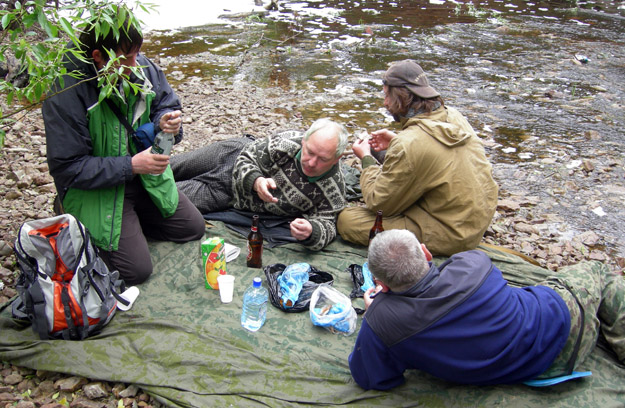
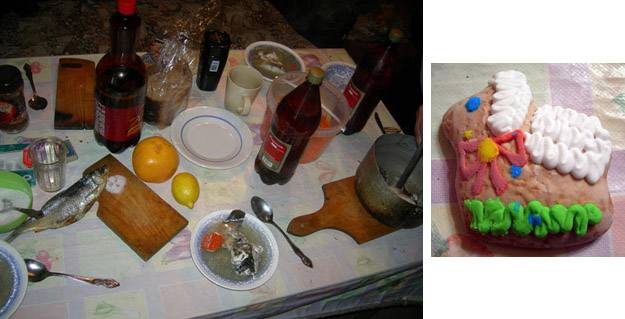
Typical field lunch of smoked fish, beer and (of course) vodka.

Typical field lunch of smoked fish, beer and (of course) vodka.

I will ask questions when I can, trying to find the breaks in a conversation I can’t follow.  My questions are always answered enthusiastically, especially when they are about geology, politics or history (which they usually are, other than the frequent, “Now what is it we’re eating?”).

What I can sense is the joy to converse in another language with a native speaker.  Even my few words are received with a spark of interest — the American is trying!  I admire so much my multilingual colleagues, friends … and Russian-speaking daughter Amy!
Posted in Uncategorized | Tagged , | Leave a comment

How Russian Geologists Remove a Tick

NEAR KHAMONTOVO, LENINGRAD REGION, RUSSIA–Using about 25 cm of thread, they tie a simple slip knot in the center.  The loose loop of this knot is placed around the tick’s body and then worked down to its embedded head.  The knot is then tightened by gently pulling the ends of the thread.  If done correctly, the back of the tick’s head is tied fast.  Then by slowly working the ends of the thread back and forth, the tick is pulled from its bloody little hole in one piece.

Posted in Uncategorized | Tagged | Leave a comment

Goal!

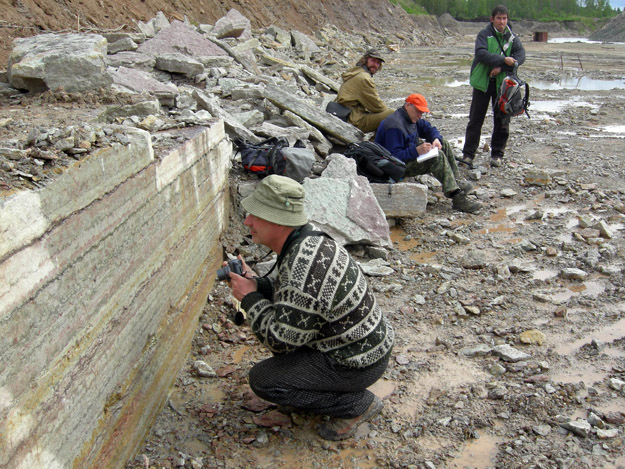
BABINO, LENINGRAD REGION, RUSSIA–Today we visited an active quarry, which is a different experience from the riverbank exposures and abandoned quarries we have been frequenting.  Quarry mud has a special character — a kind of purified mud, the kind of mud all mud aspires to be.  There are also very large trucks splashing by, giant rock saws whining, cranes lifting large blocks, and small groups of curious workmen who want to see what we are doing there with our hammers that now seem so small.  Active quarries can produce the very best exposures for geologists, especially those interested in the boundaries between rock units as we are.  This quarry at Babino N60.03035°, E32.38613°) is particularly good because they quarry Ordovician limestone by first cutting it vertically, and then lifting the rocks away in sections, revealing smooth surfaces perpendicular to bedding.

Cut surface through Ordovician section, Babino Quarry.

Cut surface through Ordovician section, Babino Quarry.

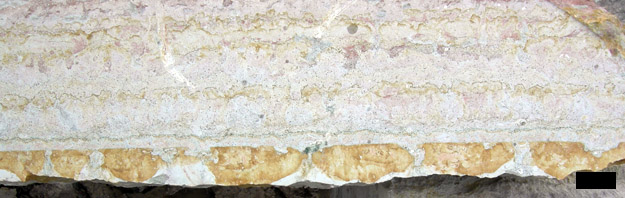
I want most to see the boundary between the Lower and Middle Ordovician rocks, and look at the trace fossils above and below it.  This boundary — a plane in the rocks which extends across northeastern Russia, Scandinavia, and parts of northern Europe — could not be better displayed than the way we saw it here.  It is an erosional surface which has been cemented into a carbonate hardground and then bored (to some extent that we are debating) and abraded smooth.  Above it is a significant change in the fossil fauna, a change which can be seen around the world.  In no place is this boundary better presented to geologists than here.

Lower/Middle Ordovician boundary in the Babino Quarry.

Lower/Middle Ordovician boundary in the Babino Quarry.

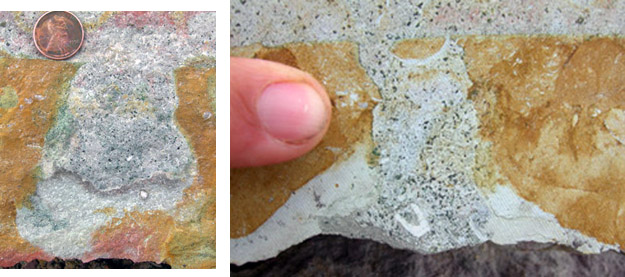
The trace fossils along this boundary are complex and may show both boring and burrowing behavior.  The distinction depends on when the sediments were soft, firm and cemented, and on the varieties of organisms which did the work.

Borings in the Lower/Middle Ordovician boundary at Babino Quarry.

Borings in the Lower/Middle Ordovician boundary at Babino Quarry.

I can’t take these specimens home for further examination.  I’d very much like to make thin-sections (slices of rock shaved down until almost transparent for microscopic analysis) of all the critical intersections, but that will have to wait.  Andrey collected many samples he can cut up and share from his lab in Moscow.

Posted in Uncategorized | Tagged , , , , , | 1 Comment

Typical Geological Field Day in This Part of the World

LENINGRAD REGION, RUSSIA–Before I describe the usual routine we have for this fieldwork, I should note that we are in the “Leningrad Region”, which is distinct from the “St. Petersburg Region” in a formal political sense.  The Leningrad Region is essentially the rural portion of Russia outside the city of St. Petersburg.  The people who live here voted to retain the name “Leningrad” after the dissolution of the Soviet Union.  My colleagues say these people are “more conservative” and thus include many more communists than in St. Petersburg.  Interesting use of the term “conservative”, I’d say.

We rise from our finally-warm beds rather late for typical geological fieldwork, usually around 8:00 a.m.  I’ve at last figured out why: the “white nights” mean we have usable sunlight until deep into the evening.  We typically return to the field house at 8:00 p.m. and then begin the process of our dinner, which is usually ready by 10:00 p.m.  Not quite my Wooster schedule, but I’ve adapted!

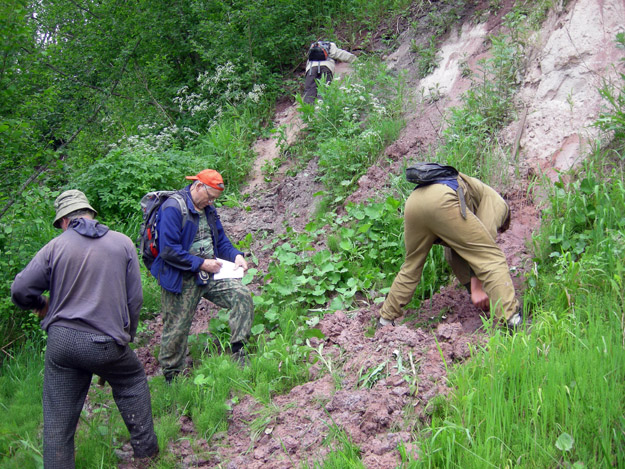
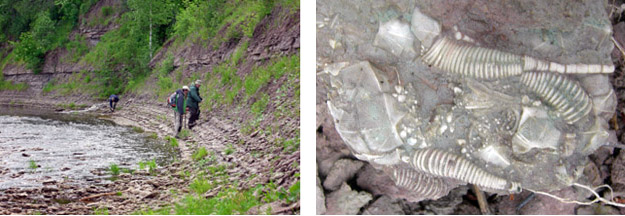
We drive to our outcrops in a 1990s Russian version of a Fiat which, although lacking most of the modern conveniences, has heated seats!  (It is the only place I’m truly warm.)  The roads are poorly marked, so we spend a bit of time in orientation.  Since the pavements on the secondary roads — if there is a pavement — is badly potholed, we move slowly.  Most of our outcrops have been on riverbanks, so we stop on the top and then climb down a nearly vertical path (inevitably lined with stinging nettles and mosquitoes waiting for that outstretched hand) to the river itself.  After a geological introduction from Andrey, we scatter and explore the cliff, meeting together in an hour or so to exchange observations.  Andrey knows the stratigraphy precisely, with names for units as thin as a few centimeters which correlate for hundreds of kilometers.

On our way to an outcrop of Ordovician rocks along the Sass River.

On our way to an outcrop of Ordovician rocks along the Syas River.

Mud.  Mud everywhere.  Every slope is slick with it, and every outcrop has its roots in brown, sticky mud.  I am overly concerned with it only because I have a fixed set of clothes and no laundry possibilities for at least another week.  I desperately do not want to fall in it.

Typical riverbank fieldwork.

Typical riverbank fieldwork.

Every day has had rain in it.  I’m not good at predicting it here, even though the skies are extraordinarily wide above these forests.  As it starts to pour that old cowboy verse comes to mind: “Cloudy in the west, looks like rain.  Danged ol’ slicker’s in the wagon again.”

We do all this, of course, because the rocks are fantastic, with each exposure a puzzle to be solved, and every piece you break off shows a sight no human has seen.  Scientific and historical treasures await us every day.  It is also the time our diverse team bonds over common goals and wonders.  No language is needed when one geologist grins and shows another a particularly well-preserved fossil, or a sequence boundary stunning in its clarity.  I have the best job ever.

Posted in Uncategorized | Tagged , | 1 Comment

Tree Ring Dating of Revolutionary War (and some later) Buildings in PA and OH

crew3This summer the Wooster Tree Ring Lab is funded by the College of Wooster’s Center for Entrepreneurship to date buildings of historical interest using tree rings. The crew in this endeavor is shown above and includes – Dr. Greg Wiles, students Kelly Aughenbaugh and Colin Mennett, and Nick Weisenberg who is a timber-framer and works in building restoration. The demand for our service has been excellent and is concentrated in the Pittsburgh area, locally in Kidron, Ohio and now in the Cincinnati area. We can use our archive of tree-ring data and lots of hard work by our staff to tell homeowners, folks at historical sites, historical archaeologists etc. the year timber was cut prior to building the structure. The tools of the trade are shown below. We will tell you a bit about the results of our work soon.

Below: The gear pile includes standard powertools and generators along with specialized dry wood bits. Nick illustrates the proper coring technique. This historic building is Woodville PA – the oak beams that he is coring were cut in the fall or winter of 1785.

gear4tst8

Posted in Uncategorized | Tagged , , | 2 Comments

The Other Kind of Deep History

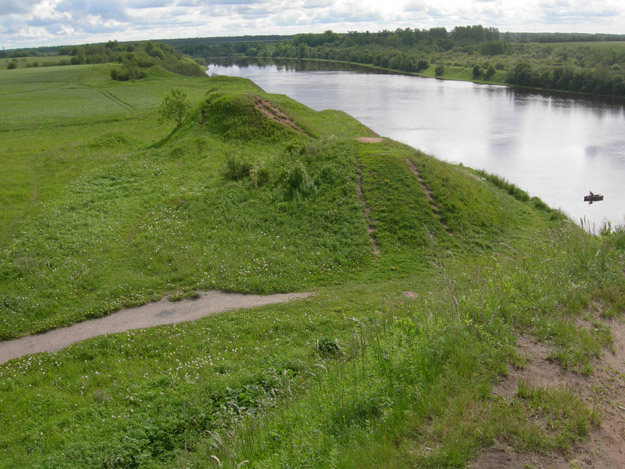
STARAYA LADOGA, LENINGRAD REGION, RUSSIA–This place, known as “Old Ladoga” is where the Russian state began.  It is an important trade junction situated on the Volkhov River not far from where it enters Lake Ladoga.  The Viking roots of this country are dramatically evident in a series of eighth to tenth century burial mounds on both banks of the river.

Viking burial mounds along the Volkhov River.

Viking burial mounds along the Volkhov River.

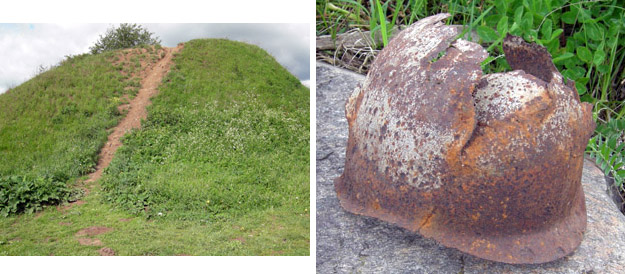
One of these mounds, the largest, is reputed to be the grave of Oleg, the most vigorous of the earliest rulers.  I couldn’t help juxtaposing it with an image of a German World War II helmet we found nearby.  The hand of history lies heavy on this fertile land with broad rivers and no other natural defenses.

Oleg's Mound (reputedly), and a German World War II helmet found in the woods nearby.

Oleg's Mound (reputedly), and a German World War II helmet found in the woods nearby.

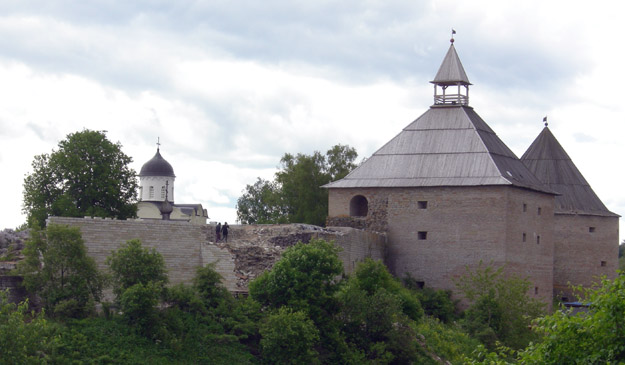
This site was fortified for centuries.  The current manifestation is the Ladoga Fortress from the 17th and 18th centuries.

Ladoga Fortress.

Ladoga Fortress.

It protected a river crossing and controlled navigation on the lower Volkhov.  Unfortunately virtually all of the original fortress was destroyed in WWII, so what you see above is a reconstruction based on pre-war maps and photographs.

Posted in Uncategorized | Tagged , | 1 Comment

Eating Well in Russian Geologist Style

NEAR KHAMONTOVO, LENINGRAD REGION, RUSSIA–Like most American travelers, I worry most about foreign food and bathrooms.  The food, at least, turns out to be delightful.

One of our many dinners in the field house.

One of our many dinners in the field house; a Trinity Sunday cookie.

I try to drink just water and tea where possible, but I am occasionally encouraged to drink “kvas”, which is a non-alcoholic beverage made from dark bread and sugar.  It is referred to as the “Russian Coca-Cola”.  I use it as a substitute for the many vodka toasts during dinner.  (Translated for me, most of the toasts are on the order of, “Here’s to fish and oranges!”  I managed to get one in for D-Day on June 6th, combined with Pushkin’s Birthday.)

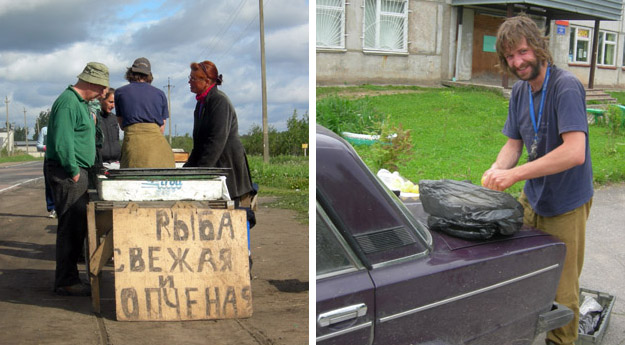
Our field day usually starts with food shopping.  We buy fresh and smoked fish from roadside vendors and other items from small stores in the local villages.  For some more elaborate dinners we take the ingredients with us in the car and at slow moments someone pulls out the pot and slices meats and vegetables!

Buying smoked fish on the way to the field on the left, and Andrei preparing for the night's dinner on the right.

Buying smoked fish on the way to the field on the left, and Andrei preparing for the night's dinner on the right.

Posted in Uncategorized | Tagged , | Leave a comment

Ordovician Hardgrounds

SYAS RIVER, LENINGRAD REGION, RUSSIA–The main geological attractions for me on this expedition are the abundant carbonate hardgrounds in the Lower and Middle Ordovician in this part of the world.  A carbonate hardground is a cemented seafloor.  What were soft sediments on the bottom were cemented with carbonate minerals (calcite in the Ordovician) so that they became a rocky surface several centimeters thick.  The sediment is usually carbonate mud and shells, so the result is essentially a limestone seafloor.  Many invertebrate animals colonize these hard surfaces by wither encrusting them or boring into them.  Those eocrinoids illustrated earlier, for example, often encrusted Early and Middle Ordovician hardgrounds.

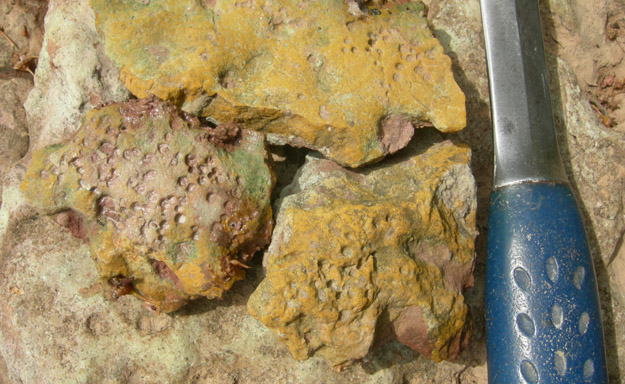
Today at the Syas River Carbonate Mound locality (N60.02316°, E32.62471°) we saw numerous hardgrounds bored by a shallow variety of a trace fossil called Trypanites.

Borings in Ordovician hardground fragments.

Borings in Ordovician hardground fragments.

These are the most common borings in hardgrounds.  This particular type of Trypanites is remarkably shallow — often appearing as pits rather than the usual penetrating cylinder.  Another difference between these hardground fossil faunas and those I know best in North America and western Europe.

Posted in Uncategorized | Tagged , , , , , | Leave a comment

A Tunnel to a Frozen Past

SYAS RIVER, LENINGRAD REGION, RUSSIA–“Do you have a light? We are going into caves tomorrow.” I must admit to a bit of trepidation, hearing that question. I indeed have a small flashlight, but not one I’d like to have with me in a cave. Turns out the caves today were actually abandoned mine tunnels in a Cambrian quartzose sandstone on the right bank of the Sass River (N60.05429°, E32.59517°). The mines were designed to extract the quartz sand to make glass — some kind of Stalinist enterprise in the 1930s to turn the local peasants into proletarians. These mines were abandoned once the Germans invaded in 1941.

Yes, I followed. Nuts, but worth it.

Yes, I followed. Nuts, but worth it.

“We will have to crawl a bit.” As you can see from the photograph of the tunnel entrance, “crawling” is not quite the term. “Squirming on your belly” would be closer. I didn’t want to play the soft American, so I just made sure someone was behind me and in front of me, and in I went. The squirming through the mud with my back scrapping against the ceiling seemed interminable, especially since I couldn’t hold the light and pull myself through at the same time. This had better be a good blog entry in the end, I thought. The substrate dropped below me and I slid down into a comfortable cavity (relatively speaking) about five feet high and lit fleetingly by the flashlights of the others ahead. I hunched over and crab-walked to the source of the lights, finally emerging in a mine tunnel fortunately higher than my head. Half success! (Full success is getting out, of course.)
tunnel060609
Now it is more interesting than terrifying. The mine cuts horizontally along bedding, so you can follow a single unit of rock throughout the tunnels, watching it change character with distance. The main rock is very white, relatively soft, and marked by the pickaxes of the miners. At about eye-level are darker beds with contortions which contrast dramatically with the flat-bedded sandstone below. Cracks descend down into the sandstone and are filled with iron pisolites (spherical structures made of hematite and from bb- to marble-size). In places the darker beds drop downward into complex breccias (conglomerates in which the clasts are very angular).

Cryokarst features in the abandoned mine tunnels.

Cryokarst features in the abandoned mine tunnels.

The interpretation of these rocks by Andrey Dronov is that they represent a Cambrian permafrost buried by Ordovician sediments. The reason the Ordovician clays, pisolites and siliciclastic sediments are contorted is that they had collapsed to varying degrees as the ice below them was melted after burial. We are looking, then, at a wonderful example of “cryokarst”, or the deformation of sediments associated with ice formation and melting. I had known of only such features in theory, never in practice. It is even more remarkable that these structures are almost half a billion years old. Well worth a bit of slithering through dark Russian mud!

Posted in Uncategorized | Tagged , , , | 1 Comment

First Find

NEAR KHAMONTOVO, LENINGRAD REGION, RUSSIA–When you’re a paleontologist in the field with other geologists for the first time, you need to prove your general scientific worth by either saying witty things or finding an excellent specimen right away. I went for the latter and picked up on our first outcrop the rhombiferans you see below. I’m golden now, at least for a few days.

Ordovician outcrop near the field house, and the beautiful eocrinoids found there.

Ordovician outcrop near the field house, and the beautiful rhombiferans (probably Glyptocystites) found there.

Rhombiferans are Early Paleozoic echinoderms which resemble crinoids and blastoids but have few brachioles (extensions around the mouth to filter food from the water). I’ve only previously seen random plates and holdfasts, so I was plenty surprised by these beauties. I donated them graciously, of course, to the echinoderm expert. This is not hard to do since Russian law does not allow foreigners to take fossils out of the country.

Posted in Uncategorized | Tagged , , | 1 Comment