


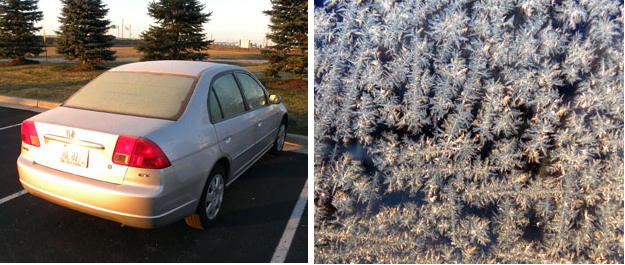
... when your car is well frosted.
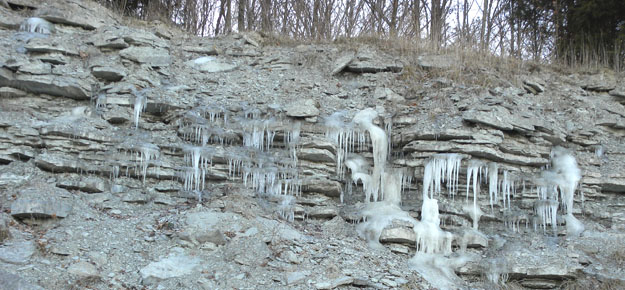
... and your outcrop looks like this! (Whitewater Formation, Upper Ordovician, emergency spillway at Caesar Creek State Park, Ohio; N39.47808°, W84.05981°)
... when your car is well frosted.
... and your outcrop looks like this! (Whitewater Formation, Upper Ordovician, emergency spillway at Caesar Creek State Park, Ohio; N39.47808°, W84.05981°)
MAYSVILLE, KENTUCKY–Strong earthquakes produce seismic waves which can do much damage on land, as we well know. They can also disturb unconsolidated sediments on shallow oceanic shelves and platforms, producing characteristically swirled structures called seismites. The Upper Ordovician outcrop we visited today has three horizons of well-preserved seismites associated with those strange blocks described previously.

The "ball-and-pillow" structures in this view of the Kentucky Route 11 outcrop of the Fairview Formation are seismites produced by Late Ordovician earthquakes. There are two seismite horizons visible here, each with a flattened top produced by later erosion and redistribution of the sediments by oceanic currents.
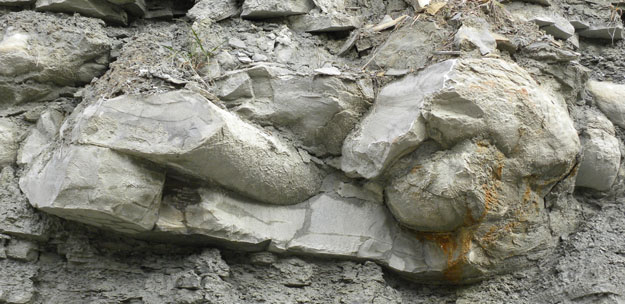
Closer view of a seismite in the Kentucky Route 11 outcrop. ( I couldn't reach this high to place my hammer for scale; the structure is about a meter thick.)
The earthquakes which caused these seismites were probably associated with orogenic (mountain-building) activity to the east where the present (and much later) Appalachian Mountains sit. Careful measurement and mapping of seismites can tell us much about the specific locations and magnitudes of these earthquakes, as well as the consistency of the sediments they disturbed long ago on those ancient seafloors.
MAYSVILLE, KENTUCKY–Our short geological expedition to northern Kentucky today was to look at some odd blocks of limestone that sit suspended in the sediments as if they were dropped in while the sequence was accumulating.
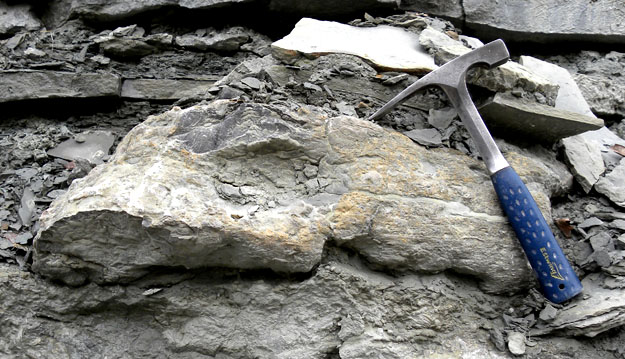
An eroded, bored and encrusted limestone block in the Fairview Formation (Upper Ordovician) of northern Kentucky at the Route 11 outcrop (N38.61243°, W83.75575°).
These rocks are bored by worms and encrusted by bryozoans on their top and sides, and they often sit at high angles to the surrounding strata.
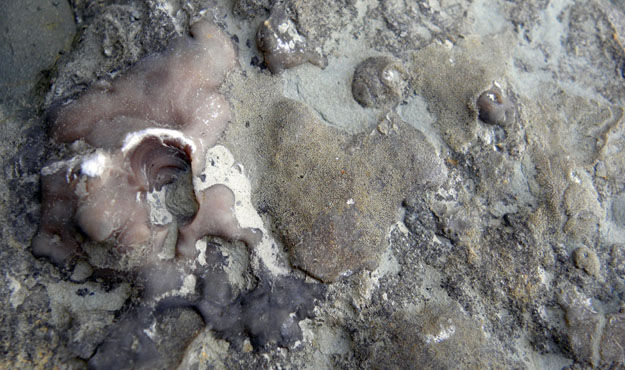
Bryozoans encrusting a side of the block above. The beautiful pinkish bryozoan on the left is the holdfast of a ptilodictyoid which in life held an erect bifoliate portion of the colony. The field of view here is about 10 cm wide.
It is difficult to imagine a mechanism which deposited large, lithified limestone blocks in the middle of a shallow carbonate ramp. They are almost certainly related to “seismite” structures in the outcrop (see next post), but how these earthquakes would have transported such rocks is a mystery. We also do not know how quickly the limestone had been lithified before emplacement. We do know that the sides of these blocks were exposed on the seafloor long enough to accumulate encrusters and borers.
Plenty yet to discover in these well-studied rocks. It is a continuing lesson for scientists: the more you see the more questions you have.
MAYSVILLE, KENTUCKY–Today I visited the University of Cincinnati for a meeting of Aaron House’s thesis committee, on which I serve. (Aaron is a 2004 geology graduate from The College of Wooster.) It all went very well and soon after Aaron took me and two other geologists on a short field trip to an Upper Ordovician outcrop near the Ohio River town of Maysville.

Outcrop of the upper Fairview Formation (Upper Ordovician) on Kentucky Route 11 near Maysville, Kentucky (N38.61243°, W83.75575°). A distant Aaron House for scale.
Many Wooster students and alumni will immediately recognize all the elements of a typical roadside outcrop of the Cincinnatian Group in winter: gray rocks matching the gray sky, the muddy ditch at the base, and the thin verge of grass extending to the road. Alternating limestones, siltstones and shales give the outcrop its jagged appearance.
Some of the best Ordovician fossils in the world are found in these sedimentary sequences, and the stratigraphy holds many mysteries despite over a century and a half of intensive study by geologists. Wooster students have completed dozens of Independent Study theses with these rocks, and there are many more to come. Aaron House is now pursuing a masters degree by assessing and interpreting the preservation of mollusk fossils in the Cincinnatian.
The Mineralogy of Hotspots by Elizabeth Deering (’11).
The Mineralogy of Acid Mine Drainage, presented by Lindsey Bowman (’12).
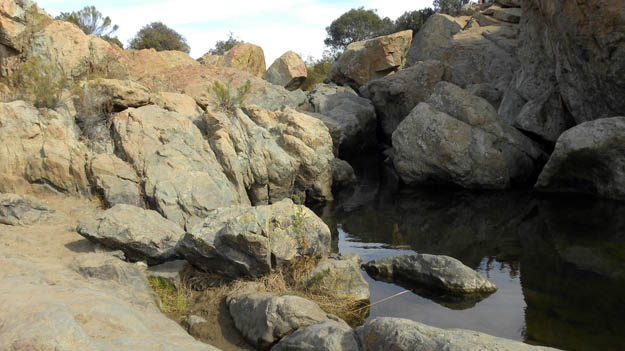
Waterfall (mostly dry) over Jurassic rocks in the Los Peñasquitos Canyon Preserve in San Diego County (N32.92712°, W117.17757°).
SAN DIEGO, CALIFORNIA–A nice geological interlude for this Wooster geologist during a family Thanksgiving. This afternoon we visited Los Peñasquitos (meaning little cliffs) Canyon Preserve in San Diego County. We walked about two miles along a trail to an exposure of Jurassic metaconglomerate. The rock is interesting for several reasons. The clasts are either highly angular (meaning parts are a breccia) or very well rounded; the clasts are volcanic in origin; and the matrix includes recrystallized belemnites. The composition suggests that the main sediment source (if not the only one) was a set of offshore volcanic islands.
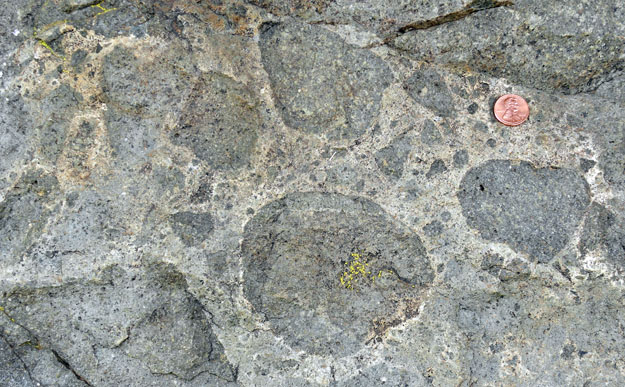
Note the very rounded and very angular clasts in this metaconglomerate.
This area has connections to Old California history. Rancho Los Peñasquitos was where General Stephen Watts Kearny and his Army of the West rested after the Battle of San Pasqual in 1846.

CLAREMONT, CALIFORNIA–The peak above is part of the San Gabriel Mountains just north of Claremont. Today is one of the best southern California offers: brilliant sun, temperatures in the 70s, and very clear skies. Apparently this view of the mountains is not always available because of air pollution, but you would never know it this morning.
The San Gabriel Mountains separate the Los Angeles Basin from the Mojave Desert on the other side. The San Andreas Fault runs through them in a very complex way.
I’m here for family reasons (Thanksgiving in San Diego — can’t beat that!), but there is always something geological about!
As promised, here’s another digital presentation. The Mineralogy of Mars is presented by Colin Mennett (’10).

COLLEGE STATION, TEXAS–I never get tired of that too-obvious joke. I found the above productid brachiopod on the last outcrop of our little Texas expedition. It has been drilled by barnacles, which leave a distinctive slit-shaped hole with a tiny little comma shape at one end. It may not look special here photographed on my backpack in the sunlight, but it is. Hard substrate communities in the Permian are still poorly known. This specimen tells us that a future trip may reveal many more such specimens.
Paleontologists (and anyone else) should be able to tell me whether these borings were produced during the life of the brachiopod or after its death. Your determination can be posted in the comments below!