PA Geological Survey Field Trip

Sorry to have kept you waiting so long for the ending of the PA diabase field trip. Last Friday, we spent a wonderful day in the field with a group from the PA State Geological Survey.

Our first stop was the Pennsylvania Granite Quarry.

Dr. LeeAnn Srogi was an excellent host. Here she is describing the orientation of the Morgantown Sheet on the geologic map.

The PA geologists had the opportunity to examine the plagioclase layers and cross-cutting dark channels up close.

They even had a chance to see the big saw in action. (The PA Granite quarry guys are so good to us).
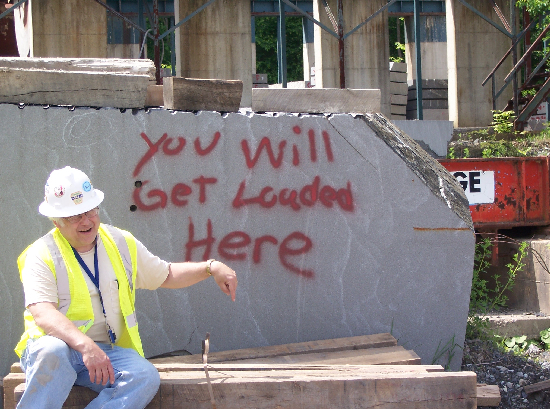
After a good laugh (oh, those geologists and their humor!) and a nice lunch in a local park, we headed to the Dyer quarry.

Here we're discussing the fault patterns in the Dyer quarry. The wonderful thing about being in the field with a dozen other geologists is that the discussions are invigorating. We are so fortunate that these professionals took the time to visit our field area and add their observations and ideas to our own.

After a week in the field, I have a notebook full of observations, a head full of ideas, and a trunk full of samples! Sounds like a good week to me.
Posted in Uncategorized | Tagged , , | 4 Comments

Fixing your search images

NEW ALBANY, MISSISSIPPI — The kind of science our paleontological field team is doing ultimately depends on unpredictable discoveries.  We came to this part of the world based on the recorded experiences of generations of geologists who assembled maps of rock types, calculated stratigraphic ages, and made long lists of fossils they found.  From this body of knowledge we could estimate our chances of finding certain kinds of fossils in certain places.  Nevertheless, as with those pioneering scientists, we ultimately have to find things on our own.

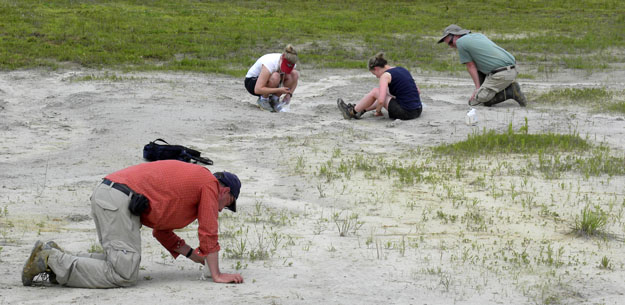
Scouring the ground for fossils in the Nixon Sand Facies of the Prairie Bluff Formation (Upper Cretaceous) in Pontotoc County, Mississippi.

The old adage that “you find what you’re looking for” has some truth in exploratory paleontology.  You have to know what your target fossils look like before you can collect them.  This means recognizing them despite their orientations in the sediment or their preservation.  We develop a “search image” over time for each particular types of fossil.  Paul Taylor, for example, can pull bryozoans off the ground right under my nose because he has trained a set of search images for decades.  On this trip we have all learned what to expect when we crawl across the Prairie Bluff or Clayton formations.  It is an honor to spend a day plucking little treasures from the ground and adding them to the store of human knowledge.

A Cretaceous oyster encrusted in the top left of the shell with a bryozoan and drilled by a predatory snail in the center, with a coin showing The Great Emancipator for scale (Troy Beds, Ripley Formation, Pontotoc County).

Posted in Uncategorized | Tagged , , | Leave a comment

Geologists a bit weathered after a week of southern sun

A week’s worth of fieldwork done.  All is going well.  We have learned so much since we arrived last week so fresh and clean.  Mark Wilson, Caroline Sogot, Megan Innis and Paul Taylor.  Two more days of fieldwork to go.  Bags and bags of fossils already collected.  Photo taken at Rockin’ G Ranch, Pontotoc County, Mississippi.

Posted in Uncategorized | Tagged | 2 Comments

An abundance of Cretaceous shark teeth

Shark teeth found in the Upper Cretaceous Prairie Bluff Formation in Starkville, Mississippi.

STARKVILLE, MISSISSIPPI — OK, Andrew Retzler, please identify these teeth as best as you can in the comments below!  For everyone else, Andrew will be leaving with me in little more than a week for Israel where he will be collecting Late Cretaceous shark’s teeth as part of his Independent Study project.  He already proved very adept at sorting out a set of Israeli fossil shark’s teeth I had collected last year, so we’re giving him some more practice before his fieldwork.  It is possible we will have collected enough teeth by the end of this trip that he will be able to use them for comparisons.  Megan has proven especially good at finding teeth and other shark bits.

Posted in Uncategorized | Tagged , , | 9 Comments

We meet the Cretaceous-Tertiary boundary in Mississippi

STARKVILLE, MISSISSIPPI — George Phillips took us to a series of Starkville outcrops today straddling the Cretaceous-Tertiary boundary.  The boundary here is gradational and generally marked by a color change from gray in the upper Prairie Bluff Formation to light brown in the lower Clayton Formation.  Since we want to collect fossils just below and just above the boundary, these localities were ideal for us.

Megan Innis and George Phillips at the Cretaceous-Tertiary boundary in Starkville, Mississippi.

We were able to collect many encrusters and borings above and below this fateful event horizon.  I was most impressed by the diversity of encrusting foraminiferans on shells and phosphatic pebbles on both sides of the K/T, apparently showing little effects of the extinction.  A long time ago I did some systematic and paleoecological work with this group, so I may return to them to test these observations.

We also noted the proliferation of tiny oysters (especially Pycnodonte pulaskiensis) in the Clayton sediments immediately above the extinction horizon.  These are part of the initial survival and recovery fauna and thus keys to the future repopulation of this shallow marine ecosystem.

Small oysters in the lowermost Clayton Formation (Paleocene) in Starkville, Mississippi.

Posted in Uncategorized | Tagged , , , , | 13 Comments

New Member of the Cretaceous-Tertiary Southern USA Team

STARKVILLE, MISSISSIPPI — We simply could not do this work without the guidance of local geologists who know the stratigraphy and the locations which are likely to yield the best results.  This is especially true in eastern Mississippi where most of the outcrops are in drainage ditches, cleared building lots, and on grass-covered roadsides.  There is no way we would find them on our own.

Fortunately we now have an extraordinarily knowledgeable colleague who has an ambitious schedule of fossiliferous localities to show us.  George E. Phillips met us as arranged at our first outcrop in Starkville this morning.  At first when I saw him get out of his official state vehicle in his impressive uniform and begin talking to Paul I thought we were about to be arrested.  Far from it, of course.  George is the Paleontology Curator at the Mississippi Museum of Natural Science and the Mississippi Department of Wildlife, Fisheries & Parks in Jackson.

Paul Taylor and George Phillips on the Avalon outcrop of the Prairie Bluff Formation (Upper Cretaceous) in Starkville, Mississippi.

George is a skilled paleontologist and general naturalist who knows just what sort of fossils we need for our work, and all the right places to find them.  We are very impressed that the state of Mississippi employs such scientific talent and makes it available to visitors like us.

Posted in Uncategorized | Tagged , | 3 Comments

Our first vertebrate fossil

Megan found this beautiful shark's tooth in the Prairie Bluff Formation (Upper Cretaceous) near Starkville, Mississippi, this afternoon. Andrew Retzler! We want your expert identification of it in the comments below. Thanks!

Posted in Uncategorized | Tagged , , | 4 Comments

From Alabama to Mississippi

STARKVILLE, MISSISSIPPI — Early this morning we left Demopolis, Alabama, and drove to Livingston, home of the University of West Alabama.  Our first localities, in fact, were very close to campus as we again explored the Upper Cretaceous Prairie Bluff Formation.

Megan, Caroline and Paul doing the paleontology thing on an outcrop in Livingston, Alabama (N 32.59827°, W 88.19301°). The scene looks pretty quiet and usually is, except for the occasional utterance like, "Cool! More cyclostomes!". It is a culture all to itself.

In the early afternoon we crossed the border into Mississippi.  It may be our imagination and a limited sample size, but we swear the accents got thicker and the British among us especially had difficulty understanding it.  The fossils, though, know no boundaries and were just as good as their Alabama cousins.

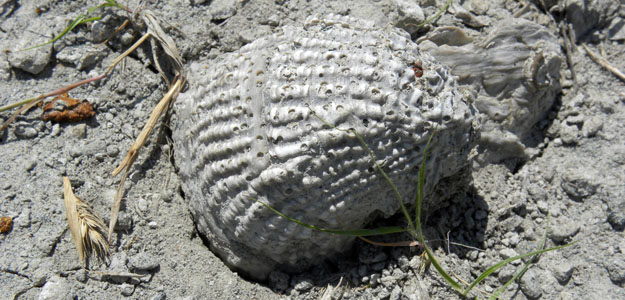
A bored Cretaceous oyster waiting patiently to be picked up on a Mississippi outcrop of the Prairie Bluff Formation (N 33.48371°, W 88.85309°).  The fossils here are found on a dried mud so when you pick them up they give a satisfying sound as they detach from the ground.  It is like opening a sealed package knowing you're the first to find it.

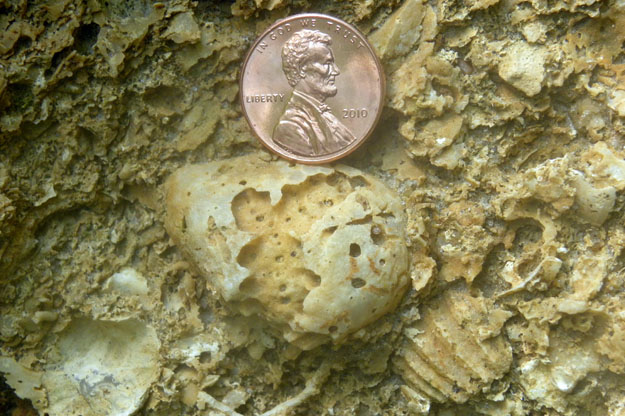
A bored oyster waiting patiently to be collecting on a Mississippi outcrop of the Prairie Bluff Formation (N 33.48371°, W 88.85309°). The evenly-spaced holes were produced by an endolithic clionaid sponge. Note the splendid preservation of the shell and just the right kind of weathering. This is the kind of outcrop where you wonder why more people aren't here picking up this great stuff!

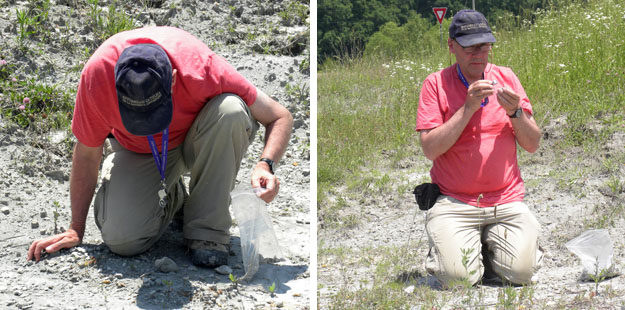
Her Majesty's Own Bryozoologist, Dr. Paul D Taylor, in action on a Mississippi outcrop. (Shout-out to Emma: This is the best I can do with your father. Always crouching close to the ground, he is. Bendiest man in paleontology.)

Posted in Uncategorized | Tagged , , , | Leave a comment

Sweet Home Alabama

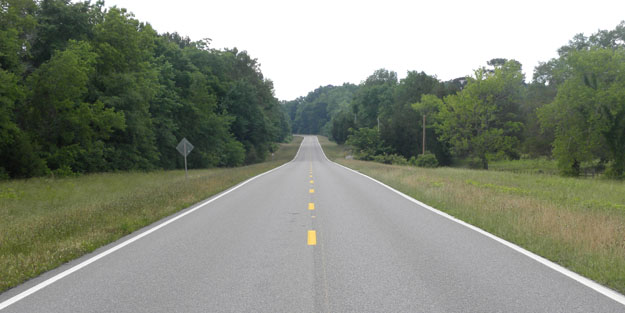
Lonely highway near Jefferson, Alabama, at one of our roadside outcrops (N 32.39412°, W 87.92422°).

DEMOPOLIS, ALABAMA — We practically had the state to ourselves on this steamy Sunday as we drove around western Alabama looking for outcrops of the latest Cretaceous and earliest Paleogene.  As is often the case, localities described in the literature disappear because of housing developments, road expansions, new dams on rivers, and the luxuriant growth of vegetation (especially kudzu down here).  Still, we found that even a meter-thick strip of the Prairie Bluff Formation in a roadside ditch can be loaded with encrusted and bored fossil shells, so we collected enough specimens to make the driving worthwhile.  Now we settle down for our last night in Alabama before crossing over into Mississippi tomorrow.  (This gives me time to soothe the chigger bites on my ankles!)

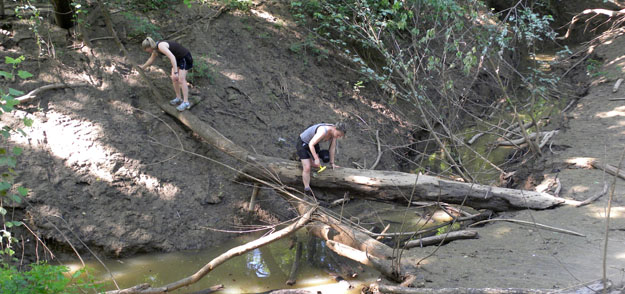
We promised Megan and Caroline that if they crossed the muddy creek to see what was on the other side, we would immortalize their heroics in the blog.

We all had our photographs taken under this most appropriate ranch sign. (For the non-geologists, "KT" is our code for "Cretaceous-Tertiary".)

Posted in Uncategorized | Tagged , , | 2 Comments

Mud, Sun and Fossils

GREENVILLE, ALABAMA — Reconnaissance is over for this part of the state, and our work commenced this morning.  We want to find good sclerobiont communities above and below the Cretaceous-Tertiary boundary, so here that means we want specimens from the Upper Cretaceous (Maastrichtian) Prairie Bluff Formation and the Paleocene (Danian) Clayton Formation.  That means plenty of muddy creekbeds and sun-smacked roadcuts.

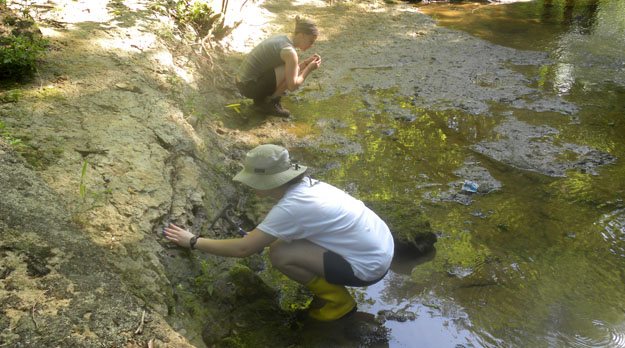
Megan Innis (below) and Caroline Sogot (above) collecting bored and encrusted fossil oysters from the Prairie Bluff Formation in Mussel Creek (N 31.97259°, W 86.70387°).

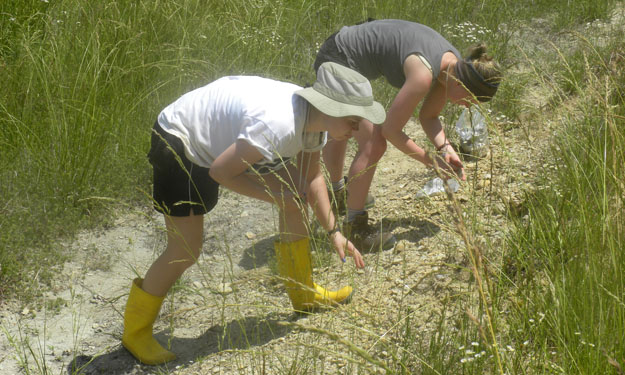
Megan (in the fashionable yellow wellies) and Caroline collecting oysters from the Prairie Bluff Formation along Alabama 263 (N 32.04082°, W 86.79367°).

This would be a good time to mention that Caroline’s father is a famous magician in England with the stage name Jack Stephens.  We think this is very cool.  And I quickly add, Megan’s father Jeffrey is a famous pediatric geneticist at the University of Michigan.  We like that too!

This is the kind of fossil we like. It is a bivalve shell from the Clayton Formation (Tertiary, Danian) thoroughly bored by sponges. Unfortunately it is also well locked into this silicified rock matrix!

Posted in Uncategorized | Tagged , , , , | Leave a comment