Sweet Home Alabama

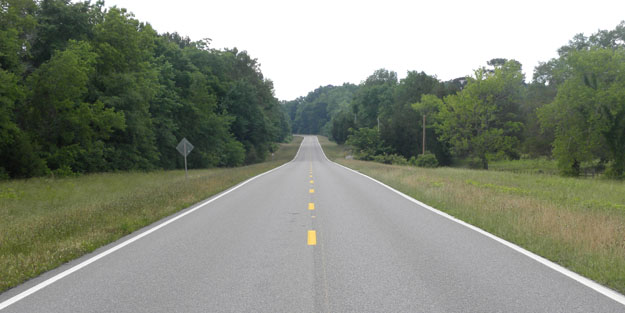
Lonely highway near Jefferson, Alabama, at one of our roadside outcrops (N 32.39412°, W 87.92422°).

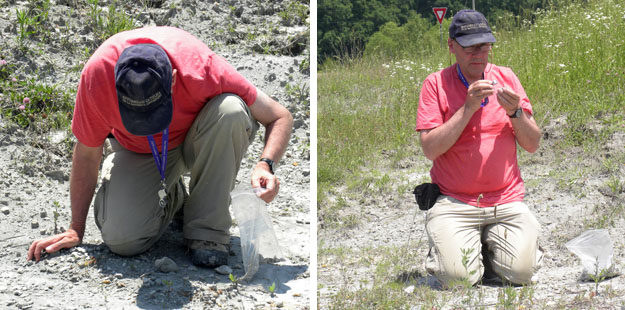
DEMOPOLIS, ALABAMA — We practically had the state to ourselves on this steamy Sunday as we drove around western Alabama looking for outcrops of the latest Cretaceous and earliest Paleogene.  As is often the case, localities described in the literature disappear because of housing developments, road expansions, new dams on rivers, and the luxuriant growth of vegetation (especially kudzu down here).  Still, we found that even a meter-thick strip of the Prairie Bluff Formation in a roadside ditch can be loaded with encrusted and bored fossil shells, so we collected enough specimens to make the driving worthwhile.  Now we settle down for our last night in Alabama before crossing over into Mississippi tomorrow.  (This gives me time to soothe the chigger bites on my ankles!)

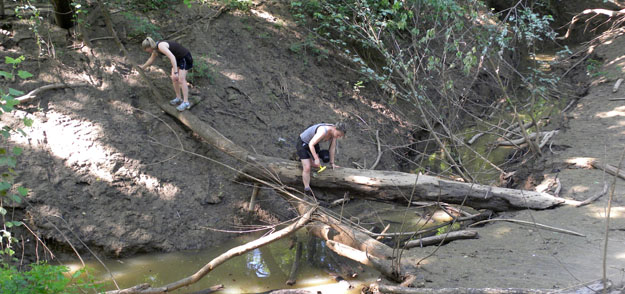
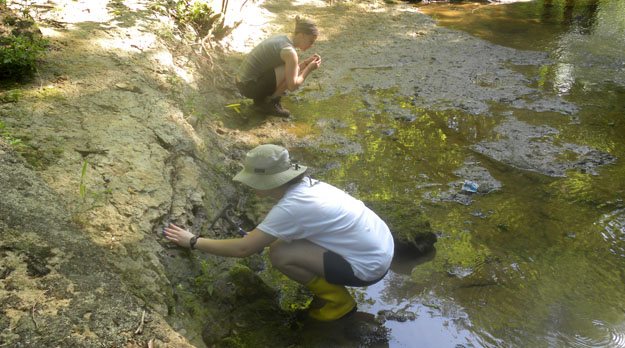
We promised Megan and Caroline that if they crossed the muddy creek to see what was on the other side, we would immortalize their heroics in the blog.

We all had our photographs taken under this most appropriate ranch sign. (For the non-geologists, "KT" is our code for "Cretaceous-Tertiary".)

Posted in Uncategorized | Tagged , , | 2 Comments

Mud, Sun and Fossils

GREENVILLE, ALABAMA — Reconnaissance is over for this part of the state, and our work commenced this morning.  We want to find good sclerobiont communities above and below the Cretaceous-Tertiary boundary, so here that means we want specimens from the Upper Cretaceous (Maastrichtian) Prairie Bluff Formation and the Paleocene (Danian) Clayton Formation.  That means plenty of muddy creekbeds and sun-smacked roadcuts.

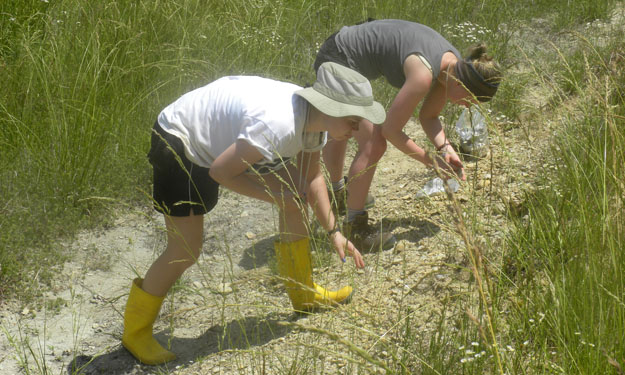
Megan Innis (below) and Caroline Sogot (above) collecting bored and encrusted fossil oysters from the Prairie Bluff Formation in Mussel Creek (N 31.97259°, W 86.70387°).

Megan (in the fashionable yellow wellies) and Caroline collecting oysters from the Prairie Bluff Formation along Alabama 263 (N 32.04082°, W 86.79367°).

This would be a good time to mention that Caroline’s father is a famous magician in England with the stage name Jack Stephens.  We think this is very cool.  And I quickly add, Megan’s father Jeffrey is a famous pediatric geneticist at the University of Michigan.  We like that too!

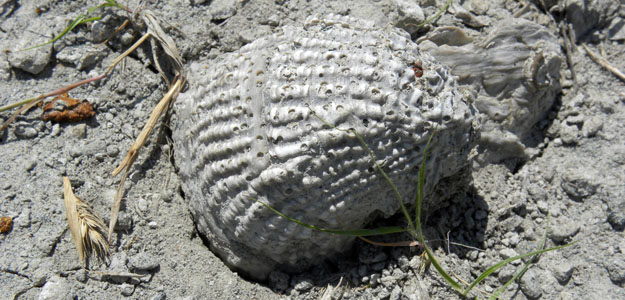
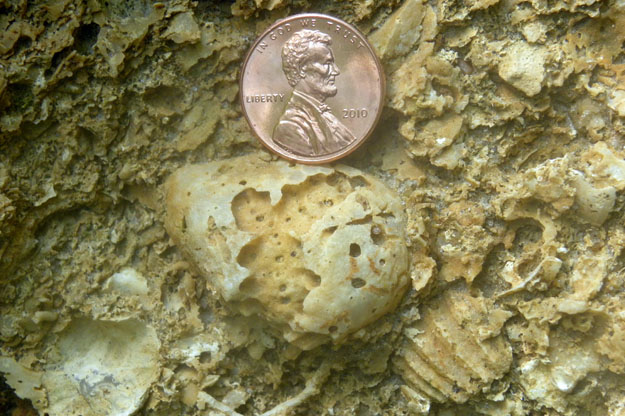
This is the kind of fossil we like. It is a bivalve shell from the Clayton Formation (Tertiary, Danian) thoroughly bored by sponges. Unfortunately it is also well locked into this silicified rock matrix!

Posted in Uncategorized | Tagged , , , , | Leave a comment

Post-Cretaceous Weirdness

GREENVILLE, ALABAMA — The Cretaceous-Tertiary boundary at Mussel Creek, Lowndes County, Alabama, has some unusual complexity.   At the southern end of the section it is simple enough, as shown in a previous blog post.  Just a few meters north, though, the boundary section looks like this:

Cretaceous-Tertiary boundary section at Mussel Creek, Lowndes County, Alabama (N 31.97176°, W 086.70414°). The "K" indicates Cretaceous rock; the "T' marks Tertiary sediments; the rounded black object is charcoalized wood.

This strange stratigraphy appears to be a stream channel filled with carbonaceous (carbon-bearing) laminated sediments which were incised into the Cretaceous Prairie Bluff Formation below.  Is this channel Cretaceous or Tertiary?  What sort of environmental conditions does it represent?  We discussed and tested many hypotheses on the outcrop this morning, which is always great fun.  We finally decided that these channel-filling sediments are Tertiary, following the conclusions of some (but not all) previous authors.  Still, the beds are unlike any channel-fills I’ve seen before, especially with all the carbon.  My favorite idea (which has no support in the literature, I quickly add) is that this channel represents erosion of a continent devastated by the impact blast in Yucatan just across the Gulf of Mexico.  The local forests were burned off in the massive wildfires (and maybe further devastated by a tsunami), leading to rapid erosion and the cutting and filling of channels on the shallow marine shelf here.  All the carbon is from the enormous amounts of burned wood.

This is what we would call a romantic view of stratigraphy.  It would mean that the big piece of charcoal in the section above is from a tree burned in the end-Cretaceous cataclysm.  I like that idea!

Posted in Uncategorized | Tagged , , , , | 3 Comments

Another beautiful fossil hard substrate

Megan Innis studying the Ripley Formation rockground near Greenville, Alabama.

GREENVILLE, ALABAMA — I have a soft spot for hard places.  (Always wanted to say that!)  Much of my career has been spent studying marine hard substrates and the communities that have evolved on and in them.  These include rocks, hardgrounds and shells on seafloors which have been encrusted and bored by diverse organisms for hundreds of millions of years.  In all the many marine environments where these substrates occur, we know the organisms faced one common problem: how to occupy and defend space in an essentially two-dimensional world.  This provides a thread to follow through the long evolution of sclerobionts (hard-substrate dwellers, to use one of my favorite words.)

At the top of the Maastrichtian (Upper Cretaceous) Ripley Formation is a rockground which was bored and encrusted on the seafloor in the classic way.  It was ably described in a paper by Jon Bryan, and we were pleased to see that the surface is still exposed and accessible today.  There were some tasty encrusting bryozoans on some of the cobbles here!

Spondylid bivalve encrusting the Ripley Formation rockground.

Posted in Uncategorized | Tagged , , , | Leave a comment

Geological fieldwork in the Deep South

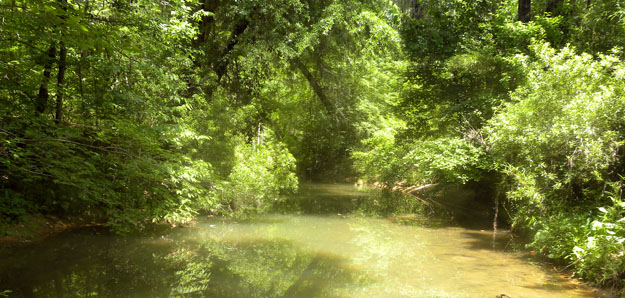
An Alabama Creek where, oddly enough, we found superb Paleocene nautiloids in the McBryde Member of the Clayton Formation (N 31.91739°, W 086.68906°).

GREENVILLE, ALABAMA — This is the first time I’ve done fieldwork in the southern USA.  The outcrops are of course very different from my favorite desert locations and oddly similar to those I visited in western Russia last summer.  I’m learning once again not to pass by the muddy creek or grass-covered hillside assuming that no useful rocks or fossils will be present.  Southern geologists Jon Bryan and Peter Harries have been excellent guides here because they know what treasures lurk under the vegetation and on the river banks.

A grassy hillside with beautiful Cretaceous oysters just underneath. We collected the lot by feeling for the fossils with our feet! (N 32.02580°, W 086.76788°)

Posted in Uncategorized | Tagged , , , , | 1 Comment

An intimate visit to the Cretaceous-Tertiary boundary

Cretaceous-Tertiary boundary at Mussel Creek, Lowndes County, Alabama (N 31.97176°, W 086.70414°). Megan's hand marks the level with the Cretaceous below and the Tertiary above.

A closer view of the same boundary. My finger is thrilled to be in such a place.

GREENVILLE, ALABAMA — It is one of the most famous geological horizons.  It marks the end of the Mesozoic Era and the beginning of the Cenozoic.  The “K/T boundary” is dated at 65.5 million years ago (±0.3 my) and is found around the world.  It is the primary datum for our work on this expedition, and we were led right to it by our friend Jon Bryan.  We want to just pause a moment and enjoy the historical and stratigraphic significance of these sediments.  (And yes, I know I should be calling this the more modern “Cretaceous-Paleogene Boundary” as Megan insists, but I grew up with “K/T” since my Berkeley graduate school days and it is hard to give up!)

More later from our hot and muggy day in southern Alabama!

Posted in Uncategorized | Tagged , , , | 7 Comments

A Short Update from the Diabase Quarries

We have an early morning tomorrow, since we’re running our NE-SE GSA field trip for the Pennsylvania Geological Survey. So, this post will be short and sweet. Here are a few of the highlights from today’s diabase escapades:

One of Betty Lou's cores that we cut for geochemistry and thin sections.

More awesome slickenfibers.

Contact between diabase and a felsic layer.

Quarry workers drilling holes to set up for the next blast.

Posted in Uncategorized | Tagged , , , , , , | Leave a comment

Wooster Geologists in Alabama!

Mark Wilson (Wooster), Caroline Sogot (University of Cambridge), Megan Innis (Wooster) and Paul Taylor (Natural History Museum, London) on our first evening in Alabama. This is our "before" photograph. Let's see what we look like in 10 days of mud, sun and mosquitoes.

GREENVILLE, ALABAMA–We were told many times before this trip that we will find the people in the Deep South to be friendly.  This has been very much the case from the employees at the Atlanta airport to the young man in Greenville who insisted on carrying our few small bags of groceries out to the car.  We also knew it would be hot, muggy, and that at the store we could buy (if we ever wanted to) loads of pig’s ears and feet!  It is a delight to experience such cultural gradients in our own country.

Megan Innis, a senior geology major at The College of Wooster, is here with me to pursue her Independent Study project on changes in bioerosion patterns across the boundary between the Mesozoic and Cenozoic Eras (the “K/T” boundary marking the end-Cretaceous extinctions).  This event 65 million years ago was the result of an asteroid impact which triggered a global ecological catastrophe, most famously taking out the dinosaurs.  Megan and I want to see what happened to the community of organisms which bore and drill shells and other hard substrates.  Some of the best exposures of rocks associated with this extinction are found here in southern Alabama and neighboring Mississippi.

My friend and colleague Paul Taylor of the Natural History Museum in London is here with his PhD student Caroline Sogot (University of Cambridge) to investigate similar patterns in the other hard substrate faunas across the boundary, especially bryozoans.  We have joined forces so that we can most efficiently measure sections and collect specimens, many of which we will be sharing in later laboratory analyses.

Tomorrow is our initial orientation in the field.  We have been joined by Peter Harries of the University of South Florida and two of his graduate students, and in the morning we will meet Jon Bryan of Northwest Florida State College.  Peter and Jon are Cretaceous experts who know the local outcrops and are enthusiastic about the chance to talk paleontology for days on end!

Posted in Uncategorized | Tagged , | 4 Comments

My New Best Friend, Betty Lou

The weather was beautiful today – slightly overcast, brisk, perfect field weather!

We began at an outcrop along the side of a road, where we debated about the origin of these coarse-grained layers in the diabase. The alternating bands of coarse- and fine-grained diabase seemed so regular that we even measured a section. (How unconventional for a petrologist!)

We spent most of the day sampling at the quarry. I could just imagine myself standing in the middle of a sill, surrounded by molten magma and crystal mush!

The beautiful textures in the wall are from layering of plagioclase and pyroxene in the diabase. This wall is about 15 feet tall. The quarry foreman told us that this stone is highly prized. They ship most of it to Italy, and it costs ~$4000 to make a countertop out of it.

Here's a closer view of the layers in a random cut block.

But the best part of the day was that we got to meet Betty Lou. Betty Lou is a Milwaukee Manta-III core drill, my new best friend! She came with Loretta from Lock Haven University.

Loretta and Tim (West Chester University) use Betty Lou to drill a core through the top of the diabase sheet.

Here's a close up of Betty Lou at work.

And here’s a video of Betty Lou in action.

Loretta shows off one of the many cores that we collected today.

The quarry workers were extremely friendly and accommodating, helping us in every way possible. Here’s a video of how they relocated the generator for us so that we could power Betty Lou on one of the lower levels.

I even managed to snap a photo of something my colleague, Dr. Judge, would have enjoyed: slickenfibers!

It’s hard to believe that I only have one more day of sample collecting and processing! We’ll be visiting another road cut and quarry tomorrow, then it’s off to the lab to slab the samples for geochem.

Posted in Uncategorized | Tagged , , , , , , , | Leave a comment

Planning for a Day in the Field

I officially started my summer field work today! Unfortunately, here in West Chester, PA, it rained all day. That didn’t keep us from being productive, though. Lee Ann and Tim (from West Chester University) and Loretta (from Lock Haven University) and I began the day by visiting the quarries that we’ll be working in tomorrow. We spent the afternoon developing a plan for the rest of the week. It goes a little something like this:

The Plan

This really isn't the plan, but it is a map of all of the sites that we're interested in.

Lee Ann set out all of her samples from these locations and let us play in the lab all afternoon. We immersed ourselves in diabase, so much so that we nearly forget to break for dinner!

Diabase samples

A table topped with diabase hand samples, thin sections, maps, and chemical data = heaven.

Diabase thin section

Action shot of Lee Ann adjusting the microfiche viewer to get the best image of a diabase thinsection.

You would think that a day of discussion would clear things up, but I’m more overwhelmed than ever! I realize that I have so much to learn about the emplacement and evolution of these rift-basin dikes and sills. I typically think of these large intrusions as composite structures, formed by multiple pulses of magma, but I wonder if I’ll be able to recognize evidence of this in the field? How did the complex plagioclase-pyroxene layers form, and why are they different in different parts of the sill? And what are the mafic channels that cut across the plagioclase-pyroxene layers? Fortunately, I have wonderful and experienced (not to mention patient) colleagues who are seeking answers to the same questions. Some insights, I hope, will be gained by whole-rock geochemistry (as long as my sampling strategy works). Whew! Are all new projects as exciting as this?

Posted in Uncategorized | Tagged , , , , , , , , | 1 Comment