Geology and religion: le Grand Animal de Maastricht

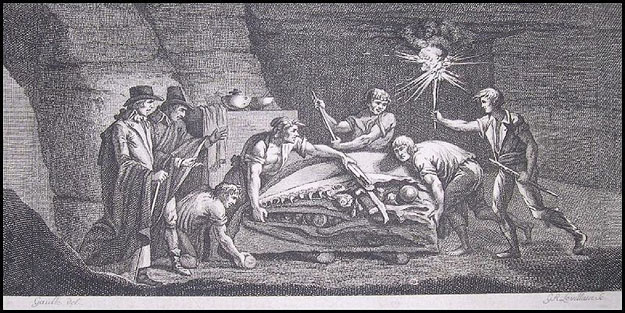
The discovery of a mosasaur in the Maastricht tunnels (1770). Engraving by G. R. Levillaire; image from Wikipedia.

MAASTRICHT, THE NETHERLANDS–Next month I am giving a talk on campus about evolution in a lecture series on “science and religion”. I was particularly intrigued, then, to hear a story about the famous mosasaur discovered in the Maastricht tunnels that highlighted tension between geology and the religious establishment long before Charles Darwin started rocking boats. It was a delight to be in the very tunnels where the drama began.

In 1770 a group of quarrymen in Maastricht discovered the skull of a very large and toothy animal. It was brought to the attention of Johann Leonard Hoffman, a local surgeon and fossil collector, who immediately knew it was very curious and would be of great interest to the savants of Europe. He corresponded with many, producing what we would call a buzz today about this creature. It clearly represented an animal which went extinct — a new concept at the time. How do you explain the existence of a large fossil like this deep underground in The Netherlands? Was it an animal which missed Noah’s Ark? Did God create some animals doomed to extinction?

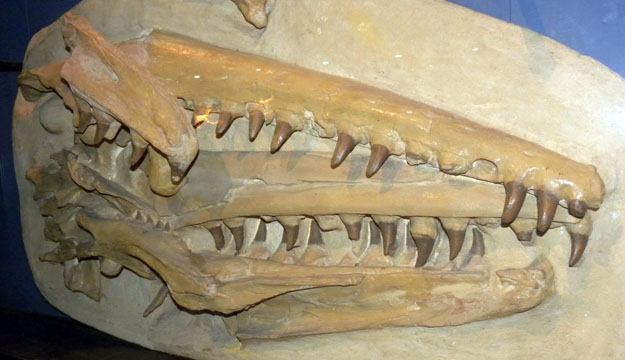
In 1794 an army from revolutionary France occupied Maastricht. Some officers wanted to seize the fossil and put it on display in Paris because of these questions about God and Creation. They wanted to use this mosasaur (the name came much later) to show that either there was no God or that God was a distant deity unconcerned with Creation. Apparently through bribery and rewards, they found the fossil and indeed shipped it off to Paris. To this day it is in the Paris Museum of Natural History and only a cast of it is in the Maastricht Natural History Museum. (The Dutch have various ways to remind visitors that the French stole the original specimen. European unity only goes so far!)

Cast of the famous Maastricht mosasaur in the Maastricht Natural History Museum.

In Paris the famous geologist Georges Cuvier took an interest in “le Grand Animal de Maastricht” and correctly identified it as a reptile — specifically a kind of marine lizard (a conclusion still supported today). Cuvier used it as evidence for his catastrophic ideas of disasters followed by re-creations of life on Earth.

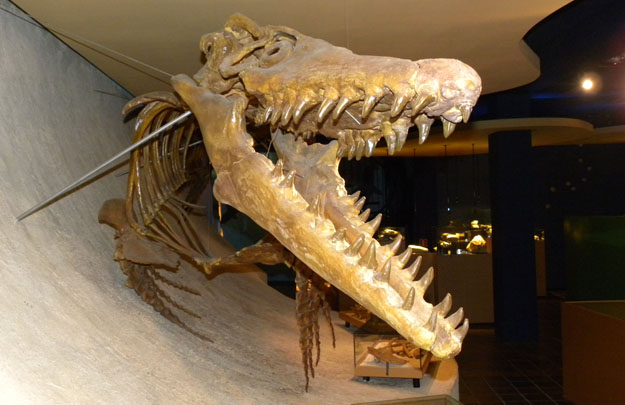
The Maastricht mosasaur, now known as Mosasaurus hoffmanni, thus was one of the first fossils to be used in the science-religion debates, and this was well before the modern theory of evolution emerged.

Mosasaur skeleton reproduction in the Maastricht Museum of Natural History.

Posted in Uncategorized | Tagged , , | 9 Comments

The best Cretaceous-Paleogene boundary yet

MAASTRICHT, THE NETHERLANDS–The Cretaceous-Tertiary boundary (K/T, or as I should be writing, the “Cretaceous-Paleogene” boundary, or K/Pg) has been one of the Wooster Geology themes this summer. We saw it in Alabama and Mississippi in May, and in Israel in June. The view of it here in The Netherlands, though, is far different. We explored it from below in the Maastrichtian tunnels at Geulhemmmerberg (N50.86692°, E5.78357°). This three-dimensional view, combined with the fact that this boundary section may be the most complete ever found, made today very special. We had a secular geological pilgrimage to the mysterious global events at the end of the Cretaceous.

After walking a long distance through the maze of tunnels guided by John Jagt of the Maastricht Natural History Museum and Rudi Dortangs, a very keen and accomplished amateur paleontologist (with a new mosasaur to his credit), we came upon excavations at the roof line which uncovered a thick sequence of clays and carbonate sand mixed together. The K/Pg boundary is a highly-irregular hardground surface with many Thalassinoides burrows penetrating up to two meters below. Carbonate sands are directly above the boundary, with the clay layers of varying vertical distances but rarely sitting on the hardground. There are at least seven clays, with the largest (Layer D) several centimeters thick. Since this boundary is near the roof of the tunnels, the bottom layers were often the ceiling above us so that we could see the very latest Cretaceous and earliest Paleogene exposed as a kind of upside-down bedding plane.


Two big surprises for: I knew there were multiple clay layers in some places, but to finally see them made them real for me. The traditional view since 1980 has been one clay layer representing the dust and debris from the meteorite impact settling back to Earth. Multiple clay layers makes this story much more complex, especially since some of the layers combine and split laterally. Maybe they were reworked during the storms of that “Global Winter”?

The second surprise was to learn that there were ammonites which definitely survived the extinction and lived briefly in the Paleogene. When these fossils were first found it was assumed they had been reworked from the Upper Cretaceous, but new studies show that they contain sediments which are indisputably Paleogene. Whether this is enough for us to change the textbooks is an interesting question: there are so few of the fossils, and in even fewer places. Nevertheless, some ammonites extend into the Paleogene.

Andrej Ernst and John Jagt at the boundary section in the Maastrichtian tunnels at Geulhemmmerberg.

This is a day I will always remember. For a historical geologist like me, it doesn’t get better!

Posted in Uncategorized | Tagged , , , | 4 Comments

Now I know why they call it Big Sky country…

Guest Blogger: Jesse Davenport

That is, when you look outside all you see is sky for miles upon miles upon miles upon…well you get the picture. It is extremely beautiful here. In Island Park, Idaho, we are sitting right on the border of Montana. Yellowstone is just a mere 30 miles away. It is one thing to read and study an area like I did for my junior thesis, but is an entirely different to actually be able to see the areas that I read about.

After a shaky first two days of traveling arrangements at the lovely Bozeman airport, everyone was finally together. Everyone including me, Caleb Lucy from Williams College, Danielle Lerner from Mt. Holyoke, Kristina Doyle from Amherst, Parker Haynes from the University of North Carolina, and Ali Walker from Smith College. And of course our two lovely professors, Tekla Harms from Amherst and John Brady from Smith. Saturday, Sunday and Monday we traveled out into our field areas in the Antelope Basin of the Gravelly Range to conduct some reconnaissance work. We familiarized ourselves with the rock formations, practiced our Brunton skills, and talked about the upcoming month.

Today, we sat down with Tekla and John to discuss our specific projects and what we would be doing individually. I will be doing geochemistry in what is termed the Madison Mylonite zone to try to determine the protolith of these highly sheared rocks by also doing the geochemistry on some of the other rock types around the region. These include diorite, schist, marble, phyllite, and many others.

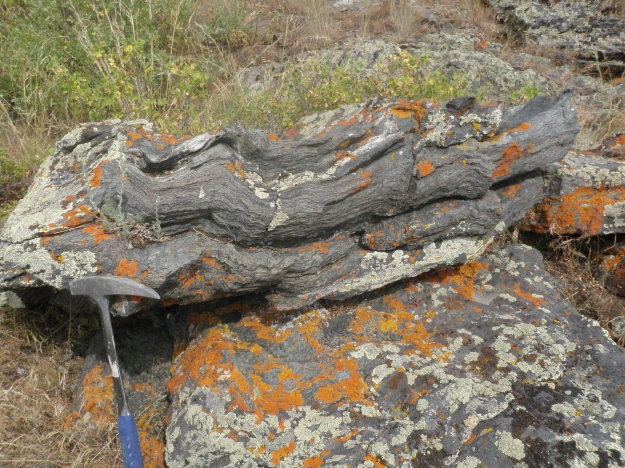
The rock here is a biotite schist. The main significance, however, are the wonderful crenulations in the rock (very small folds in the rock).

The rock here is a biotite schist. The main significance, however, are the wonderful crenulations in the rock (very small folds in the rock).

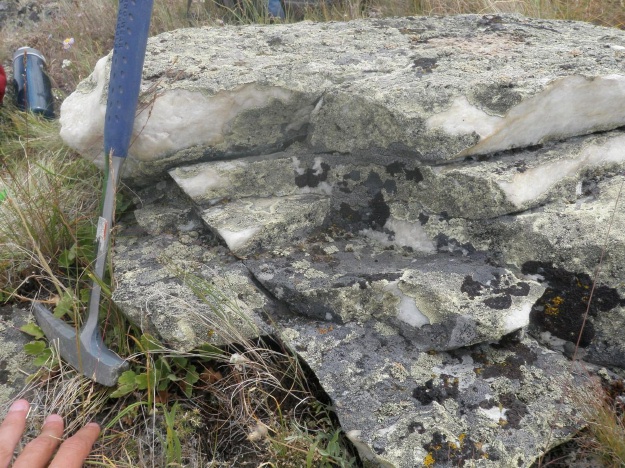
The rock you are looking at here is one of the many mylonites in the area, which I will be taking samples from to do my analyses.

The rock you are looking at here is one of the many mylonites in the area, which I will be taking samples from to do my analyses.

Posted in Uncategorized | Tagged , | 2 Comments

Tunnels (again)

MAASTRICHT, THE NETHERLANDS–After mentioning the excavations in the Maastricht Formation limestones (latest Cretaceous) in the last post, I expected to be moving on the next day to a quarry. I hadn’t read the guidebook closely enough: we were planning to spend the afternoon in them! Thinking of my last geology-in-tunnels experience in Russia, I was a bit apprehensive. This time, though, the tunnels were relatively dry, much wider and taller (no sliding on your belly for 30 feet!), and far more stable.

A portion of the tunnel map painted on a wall near the entrance.

The tunnels under Maastricht are incredibly complex, the product of hundreds of years of mining. The walls often show charcoal drawings of amazing complexity, some dating back to the 17th Century. On our particular route was a Roman Catholic chapel fashioned out of a few galleries by painting the rock walls, adding statuary and carving a pulpit. It was a refuge for the Catholic community when revolutionary French soldiers took over the town at the end of the 18th Century.

Our tour had a geological purpose. We saw, in three dimensions, what may be the most complete Cretaceous-Paleogene boundary known. I learned a great deal about the end-Cretaceous extinction event, especially that the story is getting more complex and surprising. More on that in a later post.

Posted in Uncategorized | Tagged , , , | Leave a comment

Geology and Art History

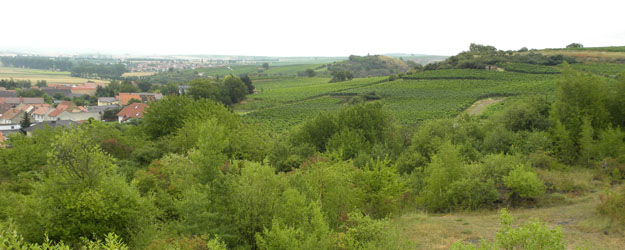
Tunnels in the Maastrichtian Formation (Late Cretaceous) in Maastricht, The Netherlands. Location = N50.82667°, E5.67978°.

MAASTRICHT, THE NETHERLANDS–The tunnels dug into the soft Maastrichtian Formation limestones in this city have a long history starting with the Romans. At first the excavations were intended only to extract building stone, but with all the battles, sieges and other military actions in this region, residents realized that these dry and deep caves also provided places of refuge. Bakeries, chapels, storehouses and dormitories were constructed in these spaces for times of war since the Middle Ages.

During World War II, the Dutch hid several works of art in these tunnels to protect them from the Germans. These included the magnificent Night Watch by Rembrandt and The Street by Vermeer. They were guarded by Dutch military police successfully throughout the occupation. We can view this art today because of the extent, thickness and composition of this Cretaceous limestone sequence — and the courage of Dutch patriots.

Rembrandt's The Night Watch (from Wikipedia).

Posted in Uncategorized | Tagged , , , , | Leave a comment

Wooster Geologist in The Netherlands

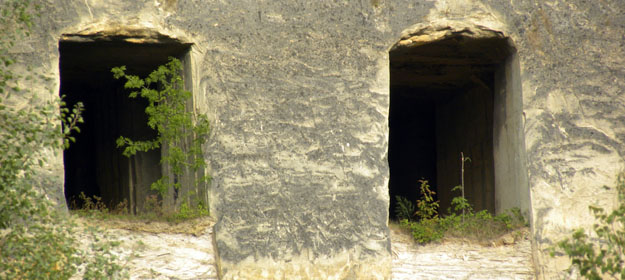
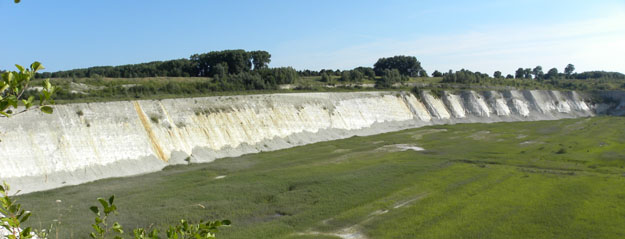
An outcrop of the Type Maastrichtian in Maastricht, The Netherlands. The square tunnels were dug in the Middle Ages for building stone. The rock is a limestone.

MAASTRICHT, THE NETHERLANDS–This is the first day of the International Bryozoology Association post-conference field trip. We took a train south from Kiel to Hamburg, Germany, and then connected with another train to Cologne. After spending a half-hour at the Cologne Cathedral (right next door to the train station), we took a bus west to Maastricht, The Netherlands, on the Maas River. We then spent the rest of the day in the ENCI cement quarry exploring the very fossiliferous Maastricht Formation, which is the type section of the Maastrichtian Stage described yesterday.

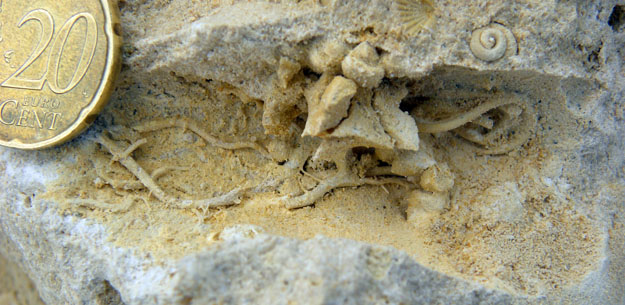
One of my favorite fossils in the Maastricht quarry. This is an external mold of an aragonitic shell in which the borings were filled with calcitic sediment. The result is a set of casts of the original borings.

Posted in Uncategorized | Tagged , , , , , | Leave a comment

The power of biostratigraphy: the Campanian-Maastrichtian boundary in the Late Cretaceous

Chalk quarry I visited today near Lägerdorf, Germany. It is Late Cretaceous in age, spanning the Campanian-Maastrichtian stage boundary. Location: N53.90395°, E9.57840°.

Outcrop of the Pierre Shale in South Dakota visited two years ago by a Wooster Geology team. It is also Late Cretaceous and at the Campanian-Maastrichtian stage boundary.

KIEL, GERMANY–Comparing the two very different geological sections pictured above, you should ask how we know that they are precisely the same age. After all, they are thousands of miles apart and are quite different in their composition and fossil content. We can even say that the boundary between the Campanian and Maastrichtian stages (these are fine divisions of geological time) is 70.6 million years old, give or take a hundred thousand years or so. The answer starts with the belemnite fossil Belemnella lanceolata, a nice example of which we found today in the German chalk quarry:

A belemnite is an extinct cephalopod (a group which includes the modern squid, octopus and others) that is a common fossil in Mesozoic sediments, especially in the Jurassic and Cretaceous Periods. They were swimming predators and so they could live happily in oceanic and shelf waters with little regard for the sediments beneath them. They are thus found in a variety of sedimentary rocks around the world. Belemnella lanceolata is present throughout Europe in a narrow time interval bounded by its origination and extinction. It overlaps in its age range with a variety of other fossils in a chain of co-occurrences that eventually includes Baculites baculus of South Dakota. Because these fossil species evolved and went extinct at specific times, correlation links them together through a particular time interval. Geologists decided that the first appearance of Belemnella lanceolata would be the marker for the base of the Maastrichtian Stage (and by implication the top of the Campanian Stage). Thus we use paleontology and evolution to mark time in the rock record and correlate these time units around the world. For more details on this story you can check out the massive Late Cretaceous correlation chart (a colorful pdf) hosted by Purdue University.

How do we know this boundary is 70.6 million years old, more or less? That is another story of volcanic ash falls, igneous rocks, and radioactive dating. Maybe later!

Posted in Uncategorized | Tagged , , | 1 Comment

International Bryozoology Association meeting ends, field trips begin

KIEL, GERMANY–The 15th meeting of the International Bryozoology Association ended this afternoon with the usual giving of awards, assessing the budget, and planning the next meeting (Sicily in 2013). I like this group very much. It is the best combination of biologists and paleontologists I know. (A larger version of the official photograph by Andrej Ernst is available.)  The field trips begin tomorrow!

Posted in Uncategorized | Tagged | 1 Comment

Cretaceous soft-bodied bryozoans from the western USA

KIEL, GERMANY–I gave my presentation to the International Bryozoology Association meeting this afternoon. It was a fun project because it involved two of my favorite things: working with Paul Taylor from the Natural History Museum and advising an Independent Study student, in this case John Sime. I’ve repeated three of the slides below. The entire set of PowerPoint slides is no farther than a click away.

(Abstract in Terra Nostra – Schriften der GeoUnion Alfred Wegener-Stiftung, vol. 2010/4, p. 47.)

Posted in Uncategorized | Tagged , , | Leave a comment

On giving a professional presentation

The lecture hall at the University of Kiel used for the 2010 meeting of the International Bryozoology Association.

KIEL, GERMANY–There is an exquisite moment as you wait in the darkened hall for your turn to speak. The presenter just before finally says something like, “in conclusion …” Even though you knew this time had to come, your heart speeds up, your vocal cords tighten, and you feel the rush of new adrenaline.

You remember how easy it was to respond to the invitation months ago and submit that abstract. You thought nothing of it for weeks, even after making all the travel arrangements and seeing your name in the program. Then about a week before the talk came a twinge of anxiety — maybe this won’t be as easy as I think? Furious action for a day as you prepare the PowerPoint slides and run through them a few times. Yes, that’s good. With relief you store it on a thumbdrive and feel accomplished.

The meeting starts and you sit through the first set of presentations. Hey, most of these talks are very good! Listening to the questions you realize it is time to up your game. The night before the talk is always when the strongest doubts settle in and you look at your simple set of slides and obsessively begin to add, subtract, redraft, rearrange. The morning of the talk is devoted to nervous pacing and absent-minded mistakes. (Today, for example, I walked a half-hour towards the university and had to go back for my wallet.)

Once your presentation slides are loaded in the computer projection system, a deep calm descends. The die is cast, your fate is set.

Standing on the stage with the microphone in place and the first slide displayed always feels like an out-of-body experience. You hear yourself begin to talk but somehow your consciousness has split free and is running an independent narration. How’s he going to do?, the observer asks. He seems to be going a bit fast there. Steady that laser pointer. There’s a man in the back with a laptop open. Is it raining outside? All the while the speaker speaks on.

Everything is going well enough. No blank pauses, no stumbling with words. Still within the time limit. Almost to the last slide … keep talking …

Fire alarm!

And not just any fire alarm. This is a heavy-duty German version with blaring horns and flashing lights. It is so loud that it silences even the narrator. The audience sits stunned by the noise, waiting for instructions. None can come because no one would hear them. A few people stand up and head to the doors, and soon everyone follows. I take off the microphone and go along. Only one minute left and I would have been fully released!

It was, of course, a false alarm, but it involved two fire engines and their crews. Two hours later we reassembled and I presented the last minute of my paper, which was a bit of an anticlimax. You’re lucky, people told me, for we will all remember your talk — or, rather, that you were the one who was talking.

Posted in Uncategorized | Tagged | 3 Comments