


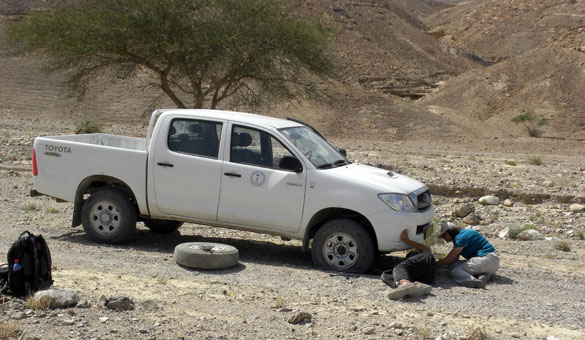
Flat tire at N30.54352°, E35.14007°.

Near miss (if we had been eating lunch here, say, 15 years ago).
Flat tire at N30.54352°, E35.14007°.
Near miss (if we had been eating lunch here, say, 15 years ago).
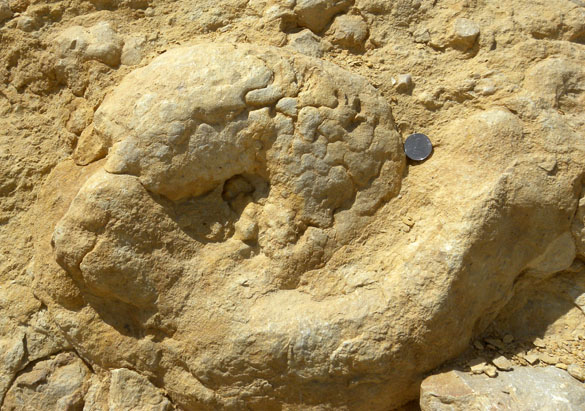
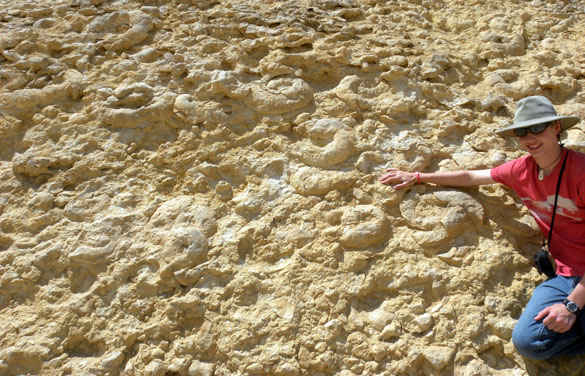 MITZPE RAMON, ISRAEL–On our way back from Eilat this afternoon, Will and I took a short hike to see the “Ammonite Wall” on the southern outside beds of Makhtesh Ramon. It is an impressive tilted array of large ammonites in the Tamar Formation (Cenomanian). Current thoughts are that this represents a massive death assemblage. The ammonite conchs, which all seem to be of the same species, washed into an embayment and were buried. This is not uncommon as ammonite conchs probably filled with gases after death and floated great distances. They are all preserved as internal molds, with a few, such as the one below, showing their suture patterns.
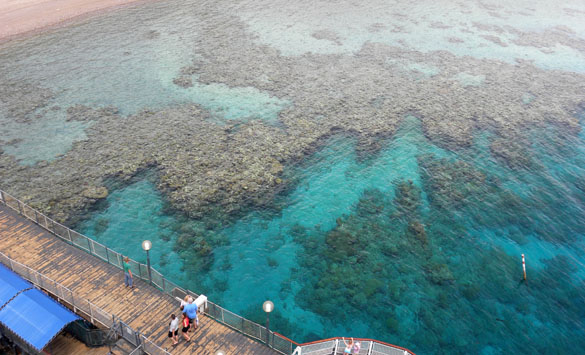
Fringing coral reef seen from the top of the Underwater Marine Observatory tower near Eilat, Israel.
EILAT, ISRAEL–When I first visited the Underwater Observatory Marine Park outside Eilat on the Red Sea coast near the Egyptian border, I was enchanted. An elegant steel and glass tower was built into a reef so that you can descend well below sea level and look out at a living, natural reef. I’ve brought students to this Observatory ever since to enjoy the beauty of a reef close-up without having to get wet. It is also a splendid place to see living analogues of the many organisms we are studying as fossils in the Jurassic and Cretaceous.
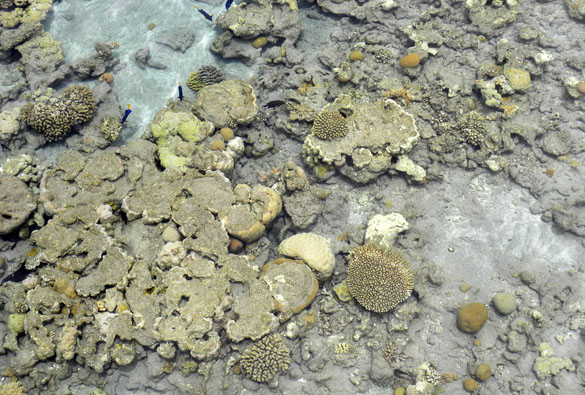
Closer view of the reef in the first image. Almost all the corals are dead.
Alas, the Eilat coral reefs are dying quickly. I see a significant difference in the health of the reefs in the last eight years. Most of the framework corals are completely dead, leaving gray aragonite skeletons to be sparsely inhabited by sponges, feather worms and the inevitable algae. The park tries gamely to keep up appearances at the observatory windows, but it is clear that the dwindling diversity of fish is now the primary attraction, not the corals themselves.
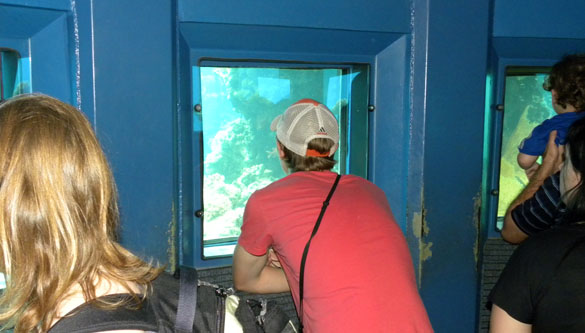
Will Cary looking out one of the underwater windows into the coral reef.
Coral reefs are dying all over the world, but their rate of disappearance in the Red Sea is unusually high. There are many causes, my biologist friends tell me, most related to the narrow nature of the Gulf of Eilat here. Many ships pass through daily, water-loving tourists are abundant, and wastes inevitably drain from the cities of Eilat and Aqaba into the sea. There is also a problem of sand being added to hotel beaches which gets redistributed onto living reef.
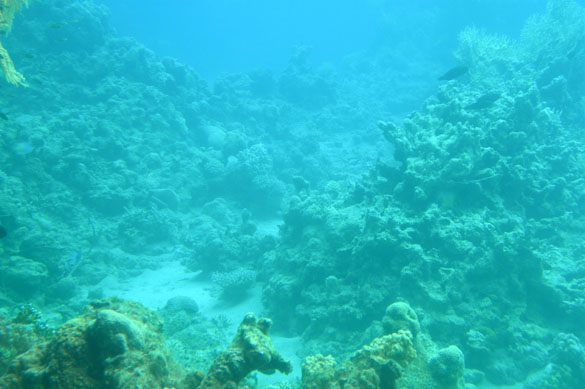
The coral reefs viewed from below. The framework is mostly dead coral skeleton.
Fifty years ago there were about 10 square kilometers of living coral reef in this area. Now it is less than 2.5 square kilometers, and much of this remaining reef is so stressed that no new corals are recruited. Very sad.
In the future I may be showing my students a few living corals preserved in the aquaria of the Underwater Observatory Marine Park, and then looking out at what happens to an ecosystem when the reefs die.
 MITZPE RAMON, ISRAEL–The only other time I’ve seen rain in southern Israel was with Elyssa Krivicich on our March 2008 trip. By May the rains are done in this part of the world. Nevertheless, it rained last night and then sprinkled on us as we drove south to Eilat this morning. The temperature has also dropped a good 6°C, which suits us just fine.
This is the 400th post on the Wooster Geologists blog! It is also near our two-year anniversary. It appears from our statistics (which I do not fully understand) that we have had 21,793 visitors and 163,072 pageviews. I’m not sure if those are unique visitors or what a “pageview” is, but I know we’ve had enough feedback to make this project much fun.
 MITZPE RAMON, ISRAEL–This morning Will and I finished our work with the Zihor/Menuha boundary cobbles. We drove to the southern side of Makhtesh Ramon (pictured above) to see the same units we examined 25 kilometers to the north in Wadi Aqrav yesterday. The scenery was spectacular — and the day so hot that the wind felt like a hair-dryer in the face.
 Will standing on the very top of the Zihor Formation where it is overlain by the Menuha chalks. This picture was deliberately posed to give his parents a bit of a thrill.
 The Zihor/Menuha cobbles in the southern sections. They look very much like those we studied in Wadi Aqrav. They certainly are more numerous here and easy to measure. Some have borings by bivalves (Gastrochaenolites) and worms (Trypanites). We found no encrusters here, but we did find oyster shell fragments.
 A difference between these southern exposures and those to the north is that the Zihor Formation top surface here is very well exposed. We can see that it was probably lithified during the erosion that created the disconformity and the cobble lag. It is undulating and well polished. Note that it is also on the edge of oblivion.
 The Zihor/Menuha boundary is very distinctive because of the erosional differences, so faults through it show up well. What kind of fault is this? (It is not a trick of perspective because the fault plane has eroded back a bit.)
 This is the kind of shade we had in the field today — when we were lucky! It was 40°C by 1:00 p.m. Will is pressed up against an outcrop of the Menuha Formation, by the way, showing a sequence of carbonate nodules that may help explain the origin of the boundary cobbles.
MITZPE RAMON, ISRAEL–I’ve always enjoyed seeing the Ora Formation, which is exposed only in Makhtesh Ramon and to the south. It is early Late Turonian in age, so it is part of the Upper Cretaceous and about 90 million years old. It has an astonishing range of depositional units, many of which Will and I saw today on our way to our localities. The Ora Formation has been very well studied by Israeli paleontologists and stratigraphers. Their work can now be expanded with more paleoecological analysis and some of the insights we’ve gained from new ideas about Calcite and Aragonite Sea alternations. Maybe another Wooster Independent Study project or two in the future?
 A carbonate hardground in the Ora Formation. The holes were drilled by lithophagid bivalves, producing a trace fossil called Gastrochaenolites. These borings are very densely packed, which is more typical for the Jurassic than the Cretaceous.
 A unit composed of almost entirely oyster valves in the Ora Formation. It is above what is called locally the “Vroman Bank”. The shells are like large cornflakes. We didn’t get a chance to look in detail, but I’d love to see what kind of sclerobionts are preserved on these oysters.
 Will is sitting in an unusual diapiric structure in the Ora Formation. This is a dissected “mud volcano“, or at least what would have been a mud volcano but for the resistant capping rock. Soupy mud was forced out from underneath the overlying limestones forming an inverted cone in cross-section. The limestones dip into the structure because they were forced down by the accumulating mud. The criss-cross lines in the mud are planes of gypsum that intruded the sediments later. Note the blocks of limestone in the “throat” of the structure — this means the limestones were lithified during the event.
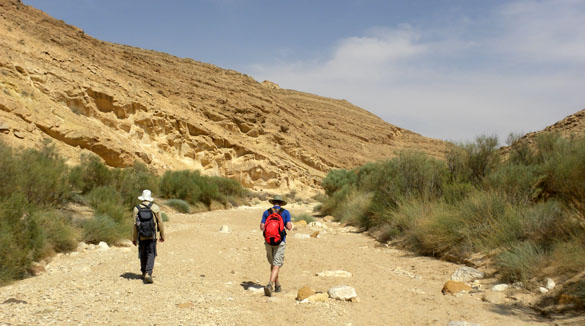
Yoav Avni and Will Cary hiking down the wadi that exits Makhtesh Gadol. In the background is the wall of the makhtesh. It is made of diverse Cretaceous units.
MITZPE RAMON–Our colleague Yoav Avni of the Geological Survey of Israel is part of a movement to declare the Negev Desert around the three major makhteshim a Geopark cataloged by the United Nations Educational, Scientific and Cultural Organization (UNESCO). A Geopark is defined by UNESCO as “A territory encompassing one or more sites of scientific importance, not only for geological reasons but also by virtue of its archaeological, ecological or cultural value.” Yoav’s dream is that scientists and the general public from around the world will someday visit the makhteshim to tour the unique geological features with an infrastructure in place much like that of a US National Park. The ecological and cultural heritage of this region will be as important as the geology.
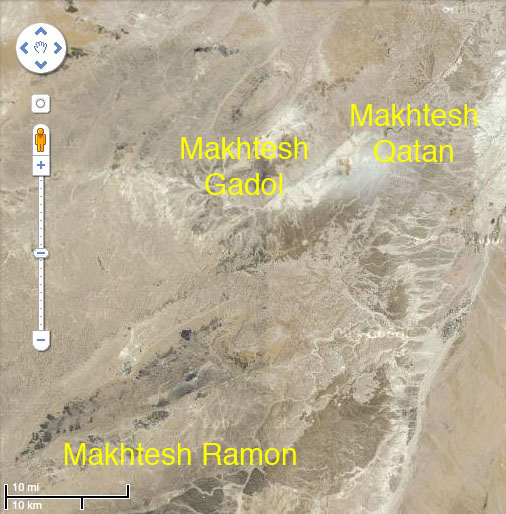
Modified from Google Maps.
I played a small role in this process when I wrote a letter to the Israeli government in 2005 (at Yoav’s request) explaining the geological value of Makhtesh Gadol and opposing further expansion of a sand quarry in the northern part of the makhtesh. This added a seed of international scientific interest to the discussion that continues to grow.
Now when we describe geological phenomena and fossils in the makhteshim, we are thinking about the ways we can explain these things to the public through nature trails, museum exhibits and popular press articles. It is exciting to be on the ground floor of such an endeavor.
There is plenty of opposition to this Geopark, of course. On one side are industries and government officials who want to squeeze every bit of economic usefulness from the land; on the other are extreme preservationists who wish to close off large tracts to all human entry. Somehow Yoav and his colleagues will have to find a way to make the future Geopark economically viable and yet with all the protections necessary to preserve its natural assets. This will be a slow process but maybe I will someday be posting blogs from the Makhteshim Country Geopark.
 MITZPE RAMON, ISRAEL–Sclerobionts are organisms that live on or in a hard substrate. Paul Taylor and I coined the term in 2002, so I use it as often as I can. Maybe someday more than six people will know what it means. A project for this year’s Israel field expedition is to revisit a locality where an extensive bed of hiatus concretions, most of them bored or encrusted by sclerobionts, is found between the Zihor and Menuha formations in the Upper Cretaceous. (This layer is pictured above.) Andrew Retzler and Micah Risacher will remember the Wadi Aqrav (Scorpion Wash) sections well from their Independent Study work last year. These hiatus concretions were formed when deep erosion produced a disconformity and a lag of cobbles. We already had a GSA presentation on this topic; now we need more information for a future paper.
Will and I hiked through Wadi Aqrav today to collect more information about these Cretaceous cobbles. We found all our previous study sections and a few more outcrops of the Zihor/Menuha formation boundary. Most important, we were able to collect more sclerobionts and other associated fossils.
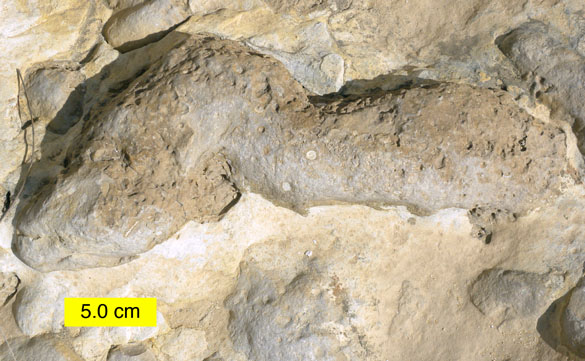
One of the bored and encrusted Zihor/Menuha cobbles showing its apparent origin as a burrow-fill.
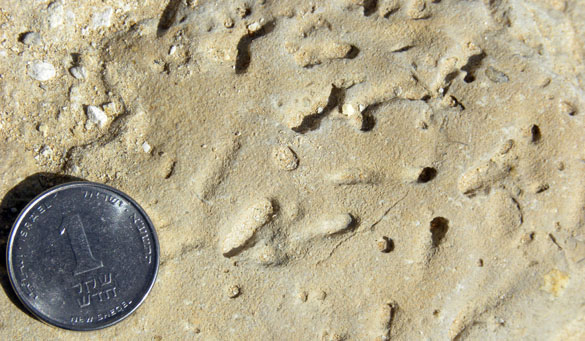
Eroded borings in the surface of one cobble. These are holes in the rock, but if you stare at them long enough they will suddenly look like bumps!
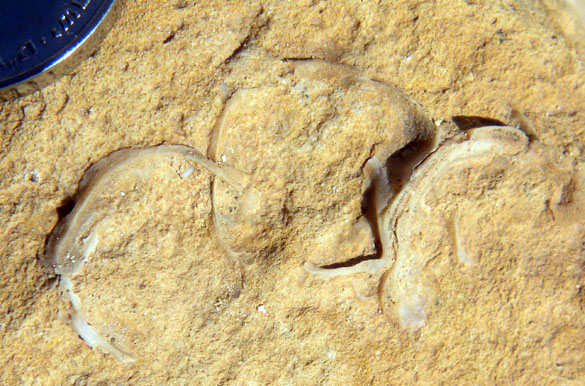
Three oysters on a cobble surface. Two grew together at the same time and one came later. Can you tell which?

Will found this nice irregular echinoid in the matrix between the cobbles. He also found a couple of shark teeth near it. A one-shekel coin, by the way, is 1.7 centimeters in diameter.
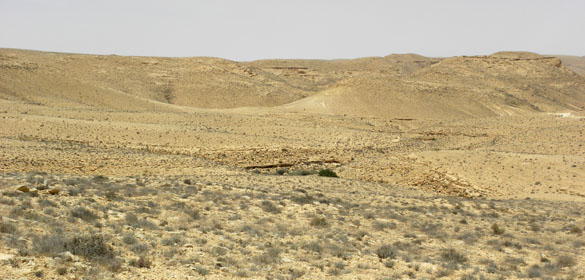
Landscape view of the Wadi Aqrav region. Beautiful desert in the Negev Highlands north of Makhtesh Ramon.
 MITZPE RAMON, ISRAEL–It wouldn’t be the Middle East without a camel encounter or two. One year a camel literally ate my lunch when I left it in the shade of the car during a long morning’s work. (He even ate the plastic around the sandwiches.) The local Bedouin care for small camel herds that range throughout the Negev. If you’re near a wadi with a source of vegetation and water, camels are nearby. The version here is the one-humped variety: the dromedary (Camelus dromedarius).
Will and I were walking up a long dirt road around noon when we met the large male camel pictured above. He stared us down, standing almost completely still. We immediately saw why he was so intense: a group of females and young camels was behind it and we were about to walk between him and them. Of course, we had no interest in dying under the hooves of a camel (or whatever they do when they attack), so we moved carefully off the road. After a few minutes he slowly strolled down a wadi and the rest of the group caught up with him, a female at the end keeping her eyes on us until they were out of sight.

Females and young following the male down a wadi.

Will Cary collecting crinoid pieces at a site we creatively call "GPS 055". In the upper left you can see a triangular exposure of marl where Jeff Bowen did his Independent Study work in 2005.
MITZPE RAMON, ISRAEL–One of our missions on this expedition to Israel is to find more and better examples of a distinctive crinoid in the Middle Jurassic Matmor Formation. Crinoids are stemmed echinoderms with a very long geological history, dating back to the Ordovician (or Cambrian, depending on who you believe). They are still alive today so we know much about their biology. They usually have long stems with a holdfast on one end (attaching it to the substrate) and a calyx on the other containing most of the body. The calyx has feathery arms attached at the top that filter the water to catch fine-grained organic particles and pass them down to a central mouth.
Parts of the Matmor Formation have abundant crinoid fragments, all belonging to at least two types of Apiocrinites (a crinoid genus). Two years ago I collected some beautiful specimens, but still lacked some critical pieces. Today Will and I revisited my earlier localities (thank you, GPS technology) and found beautiful specimens.
 Our prize is the holdfast pictured above. This is a mass of skeletal calcite the crinoid used to glue itself to the bottom of a coral. The shallow pits apparently represent additional “roots” it used to brace itself in a cavity under the coral. The stem then horizontally protrudes to the right so that the calyx and feeding arms could eventually reach the open seawater. I’ve never seen a holdfast this elaborate in the Jurassic.
 Above are typical other parts of this Jurassic crinoid (imaged with all my hotel room photographic skills). At the top are two calyx side pieces showing the interior (left) and exterior (right). The star-shaped object in the middle is the calyx base, seen from the inside. It is flanked by stem fragments, the one on the far right encrusted by an oyster. At the bottom is a crinoid stem with a branching holdfast of another crinoid attached to it.
Mission accomplished as far as the crinoids go!