Wooster’s Fossil of the Week: A carrier shell snail (Recent, Pacific Ocean)

OK, it’s true: our Fossil of the Week is not actually a fossil. (The “Recent” in the title was a clue.) I bought this shell at the Wayne County Fair and it was so beautiful it just had to make the blog. (I paid $4 for it, which I think was quite a deal.)

What we have above is Xenophora pallidula (Reeve, 1842), commonly known as the Pallid Carrier Shell. It is a remarkable gastropod (snail) that ornaments its shell with “foreign” objects, usually other shells. (The genus name Xenophora means “foreign-bearing”.) They provide a nice sampling of the shelly debris surrounding their seafloor home.
The snail cements the items to the periphery of its shell as it grows, embedding the objects with its mantle into its aragonite. It selects dead shells and carefully rotates them with its foot and proboscis so that the concave side is upwards and the smaller end is attached. Attached snail shells thus have the aperture facing up, and clams have the inner side upwards as well. It takes almost two hours for a single object to be added to the shell, and up to 10 hours for the xenophorid snail to be confident enough to resume its normal life.

Why do xenophorids decorate their shells in this way? Apparently it is a kind of camouflage on a gravelly substrate. The long shells at the periphery of the shell also lift the shell above the substrate so that the snail’s body can extend inside a protective cage. The xenophorids can then peacefully feed on algae, diatoms and foraminiferans on the sediment. A curious habit they have which is rare among invertebrates: they dig holes in the sediment and bury their feces!

A glass sponge (Class Hexactinellida) attached to the top of Xenophora pallidula.

The genus Xenophora was named and described by the natural historian Johann Gotthelf Fischer von Waldheim (1771-1853). He was a German who specialized in marine invertebrates, insects, and fossils. von Waldheim studied under the famous Georges Cuvier in Paris, had a professorship in Germany, and then moved to Moscow in 1804 to become Director of the Natural History Museum at the University of Moscow. His work in Russia included the description of many new fossils, so we ultimately come back to paleontology!

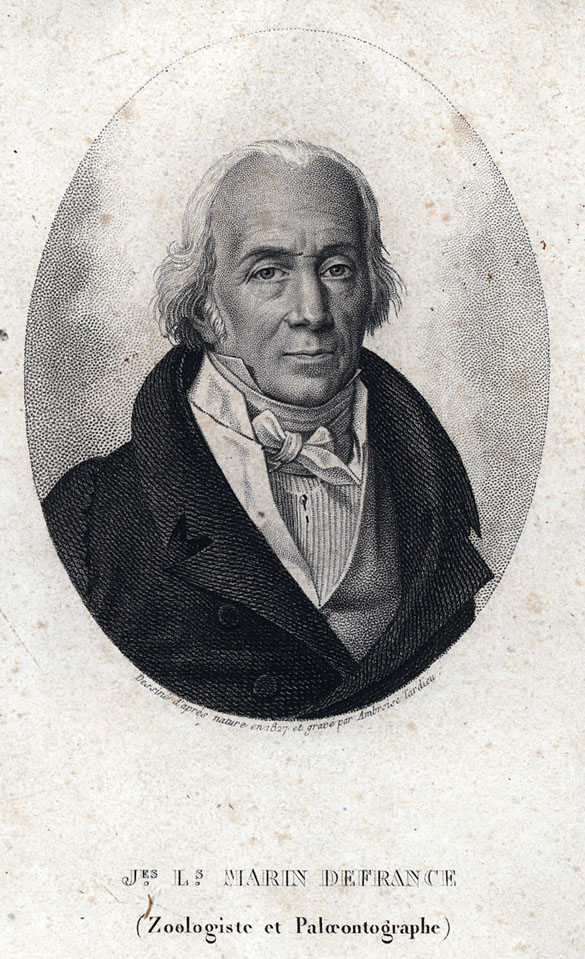
Johann Gotthelf Fischer von Waldheim (1771-1853).

References:

Kreipl, K. and Alf, A. 1999. Recent Xenophoridae. ConchBooks: Hackenheim, Germany.

Ponder, W.F. 1983. A revision of the recent Xenophoridae of the world and of the Australian fossil species (Mollusca: Gastropoda). Memoirs of the Australian Museum 17: 1-126.

Posted in Uncategorized | Tagged , , | 1 Comment

Sclerobionts and Extinctions: A Wooster Geologist Faculty Talk at the 2011 Geological Society of America Annual Meeting

The last day of a professional meeting is very different from the first. At least half the attendees have gone home. Those that remain move a little slower and have that glazed look from late night dinners, too little sleep, and dreams of getting on that flight out of here. The convention staff is clearly oriented now towards the next event of cheerful conventioneers. (The “RAM SWANA” conference. I was so hoping this was about a mystical Indian guru, but instead it is a joint meeting of the “Recycling Association of Minnesota” and the “Solid Waste Association of North America”. I’ll give it a skip.)

My friend Paul Taylor and I organized a topical session on sclerobionts and mass extinctions, and we have the honor of ending the meeting this afternoon. With generous support from the Paleontological Society, we’ve brought in an international team of paleontologists who specialize in hard-substrate marine organisms, including Michał Zatoń of Poland, Silvio Casadio of Argentina, and Liz Harper of England. Our students Megan Innis and Caroline Sogot are participating as well. The audience may be the speakers themselves, but it will be enthusiastic. (Too bad we won’t get even a small fraction of the attention the pseudoscientific and embarrassing talk on the “Triassic kraken” received earlier in the meeting.)

I’ve started this entry with the first slide of the first talk, and ended it with our conclusions. We hope we’ve at least planted the seeds of a new topic in extinction studies. We’ve certainly had fun getting this diverse group of scientists together in one room.

And yes, we are also dreaming of that flight home!

Posted in Uncategorized | Tagged , , | Leave a comment

Posters Round Two at GSA – Minneapolis


Sarah Appleton presents her research in Glacier Bay National Park and Preserve. Her IS topic Tree-Ring Dating of the Glacial History of Wachusett Inlet, Glacier Bay was part of a special session honoring Dr. David Michaelson (U. Wisconsin – Madison) a long time worker in Glacier Bay.

Andrew Collins presents his work on The Use of Geophotography as a Permanent Resource in Higher Education – this is a collaborative project that Andrew is doing with Drs. Judge and Wiles and The College of Wooster librarians – Marsha Bansberg and Jessica Clemons. The database has gone live and can be found here. In the future all those trips to Spangler and other field sites around Wooster will be archived at this site. If alumni have some photos in their collection they would like to contribute to the effort, that would be greatly appreciated.

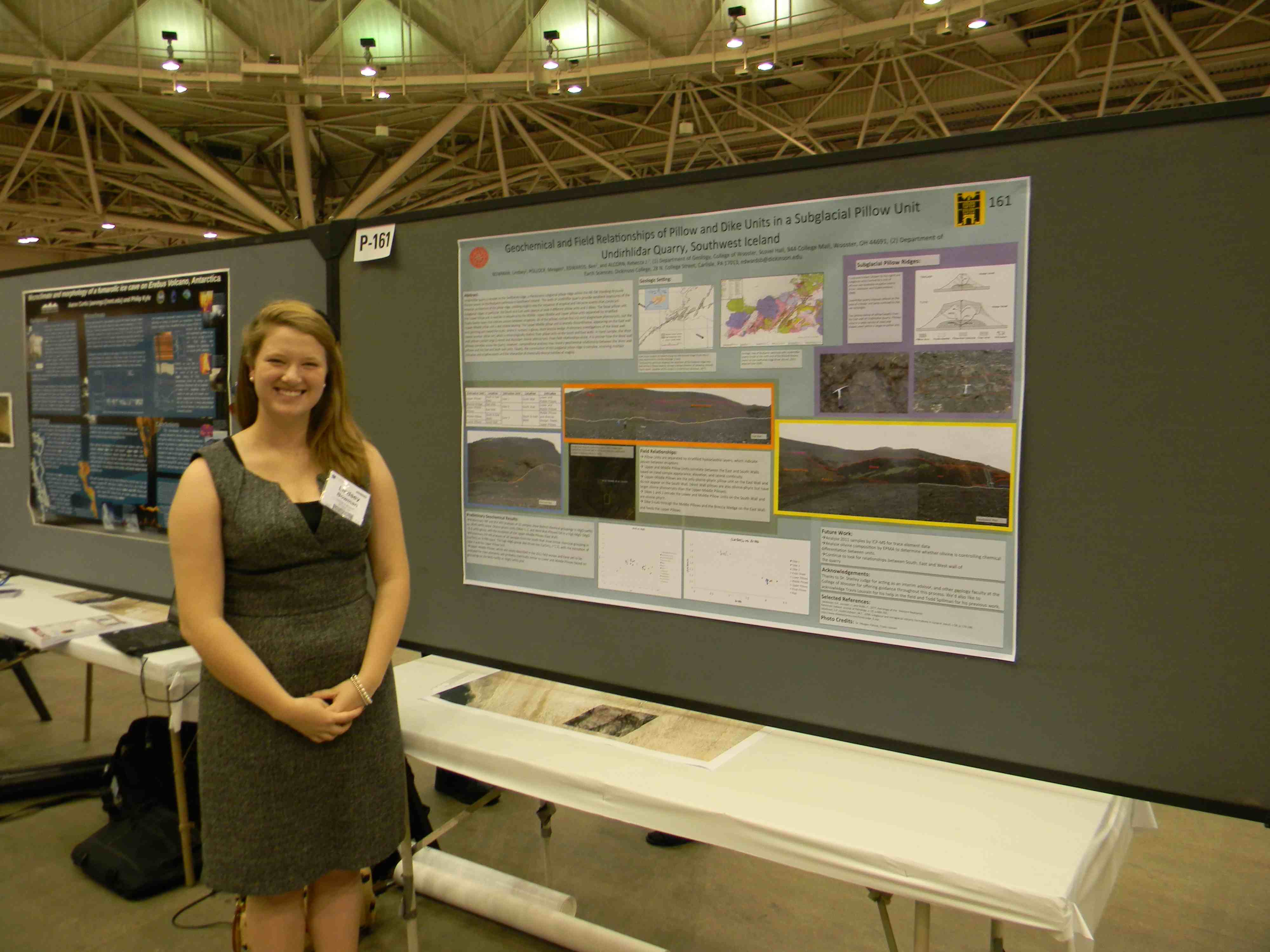
Lindsey Bowman presented her geochemical data to the geologists. He poster describes results of her ongoing IS work with Dr. Meagen Pollock in Iceland. Her poster is entitled: Geochemical and Field Relationships of Pillow and Dike Units in a Subglacial Pillow Ridge, Undirhlithar, Southwest Iceland.

Dr. Shelley Judge leads a lively discussion of her work summarizing 65 Years of Pedagogical Scaffolding and Sequencing in the Sanpete Valley of Central Utah – although it sounds like a series of structural geology terms, Dr. Judge’s poster was about assessment. In addition to being a leader in the field of structural geology, Dr. Judge is a leader in learning assessment, which makes her Chair very happy.


Posted in Uncategorized | Tagged , , | Leave a comment

Wooster Geology Alumni Gather at the 2011 Geological Society of America Annual Meeting

MINNEAPOLIS, MINNESOTA–It is a tradition that Wooster geology alumni, faculty, students and friends gather at the Geological Society of America meeting on Monday evening. Twenty-three of us were there tonight, although we never seem to get everyone in the same place at the same time for the photograph. It’s interesting how we actually talk very little about past Wooster experiences. Most of the time we’re comparing notes about our current projects and planning when we will see each other again. That and apologizing for missing each other’s talks!

Posted in Uncategorized | Tagged , , | 1 Comment

First Wooster student presentations: The Estonia team

MINNEAPOLIS, MINNESOTA–The first Wooster students presented today at the Geological Society of America annual meeting. Above is Nick Fedorchuk who talked about his work in Estonia studying the Wenlock-Ludlow boundary on Saaremaa Island and its implication for Silurian stratigraphy and depositional environments in Baltica.

Rachel Matt (above) presented her work on the Lower Silurian fauna found in the Hilliste Formation on Hiiumaa Island, Estonia. These fossils are critical evidence for the recovery of marine communities following the end-Ordovician mass extinctions.

It was fun watching Nick and Rachel interact with geologists who stopped by to see their posters. Not only did they learn a great deal about the rocks and fossils they are studying, they could also see how they fit into larger questions about Silurian plate tectonics and evolution.

Two other Wooster students also showed posters today: Lindsey Bowman and Andrew Collins. Photos and profiles of their work will be posted later.

Posted in Uncategorized | Tagged , , , , , | 2 Comments

Wooster Geologists in Minneapolis! (Annual Meeting of the Geological Society of America)

MINNEAPOLIS, MINNESOTA–Wooster Geologists are again attending the annual meeting of the Geological Society of America in force. It is strangely very warm and sunny here in mid-October Minneapolis. The convention center looks like a late summer college campus with people sunning themselves in grassy gardens surrounding the convention buildings.

We have all four faculty and six students at the meeting this year making various presentations from Sunday through Wednesday. We will soon show you our students giving poster presentations, along with comments on the meeting itself.

Minneapolis skyline from the Convention Center. Note the blue sky!

Posted in Uncategorized | Tagged , , | Leave a comment

Wooster’s Fossil of the Week: an aberrant brachiopod (Permian of Texas)

Funny word to apply to a fossil: aberrant, meaning “deviating from the normal”. It’s an old-fashioned word rarely used these days, primarily because we have a hard time defining “normal”. It was the word used when I was introduced to the above brachiopod, though, so I employ it in honor of my old-timey professors.

On the left is the dorsal valve exterior and on the right the ventral valve interior of Leptodus americanus Girty 1908. (Both valves are broken.) This species is a member of the Family Lyttoniidae in the Order Productida, which some of my students may have just figured out. The large ventral valve relative to the reduced dorsal valve is the clue. The specimen was found in the Word Limestone (Wordian Stage, Guadalupian Series, Middle Permian System, about 265 million years old) in Hess Canyon, Texas. It is replaced by silica (“silicified”) and so was easily extracted from a block of limestone by dissolving away the calcium carbonate matrix.

These brachiopods, along with many other types, lived in extensive reefs in west Texas during the Permian. The ventral valve was cemented to other shells and extended out parallel to the substrate. The much smaller dorsal valve fit into the grooves, leaving much of the soft-part interior exposed. My professors said it was “like a leaf in a gravy boat” — and I had no idea what a “gravy boat” was then.

It is likely that Leptodus americanus had photosynthetic zooxanthellae embedded in its exposed mantle tissues. These are protists (most often dinoflagellates) that live inside the tissues of metazoans and provide them with nutrients and oxygen in return for carbon dioxide and a cozy place to live. Reef-forming corals are the best known animals to have such a mutualistic symbiotic relationship with zooxanthellae today. It would thus not be surprising to see a similar system with these reefal brachiopods.

Not so aberrant after all.

References:

Girty, G.H. 1908. The Guadalupian fauna. United States Geological Survey Professional Paper 58:1-651.

Williams, A. 1953. The morphology and classification of the oldhaminid brachiopods. Washington Academy of Sciences Journal 9: 279-287.

Posted in Uncategorized | Tagged , , , | Leave a comment

Wooster’s Fossil of the Week: an oreodont (probably from the Oligocene of Nebraska)

Oreodonts are extraordinarily common fossils in the Oligocene of North America. Just about every teaching fossil collection contains at least a couple oreodont skulls, most obtained during late Nineteenth-Century field trips to the Great Plains. Our specimen above is of the genus Merycoidodon Leidy, 1848. We know it is Oligocene in age (about 30 million years old), but we don’t know where it came from. (Always label your fossils with location and stratigraphy!) If I had to guess, I’d say it is from the Upper Brule Formation, White River Badlands, Nebraska, USA. (An easy call because most seem to come from there.)

Our Merycoidodon skull is a bit distorted by burial, but you can still see some characteristic features. There is a pit in front of the eye orbital. This may have housed a scent gland like that found in deer today. The teeth (close-up shown below) include impressive canines and a row of strong molars for tearing and grinding vegetation.

Merycoidodon (the name means “ruminating teeth”) was an artiodactyl (even-toed hoofed mammal) that lived in large herds from the late Eocene to the early Miocene, with peak abundance in the Oligocene. So far they are found only in North America. They looked a bit like large pigs, at least in their bodies, with heads that look rather doggy to me (see below). The adults averaged about a meter and a half long. The herds of these animals would have looked odd to our eyes because they were clearly not built for fast running.

Merycoidodon culbertsoni (Oligocene of North America). (From Nobu Tamura via Wikipedia.)

Leidy (1848) named these fossils Merycoidodon. However, in 1853 he referred to them by the new name Oreodon. Cope (1884) considered Merycoidodon a nomen nudum (meaning a “naked name”; a taxon inadequately named and thus invalid). Sinclair (1924) wrote that Merycoidodon was a nomen dubium (“a name of unknown or doubtful application”). Lander (1998) called the original name a nomen vanum (“available name consisting of unjustified but intentional emendations of previously published names”). I report this only to show you a bit of the legalism necessarily underlying taxonomy — the science of naming organisms. Taxonomy is a universal language in science and so it must have rigid laws to keep usage uniform. I think it is rather fun to sort out the histories of names and their validity, but most students understandably find it rather dull.

We now refer to this group of oreodonts by Leidy’s original 1848 name of Merycoidodon for two reasons: (1) The Law of Priority: the first name used to describe a taxon is the valid one if done properly; and (2) Oreodon turns out to also be a name in the taxonomic history of a fish genus, and we can’t have confusion like this.

References:

Lander, B. 1998. Oreodontoidea, p. 402-425 In: Janis, C.N., Scott, K.M. and Jacobs, L.L. (eds.), Evolution of Tertiary mammals of North America. Cambridge, Cambridge University Press.

Mones, A. 1989. Nomen dubium vs. nomen vanum. Journal of Vertebrate Paleontology 9: 232-234.

Stevens, M.S. and Stevens, J.B. 1996. Merycoidodontinae and Miniochoerinae, p. 498-573. In: Prothero, D.R. and Emry, R.J. (eds.), The terrestrial Eocene-Oligocene transition in North America. Cambridge, Cambridge University Press.

Posted in Uncategorized | Tagged , , , | Leave a comment

You’re never too young to be a geologist: Nursery School students visit Scovel Hall

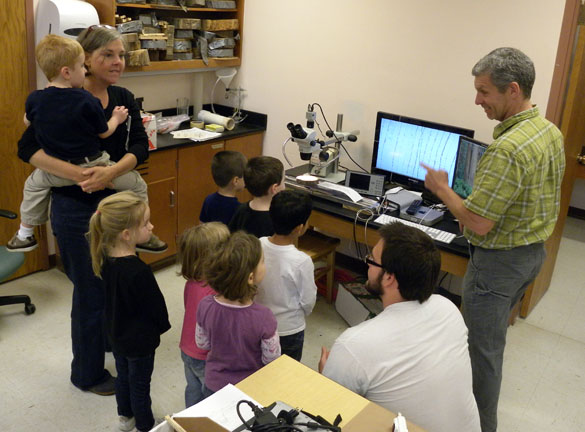
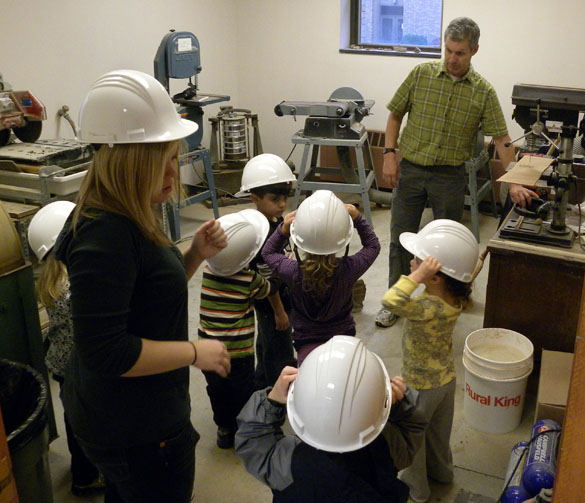
WOOSTER, OHIO–The Wooster Geologists have long had a special relationship with The College of Wooster Nursery School (where young children “actively construct their own knowledge of the world”). Every year our faculty and students talk to the children about rocks, fossils and dinosaurs. As you can imagine it is a most enjoyable — if a bit frantic — experience. For the past three years Professor Shelley Judge has been our primary faculty planner and organizer for these delightful events. Usually the kids walk up the hill from the nursery school about a block to Scovel Hall. There Shelley has exploration stations and, we hope, lots of college student volunteers to explain the materials.

Today the topic was simply “rocks”, and the children came to see and hold a variety of igneous, sedimentary and metamorphic samples. Shelley set it all up and we had two sessions of about 18 kids each march in line up to the lab. They went through the specimens enthusiastically, feeling which are the smoothest and which the roughest, how heavy some are compared to others, seeing the world through a crystal of calcite, and marveling at ancient giant shark teeth. They each got to try on a hardhat, look through a handlens, and wear safety googles (which they find oddly fun). Then they line up and march back to the nursery school, clearly having enjoyed the experience. As did we!

Kit Price ('13) showing some of our sedimentary rocks and fossils to the children.

Katharine Schleich ('12) explaining some extrusive igneous rocks.

Shelley Judge talking to some of the children about minerals. Notice how intently they listen to her. She has the touch!

Posted in Uncategorized | Tagged , | 2 Comments

A Midday Biology & Geology Field Trip

Geologist Greg Wiles and Biologist Rick Lehtinen in Spangler Park outside Wooster, Ohio.

WOOSTER, OHIO–Our colleague Rick Lehtinen in the Department of Biology had a great idea: how about a casual noon trip to the local Spangler Park to enjoy the plants, animals, rocks and streams? So Greg Wiles and I took him up on it and had a splendid couple of hours down in the gorge. We talked of ash trees, buried valleys, alluvial fans, salamanders and badgers. What an excellent break from grading!

Dr. Wiles showing where the creek flow goes from supercritical to subcritical.

An American Toad found by Dr. Lehtinen.

My contribution? An analysis of this beautiful set of bivalve, crinoid and brachiopod fossils from the Logan Formation (Mississippian).


Posted in Uncategorized | Tagged , , , , | 5 Comments