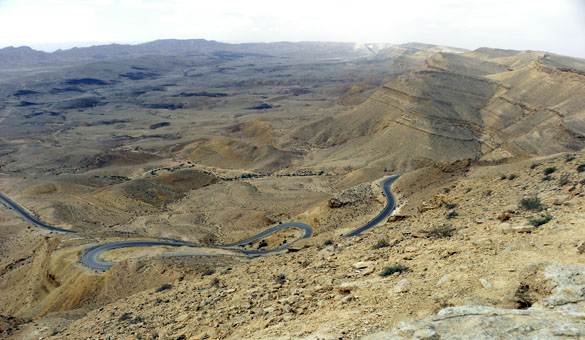
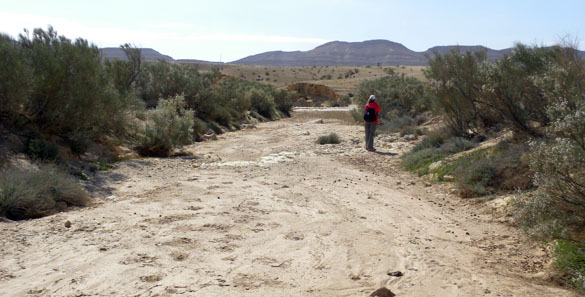
MITZPE RAMON, ISRAEL–It was difficult to coax them into standing still long enough for their portraits. The wind kept everything moving, so for some of these shots I held the camera in one hand and used the other as a windbreak for the blossoms. It was not easy to do this and not block the weak sunlight gamely penetrating through the dust above. Most of these flowers were in wadis where enough moisture persists to give them a chance for life. The Negev is in a severe drought, so every one of these flowers is a gift.
I do not know their names. Maybe an Israeli friend or two will post them in the comments and I will amend the text? I’m also not using my usual composite photograph technique for these images. Since space is cheap on this blog, why not use the whole frame for such little splendors?
[Please see the comments below by Wooster’s intrepid botanist and plant ecologist, Lyn Loveless. Very helpful!]
 This tall yellow flowering plant is found near water holes in wadis. It is not especially common — I’ve only seen three. It might be Broomrape (Cistanche tubulosa), a parasitic plant that taps the roots of other plants.
 The plant above has flowers that appear to mature first at the base of the plant, with the youngest at the top.
 These flowers (and the little insect) are found on a bush with very thin, almost leafless branches. It looks a bit to me like a pant we call “Mormon Tea” in the Mojave Desert. It may be White Weeping Broom (Retama raetam), which is an invading pest in North America. This is supposedly the bush under which the prophet Elijah sat.
 A beautiful little blue flower emerging out of dried mud on the bank of Wadi Hatira. Lyn identifies it as Anagalis arvensis (Scarlet Pimpernel), a cosmopolitan species. I can add that it is probably Forma azurea because of the blue color and Mediterranean location.
 A small purple flower common on the windswept higher regions between wadis. Lyn thinks it might be Erodium telavivense.
 Another small purple flower common along the wadi banks throughout the makhtesh.
 Surely this is a white daisy!
 And this must be a yellow one!
 Finally, my favorite Negev flower of all. This beauty was rare on our hiking routes. I found only three, all in Wadi Hatira along the edge of a dried-up waterhole. With Lyn’s help identifying this as not an orchid but an iris, we now know it is Gynandriris monophylla. Thanks, Lyn!
What a privilege it is to be a natural scientist and have a chance to experience such wildlife as part of my profession.