Dead Sea sediments and some impressive seismites

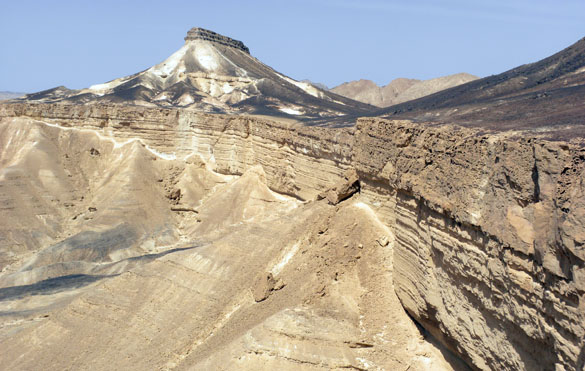
MITZPE RAMON, ISRAEL–Since the water level in the Dead Sea is dropping an astounding one meter per year, the drainage base level is dropping along with it. This means that gullies and canyons feeding into the Dead Sea are eroding deeply into their channels. Where the soft Dead Sea sediments are exposed, this erosion is stupendous. Would you believe that the canyon above was cut in less than three years? Today we explored these new canyons near the site of the pumping station (see previous post). Here we are looking primarily at the sediments themselves. Later we will examine the patterns of erosion and subsidence.

These are ripples of sand, silt and clay in a cross-section of Dead Sea sediments a few hundred years old. They started, at least, as wave ripples on the floor of the Dead Sea. Some have been modified by later storm currents. There is also an element of loading and compaction here. I suspect another factor in their morphology is the dissolution of any salt that was deposited with them.

This is one of the simpler seismites. These are beds of sediment that have been disturbed by the shaking of an earthquake. Since these sediments were originally deposited horizontally, they do not show gravitational rolling features. Instead they show upward movement and considerable plasticity. Recently Israeli geologists have carbon-dated these newly-revealed seismites and correlated many to known historical earthquakes. They show that in this region there is a periodicity of about 80 years for major ‘quakes. (The next one is now several years overdue — just saying.)

Another seismite showing well the upward injection of soft clays into overlying silts.

This is my favorite seismite. I can’t explain what happened here, but a whole lotta shaking was going on.

It is only near the top of the sequence, in the most recent beds, that we see salt deposits. The older salts were dissolved away by fresh groundwater coming from the alluvial fans. This is always a lesson in sedimentary geology — think of what you don’t see. The previous salt beds were erased from the record as the other sediments collapsed down into their places.

The rapid decline of the Dead Sea is an environmental disaster with many ramifications. Nevertheless, the resulting massive erosion of the Dead Sea sediments has given us much information about the past, and data with which we can predict the future.

Posted in Uncategorized | Tagged , , | 19 Comments

Wooster Geologists in an extraordinary world of salt

MITZPE RAMON, ISRAEL–Today we saw the Dead Sea in an amazing way. Yoav is working on a project involving the siting of a new pumping station along the western shore of the Dead Sea. We had a preview of a trip he is taking on Monday with a group of government officials to discuss the environmental and geoengineering factors that should be considered during this construction. We were able to go to places rarely visited, and to have an account and analysis by a well-respected expert.

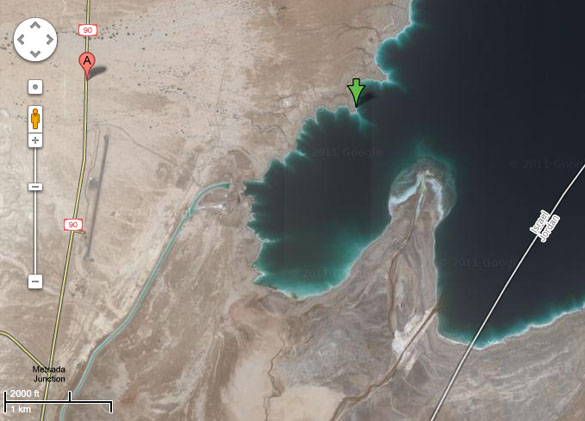
This is a Google Maps view of where we explored the shoreline of the Dead Sea. The green arrow marks our lunch spot (N31.33594°, E35.41427°). Note the thin bluish canal in the lower left running through the scale. The top end of it is where the pumping station sits today. It is pumping water into the southern evaporation ponds to be used in the Dead Sea Works mineral extraction process.

We walked down an active gully of an alluvial fan to meet the edge of the water. Its deep blue color was striking. The raised brown area in the background consists of dissected Dead Sea bottom sediments. Water levels have been dropping about one meter a year for decades now, leaving vast areas of Dead Sea mud exposed and eroded.

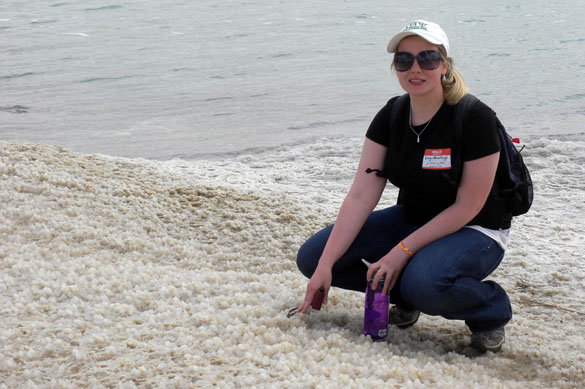
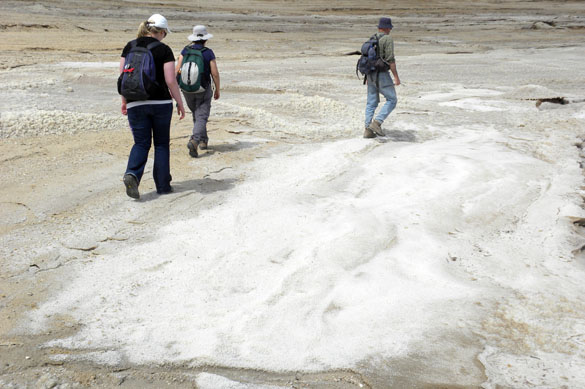
Melissa examining the halite crystals at the edge along the shoreline. It is very thick from the receding water levels and storm waters splashed up on shore, precipitating salt crusts.

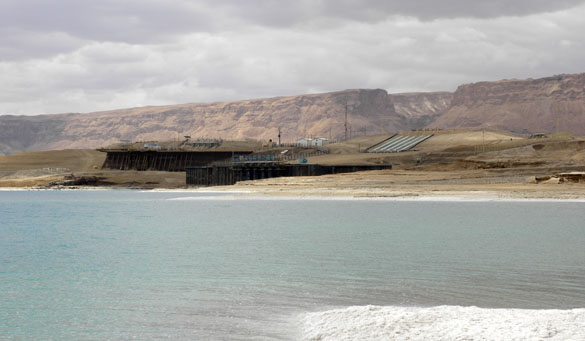
This is the pumping station today. It must be replaced soon because the water levels are dropping rapidly, which will leave its intake systems exposed. This station pumps water to the southern evaporation ponds about three months during the summer. This is when the brines are at maximum concentration. That is Masada, by the way, in the background on the far right.

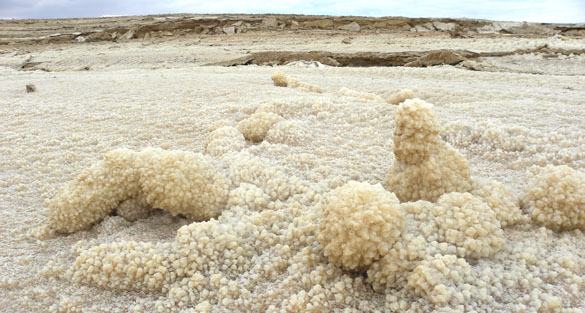
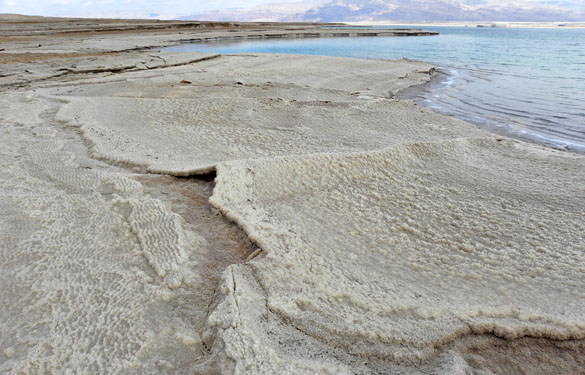
All of us who teach sedimentary geology talk about teepee structures formed when crystallization pressures expand an evaporative mineral sheet until it breaks and bends. Can there be a better example than this?

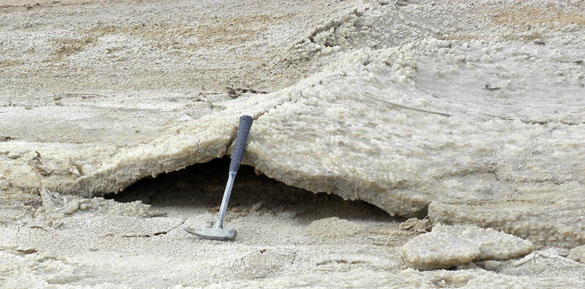
Here is another teepee structure in side view with a hammer for scale. The broken apex is visible at the top of the arch formed by crystals growing with nowhere to expand but up. I’ve seen these in outcrops of ancient evaporative sequences, but never in a recent situation.

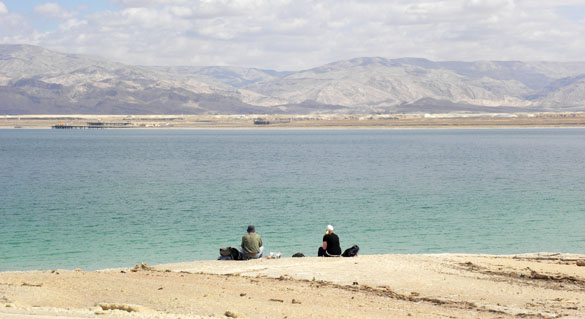
Our lunch stop. We are seated on the salt looking across the Dead Sea at the beautiful mountains of Jordan. A Jordanian pumping station for their own mineral operation is just visible on the opposite shoreline.

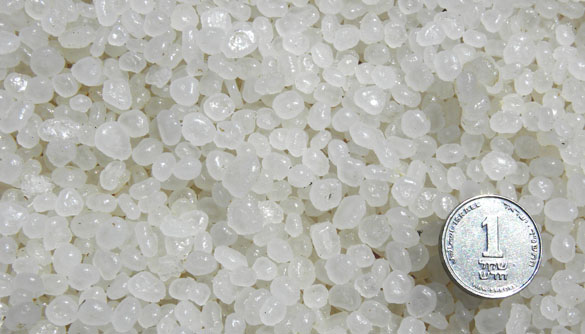
This amazed me. There are small pocket beaches along the shoreline made of rounded grains of salt eroded by the waves of brine. The Dead Sea is forming its own beach sand and granules — all of pure halite.

The salt granules are smooth and well sorted by the beach processes. I’d love to bring some of these unique sediment home to Wooster, but the Ohio humidity would destroy it very quickly!

We had a great visit to the Dead Sea today, the lowest spot on land (425 meters below sea level). Yoav gave us an excellent tour of this Land of Salt, and the partly cloudy weather meant we could get good photographs without the usual intense glare of the salt crystals in the sun. We were also as warm and dry as we’ve yet been on this expedition!

Posted in Uncategorized | Tagged , , , | 8 Comments

A salt cave in Mount Sodom, Israel

MITZPE RAMON, ISRAEL–Yes, that Sodom. This morning Melissa, Yoav, Noa and I visited a cave formed in Mount Sodom in the Dead Sea Rift Valley. Mount Sodom is a remarkable mountain of halite (sodium chloride — table salt) with very complex internal bedding. It was formed (and is still forming) as subsurface salt was forced above ground by massive overpressure of more dense sands and gravels. It is thus an excellent example of a diapir and a salt dome. The salt extends steeply upwards with its bedding mostly vertical on the outer flanks of the mountain.

Mount Sodom has thousands of caves formed as rainwater drains through the mountains. It often forms giant vertical solution cavities and then horizontal rooms and tunnels at their bases. These caves are, like most caves, cool on the inside. The solution cavities act like reverse chimneys bringing in breezes that flow out the channels below. Very pleasant places.

Melissa on her way into the salt cave. She is walking alongside a vertical wall of pure halite.

This anticline in the salt is one of the simpler structural features. There are also overturned folds, numerous faults, and serious brecciated layers. All of these features are related to the easily-deformed salt squeezing its way to the surface.

It is impossible to do justice to these majestic solution cavities with a photograph. The white salt reflects the sunlight all too well, and the lower reaches are relatively dark. Plus this cavity is probably 200 or more meters high. I think Yoav and Noa have suitably awestruck poses here! Without them with us we would not have found this cave or had the courage to enter.

Posted in Uncategorized | Tagged , , | Leave a comment

Wooster Geologists as guests in a Bedouin village

MITZPE RAMON, ISRAEL–Melissa and I had a fantastic day, much of which will stretch over at least another couple of blog entries. We traveled to the Dead Sea region with our Israeli geologist colleague and friend Yoav Avni and his wife Noa (an education specialist and botanist). We saw extraordinary things at the Dead Sea itself, and then on the way back we visited with some Bedouin friends of the Avnis in a tiny village of three families a few kilometers north of Mitzpe Ramon. In the image above we see the family patriarch Ali, one of his sons, and two visiting neighbor boys. We are gathered around glowing coals in their tent — welcome warmth in the cold. Note that we have just been served sweet Bedouin tea in glasses. (Empty your glass and it is immediately refilled.)  Ali, Yoav and Noa conversed in Hebrew and occasionally translated for us the stories Ali was telling in a very animated way. Melissa and I later commented to each other how interesting it was to watch a conversation we could not understand. So many moving hands!

We were served this Bedouin goat cheese. It is very hard so you nibble off small bits. It is also very salty, so the tea was quite welcome!

This is the inside of the tent. It is made of diverse materials, including cotton sheets and canvas. The rugs are laid on packed soil.

Ali wanted to demonstrate for us the traditional Bedouin way of grinding wheat grains between two carefully-fashioned limestone disks. Here he is adding grain to the hole in the top block.

Ali is rotating the top stone across the surface of the bottom stone with an inserted stick. The limestone must be coarse enough to grind the grain and hard enough not to add rock to your meal!

Here is the product — whole-grain flour! They often mix this with warm water to make a simple porridge.

This is a view of the small village from Ali’s tent. The buildings are made from diverse materials. In the foreground is a donkey pen.

We enjoyed this brief cultural moment very much. The Bedouin are in transition from their original nomadic state to settlement. Ali and his family wish to preserve some of the old ways to educate others (like us) and pass down traditions to succeeding Bedouin generations who will not know life in a tent.

Posted in Uncategorized | Tagged , | 2 Comments

A tribute to our Garmin Montana 600 GPS

MITZPE RAMON, ISRAEL–This isn’t a product review — it’s a love note. We’ve mentioned our field equipment on this blog before, most notably while using iPads in Estonia and Iceland. I just want to express a little gratitude for the technology and national effort that brought the Garmin Montana 600 GPS into my needy hands. (And to thank the Luce Fund at The College of Wooster for buying it!)

You can find many formal reviews of the Garmin Montana online, and some excellent instructive videos on YouTube. As usual with my electronic gear and fancy software, I use less than 10% of their actual capacities. I need a GPS to record sample locations, remember where I parked the vehicle, and figure out how to get from here to there before sunset. The Garmin Montana has made all of this so much easier and intuitive than with my many past GPS devices.

The Garmin Montana is touchscreen-operated, which makes a huge difference when you need quick measurements and want to record waypoints. The screen is also plenty large and in color. I can now record a waypoint and then edit its name (015 becomes “camels be here”, for example). I can also add a long note to each waypoint, all done with a qwerty typepad in landscape mode. So easy. The map and go-to functions are also easily accessed and used. There is a real magnetic compass inside to supplement the one based on the GPS system. There are many other extras, from waypoint averaging (increasing the accuracy of a waypoint) to sunrise/sunset local times, a calculator, alarm clock, stopwatch, calendar … you get the idea. You can even use the device to pace out a polygon and measure its area.

I use a free app called “Garmin BaseCamp” on my MacBook Pro laptop to download and upload waypoints and other data through a USB cable supplied with the GPS. This can include photos for reference in the field. There is also a free software program to connect your device to the Garmin website to receive updates and new free gizmos. (My previous GPS systems did not like the Mac — this one uses the interface quickly and easily.)

Melissa is currently using my old Garmin because of all its stored waypoints from Israel, so we’ve been able to see the two devices in action together. The Garmin Montana receives data from the satellites much faster, and I suspect it is more accurate. My test is to stand at an easily recognized point and take a measurement, then look at it on Google Maps. Above you see a Google Map view of an acacia tree along a wadi in Makhtesh Gadol. I stood beside it and took the measurement shown by the green arrow. At most there is a meter or so difference between where I was standing and what is indicated, so Google Maps has a little correcting to do!

Posted in Uncategorized | Tagged , | 1 Comment

Glorious blue skies emerge in southern Israel

The first photo below was taken from my hotel room yesterday afternoon as the cold wind raged and rain approached. The second was taken this morning. Springtime in Israel!

We are now leaving on a trip to the Dead Sea with Yoav. It is always a privilege to travel with him, but this is extra special because he is one of Israel’s top experts on the Dead Sea and surrounding region.

Posted in Uncategorized | Tagged , | 1 Comment

Iron Age water management in the northern Negev

MITZPE RAMON, ISRAEL–This region has a very deep human history, and some of it is evident in subtle changes to the landscape itself. Throughout the northern Negev are simple stone structures that are sometimes called “Davidic forts” after King David of Israel. They are, though, a lot more mysterious and difficult to date. They are usually associated with cisterns and water systems, and so they may have indeed been guardposts of some kind. Who exactly made these buildings and the water infrastructure is unclear. All we can say is that they are Iron Age and show an early agricultural people who had skills in collecting and managing the scarce water resources of this area. We saw evidence of them today in the field north of Mitzpe Ramon. Above you see Yoav and Melissa walking by one of these open cisterns cut into Upper Cretaceous limestone (the Vroman Bank of the Ora Formation) and then dug below in shale and claystone.

The hillsides to the sides and above these cisterns have long ditches lined with slabs of limestone on their downward sides. These were designed to catch runoff water from the slopes above and direct it to the open cistern below. Some of these ditch-and-rock channels stretch for kilometers.

Here a ditch heads to a large cistern, recognizable immediately by the sediment tailings dug out of the hole. This system takes advantage of the heavy and infrequent rains in the northern Negev. Sheetflow and water in small natural channels is captured and sent along the gentle gradient to the cistern below. By keeping the water from flowing too fast these early engineers minimized erosion of their channels.

This is the second cistern we saw today. It is many meters deep and could have held a great deal of water year-round. Bedouin herders today still use some of these cisterns for their flocks.

The later Nabateans elaborated upon these innovations and made roofed cisterns to reduce evaporation (which is 2.5 meters of water per year in Mitzpe Ramon). Sometimes they dug their cisterns into solid limestone rather than shale so they could have a small top opening and large covered container below.

As I write this the wind howls and rare rain is falling on the Negev. These rock systems are still channeling water after 3000 years!

Posted in Uncategorized | Tagged , , | 2 Comments

Desert Tulips!

MITZPE RAMON, ISRAEL–These were a delightful surprise this morning. Scattered across the rough Cretaceous limestones were these astoundingly red desert tulips (Tulipa systola). They looked like drops of blood across the landscape. (An unfortunate metaphor in this part of the world, but true nonetheless!) They are so red they even overwhelm the red distinctions in my digital images, making them just glow like light bulbs.

These tulips are very sensitive to soil moisture. Because of the drought, Yoav was impressed we saw any, let alone dozens. All appear to be nestled between rocks which might have preserved just a tad of moisture for their growth. Many other tulip plants can be seen in the area, but only a minority are flowering.

Hard to believe with these warm, bright colors that we were freezing in the wind as we admired them!

Posted in Uncategorized | Tagged , , | Leave a comment

A windy, windy day in the Cretaceous

MITZPE RAMON, ISRAEL–Melissa and I finished our work in the Jurassic of Makhtesh Gadol yesterday, so today we went out with Yoav to explore the Upper Cretaceous and Eocene exposures just a few kilometers north of Mitzpe Ramon. This is what we do near the end of each expedition so that we have more ideas for the next. It was cold and very windy on the barren hillsides this morning, but we still saw and learned a great deal.

We examined outcrops of four units: The Ora Formation (Upper Cretaceous) is primarily shales and claystones and below the stratigraphic column shown above. It has an interesting limestone unit composed mostly of rudistid bivalves and their shelly debris shown later below. The Gerofit Formation, also Upper Cretaceous, is a mix of limestones and marls unconformably above the Ora Formation. The Mishash Formation (Upper Cretaceous again) is a chert-rich unit unconformably above the Gerofit here. Andrew Retzler and Micah Risacher, who worked in the region two years ago, will immediately ask, where are the Zichor and Menuhah Formations that are supposed to be between the Gerofit and Mishash? They are absent due to a deep unconformity. On top of the Mishash, above another significant unconformity, are nummulitic limestones of the Avedat Group (Eocene). These three unconformities are all structurally and paleoenvironmentally significant — and they no doubt will be future projects for Wooster Geologists.

Some items of interest in this long section. Just below the Vroman Bank in the Ora Formation is the above cemented horizon with well-distinguished Thalassinoides burrows. These were produced by crustaceans burrowing into stiff mud in shallow waters. This unit is usually not very well exposed, but Yoav and I dropped down into an ancient cistern to see this outcrop.

This is a polished surface at the top of the Vroman Bank in the Ora Formation. Erosion in a small wadi over the centuries smoothed it off. We can see here borings known as Gastrochaenolites, some with outlines of bivalve shells still inside them. This is thus a carbonate hardground.

Some of the units in the Gerofit Formation are lithographic limestones, meaning they are very fine-grained and of uniform composition. You can see in the above photo that the stress pattern around my hammer blow is preserved as a nearly perfect sphere. This rock has been the premier building stone in Israel for millenia. It is known as “Jerusalem Stone” because so many buildings in that city are made of it and its equivalents.

Melissa is standing in what appears to be an ancient quarry for the lithographic limestone. There is a small Iron Age fort made of the stone nearby. Note how bundled up Melissa is. Not the usual image of Israel in this blog!

Finally, all our localities today were on ground that has been part of an IDF training base for decades. There is much discarded military gear around. I thought I would add this old British tin-hat to our blog’s collection of shot-up helmets! (We have German examples already, and somewhere in there is a Russian set.) I neglected to take a photo of a well-worn Egyptian helmet we found this morning.

Posted in Uncategorized | Tagged , , , , | Leave a comment

The Dancing Flowers of Makhtesh Gadol

MITZPE RAMON, ISRAEL–It was difficult to coax them into standing still long enough for their portraits. The wind kept everything moving, so for some of these shots I held the camera in one hand and used the other as a windbreak for the blossoms. It was not easy to do this and not block the weak sunlight gamely penetrating through the dust above. Most of these flowers were in wadis where enough moisture persists to give them a chance for life. The Negev is in a severe drought, so every one of these flowers is a gift.

I do not know their names. Maybe an Israeli friend or two will post them in the comments and I will amend the text? I’m also not using my usual composite photograph technique for these images. Since space is cheap on this blog, why not use the whole frame for such little splendors?

[Please see the comments below by Wooster’s intrepid botanist and plant ecologist, Lyn Loveless. Very helpful!]

This tall yellow flowering plant is found near water holes in wadis. It is not especially common — I’ve only seen three. It might be Broomrape (Cistanche tubulosa), a parasitic plant that taps the roots of other plants.

The plant above has flowers that appear to mature first at the base of the plant, with the youngest at the top.

These flowers (and the little insect) are found on a bush with very thin, almost leafless branches. It looks a bit to me like a pant we call “Mormon Tea” in the Mojave Desert. It may be White Weeping Broom (Retama raetam), which is an invading pest in North America. This is supposedly the bush under which the prophet Elijah sat.

A beautiful little blue flower emerging out of dried mud on the bank of Wadi Hatira. Lyn identifies it as Anagalis arvensis (Scarlet Pimpernel), a cosmopolitan species. I can add that it is probably Forma azurea because of the blue color and Mediterranean location.

A small purple flower common on the windswept higher regions between wadis. Lyn thinks it might be Erodium telavivense.

Another small purple flower common along the wadi banks throughout the makhtesh.

Surely this is a white daisy!

And this must be a yellow one!

Finally, my favorite Negev flower of all. This beauty was rare on our hiking routes. I found only three, all in Wadi Hatira along the edge of a dried-up waterhole. With Lyn’s help identifying this as not an orchid but an iris, we now know it is Gynandriris monophylla. Thanks, Lyn!

What a privilege it is to be a natural scientist and have a chance to experience such wildlife as part of my profession.

Posted in Uncategorized | Tagged , , | 3 Comments