


Imagine a world with larch trees in the uplands and dawn redwoods in the flats, and bald cypress trees in the wetlands. This existed in the Eocene (~40 million years ago) when the world was warmer, the treeline was at higher latitudes and altitudes, and carbon dioxide in the atmosphere was more than two times Earth’s preindustrial levels. In fact, in the high Arctic where no trees can survive today, deciduous conifers were as lush in terms of carbon sequestration and bioproductivity as today’s rain forests. Now, imagine a world that is sliding back into the greenhouse after millions of years of relative icehouse conditions.
How can we better understand the role of deciduous conifers in the biosphere and their utility in a warmer world. One “natural” experiment is to use dendroclimatology to infer the response of deciduous conifers to a warmer and wetter world. Secrest Arboretum in Wooster, Ohio has two species of larch trees (Siberian and European) as well as bald cypress and dawn redwood trees. These species are all exotic to Ohio and have been growing in the arboretum in some cases for over 100 years. How do they grow in their new homes? This is the subject of a new paper from the Wooster Tree Ring Lab published in Plants People and Planet.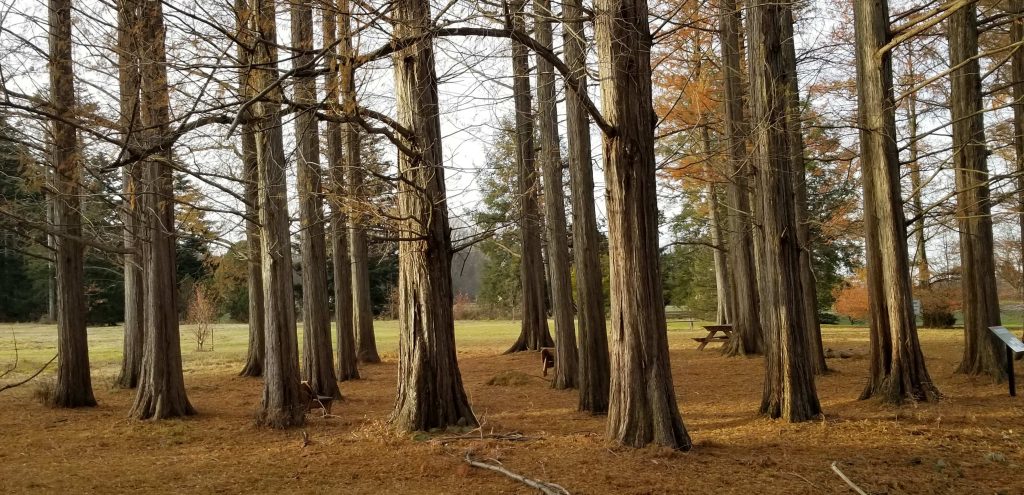 Dawn Redwoods from the Arboretum
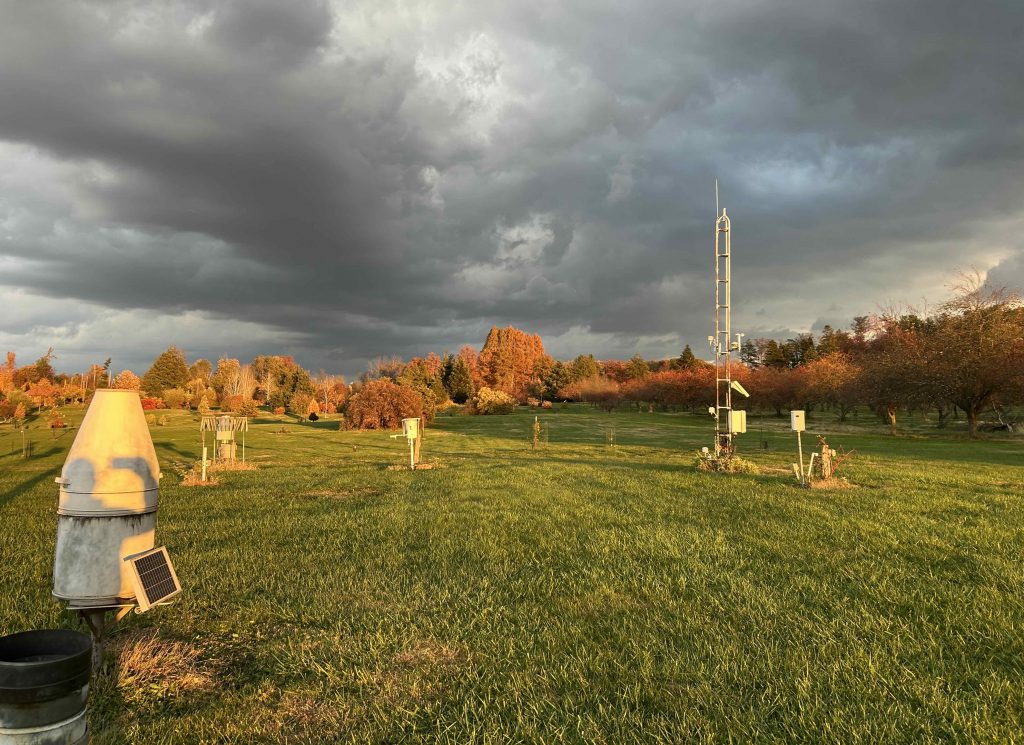 The Weather station active in the Arboretum since the late 1800s provided the monthly climate records.
Here is the upshot of the work: Rising temperatures and wetter conditions in the Midcontinent of North America are influencing climate responses in trees. Dendroclimatological analyses of the four exotic deciduous conifer species from Secrest Arboretum, Northeast Ohio help identify past, present, and future climate-tree interactions. Analyses suggest that two larch species have changed their response to climate, whereas dawn redwoods and bald cypress trees are well suited for the present and future climate. This study elucidates tree responses to climate gleaned from a largely untapped source of tree growth in arboreta that can be more broadly applied at other sites as well as facilitate forest management decisions.
This effort included professors, staff and students at The College of Wooster as well as our collaborator and geo-ecologist Dr. Ben Gaglioti from the University of Alaska – Fairbanks. We thank Jason Veil (the curator of Ohio State University’s Secrest Arboretum) and its staff and volunteers for managing this amazing facility and for allowing us to sample the trees. We also acknowledge support of the National Science Foundation, Division of Earth Sciences, Grant/Award Numbers: EAR 2039939, GP-2023154.
Congratulations on the new paper, Team Tree Rings! Important work, especially today. Nice to see familiar names among the authors!