


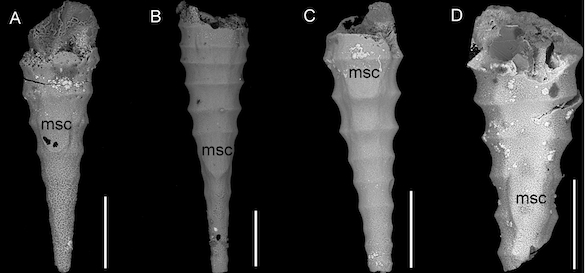
 A new paper on tentaculitid paleobiology and evolution has just appeared in its final form in the journal Historical Biology. The authors are headed by my Estonian friend Olev Vinn and include two new Armenian colleagues Tamara Hambardzumyan and Vahram Serobyan, as well as American me. I did not get the opportunity to visit Armenia, alas. The image above shows four internal molds (steinkerns) of the studied Devonian tentaculitids from Armenia. The “msc” refers to muscle scars. (Figure 5 of the new paper.)
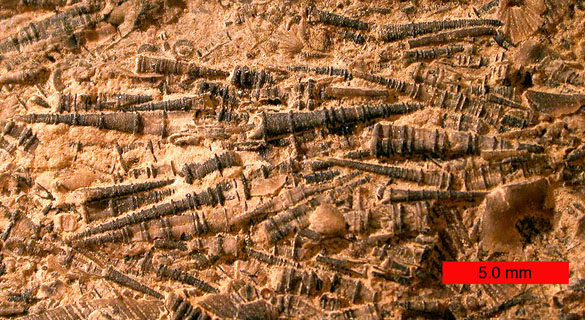 Tentaculitids are curious straight conical calcitic fossils with distinctive concentric ribbed ornamentation. They are found in rocks from the Ordovician through the Devonian. Sometimes they are incredibly abundant. For all their Paleozoic ubiquity, their systematic placement has been controversial. The microstructure of their calcite shells is very similar to that of the lophophorate brachiopods and bryozoans. For this reason and other evidence presented here and elsewhere it appears the tentaculitids are most closely related to bryozoans (Taylor et al., 2010; Vinn and Zatoń, 2012; Vinn et al., 2025a, 2025b). Above are tentaculitid original shells from the Devonian of Maryland (not used in this study).
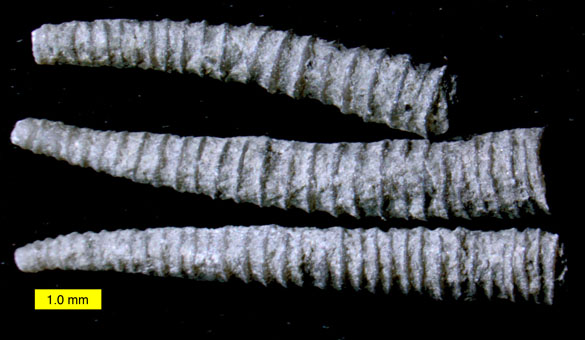
Above are tentaculitid original shells from the Devonian of West Virginia (not used in this study).
Abstract
Rare soft body impressions were discovered on phosphatised steinkerns of Devonian tentaculitids from Armenia. The muscle scars occur only in the most apical part of the tentaculitid steinkerns. The morphology of muscle scars varies between different species. There are seven different types of muscle scars in tentaculitids, and six of them are present in the Armenian material. The muscle scars were used for attachment of a well-developed retractor muscle. The muscle attachments in tentaculitids migrated forwards during the growth of the shell like the muscle scars in many brachiopods. The hypothesised architecture of tentaculitid muscle system is most similar to that of bryozoans. Tentaculitids had a defensive mechanism that allowed complete retractability of the animal into the shell. This was achieved by prominent retractor muscles that pulled the soft tissues into the protective body wall. This is opposite the protrusion mechanism that involved body‐wall musculature to increase hydrostatic pressure within the soft body to squeeze out the feeding apparatus of the animal, enabling it to filter‐feed again. This muscle arrangement is strong evidence to confidently place the tentaculitids within the Lophotrochozoa, potentially as ‘lophophorates’.

Reconstruction of tentaculitid musculature (Figure 7 of the new paper). This is very similar to a bryozoan zooid.
References:
Taylor, P.D., Vinn, O. and Wilson, M.A. 2010. Evolution of biomineralization in ‘lophophorates’. Special Papers in Palaeontology 84: 317-333.
Vinn, O., Hambardzumyan, T., Wilson, M.A. and Serobyan, V. 2025a. Palaeobiological and phylogenetic implications of preserved muscle scars in Devonian tentaculitids from Armenia. Historical Biology 37:12, 2612-2620. https://doi.org/10.1080/08912963.2025.2458115
Vinn, O., Hambardzumyan, T., Temereva, E., Grigoryan, A., Tsatryan, M., Harutyunyan, L., Asatryan, K. and Serobyan, V. 2005b. Fossilized soft tissues in tentaculitids from the Upper Devonian of Armenia: Towards solving the mystery of their phylogenetic affinities. Palaeoworld 34, 3: 100888.
Vinn, O. and Zatoń, M. 2012. Phenetic phylogenetics of tentaculitoids – Extinct, problematic calcareous tube-forming organisms. GFF, 134(2), 145–156. https://doi.org/10.1080/11035897.2012.669788
