


 One of the many reasons we need natural history museums is that they can curate large collections of specimens that can be examined for interesting features decades after they were bagged in the field. Recently my Estonian colleagues Olev Vinn and Ursula Toom searched through hundreds of museum specimens of the Middle Ordovician trilobite Illaenus for evidence of parasitism. They found one internal mold of the pygidium (“tail”) that had a constellation of pits, as if the poor creature had smallpox (which it most certainly did not!). It did have an infection of some kind, though — a rare find in the fossil record. The Estonians contacted me, Kenneth De Baets and Russell Bicknell, and the five of us put together a paper that appeared today as an open-access article in the Journal of Paleontology. Here I present the abstract and a couple of figures. This article is free to read at the journal link.
Abstract
Evidence for parasites in the fossil record is rare. As such, any examples present insight into parasitism in deep time. Trilobites have often been used for documenting parasites in the Paleozoic. Here we examine an Illaenus sp. pygidium from the Middle Ordovician of Estonia that displays thirteen small structures with domical to crater-like shapes. These morphologies are consistent with circular depressions on the pygidium inner surface. We propose that these structures formed while the trilobite was alive and record an infestation located within soft tissue. The trace maker seems to have influenced pygidial mineralization and caused a pathological reaction. The symbiont may have been capable of bioerosion, excavating these depressions by dissolving the trilobite’s mineral tissues; however, this scenario is less likely considering comparisons with syndromes and pathologies known in modern arthropods. The parasitic organism may have fed on the trilobite’s tissues or utilized nutrients within the trilobite’s body for growth. These observations are consistent with a parasitic organism.
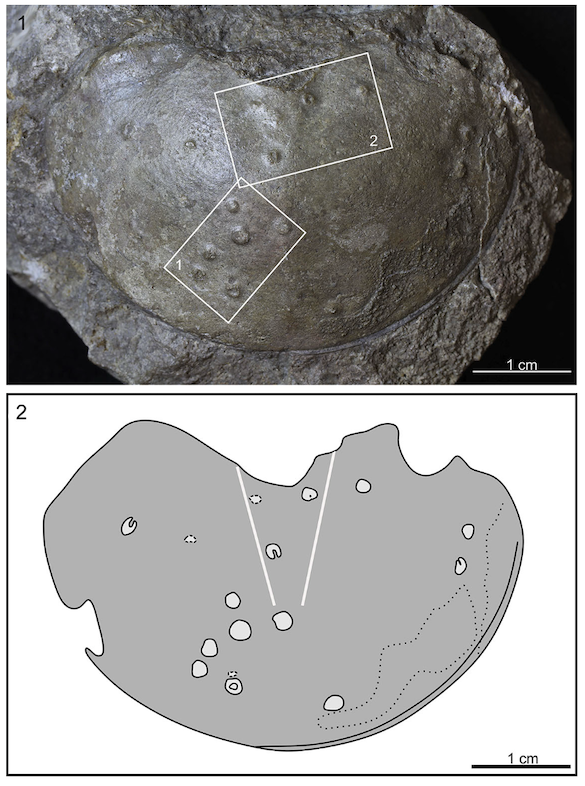 Figure 1. Internal mold of Illaenus sp. pygidium with traces of parasitic infestation from
Darriwilian of northern Estonia (GIT 437-107); (1) Complete specimens. Rectangle
1 shows location of detailed Fig. 2.1, and rectangle 2 shows location of detailed
Fig. 2.2. (2) Drawing of the pygidium.
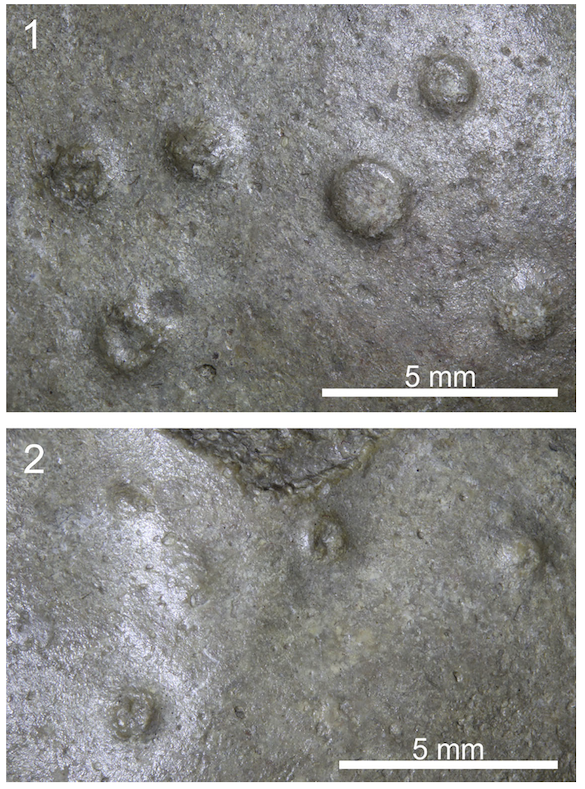 Figure 2. Internal mold of Illaenus sp. pygidium with traces of parasitic infestation from
the Darriwilian of northern Estonia (GIT 437-107); (1) Detail view of traces; showing two
simple bumps and four crater-like structures, (2) Detail views of traces; showing two
simple bumps and two crater-like structures.
Reference:
Vinn O., Wilson, M.A., De Baets, K., Bicknell, R., and Toom, U. 2025. Parasitic infestation in a Middle Ordovician Illaenus (Trilobita). Journal of Paleontology, 1–6 https://doi.org/10.1017/jpa.2025.10190
